
| Quick Answer What is a peacock jumping spider? Peacock jumping spiders (genus Maratus) are a group of small jumping spiders from Australia known for the males’ spectacular iridescent courtship displays — elaborate fan-shaped abdominal extensions in vivid colors used to attract females. With over 90 described species, they include some of the most visually striking arthropods on Earth. They are increasingly available as pets but require more specialized care than larger species like Phidippus regius. |
If you’ve seen a video of a tiny spider dancing with what looks like a miniature stained-glass window fanning open from its abdomen, you’ve seen a male peacock jumping spider. The Maratus genus contains some of the most visually extraordinary animals on the planet — not just for spiders, but for all arthropods.

The scientific and popular discovery of Maratus courtship displays, largely through the photography and research of Jurgen Otto, turned these otherwise obscure Australian endemic spiders into global internet celebrities in the 2010s. Now, with captive breeding programs expanding, they’re increasingly available to hobbyists.
This guide covers peacock spider biology, the remarkable courtship display, care requirements, and the specific challenges they present relative to more common pet jumping spider species.
Peacock Spider Biology and Taxonomy
Peacock jumping spiders belong to the genus Maratus, within the Salticidae family. As of 2025, over 90 Maratus species have been described — many discovered within the last decade, primarily through the work of researcher Jurgen Otto, citizen scientists, and the broader arachnology community.
All Maratus species are endemic to Australia, with distributions ranging from coastal southeastern Australia (Maratus volans, the most well-known species) to Western Australian sand dunes (Maratus speciosus) to Queensland rainforests. Their ranges are often highly localized.
Size and Appearance
Peacock spiders are small — male Maratus species typically measure 3 to 6mm body length. Females are similar in size but lack the elaborate color markings of males; they are typically brown and cryptic. The male’s iridescent abdominal fan (technically the expanded opisthosomal flap) is the species’ defining feature — covered in metallic scales in species-specific patterns of red, blue, orange, green, and white.
The Courtship Display
The male peacock spider’s courtship display is one of the most complex multi-modal signals in the animal kingdom for an invertebrate. When a male detects a female (by sight or chemical cue), he initiates a sequence that includes:
Raising and fanning the abdominal flap to reveal the iridescent color pattern
Extending and waving the third pair of legs — which in many species have tufted ornamental hair
Performing a rhythmic side-to-side vibrational dance (transmitted through substrate)
Moving toward the female in a precise, measured approach sequence
If the female is receptive, she remains still and allows the male to approach for mating. If she is not receptive or is hungry, she may attack and eat the male. Males typically persist in display attempts for extended periods and may be killed and eaten even after technically successful matings.
This display has been extensively studied and filmed. High-speed video analysis has revealed that the color patterns in different species are tuned to the light environment of their specific habitats — a finding consistent with sexual selection theory.
Common Peacock Spider Species in the Hobby
Maratus volans — The Original Peacock Spider
The first widely known peacock spider; range: coastal southeastern Australia. Named for the “wings” resembling a peacock’s tail. Blue and red abdominal pattern. The most commonly available in captivity.
Maratus speciosus — Splendid Peacock Spider
Western Australian sand dune species; striking orange and white pattern. Somewhat available in captivity from Australian breeders.
Maratus karrie — Karen’s Peacock Spider
One of the more recently described species with a distinctive blue central pattern. Rarer in the hobby.
Maratus pavonis
A classic species with a particularly elaborate fan display. Beautiful, less commonly available.
Care Requirements
Enclosure
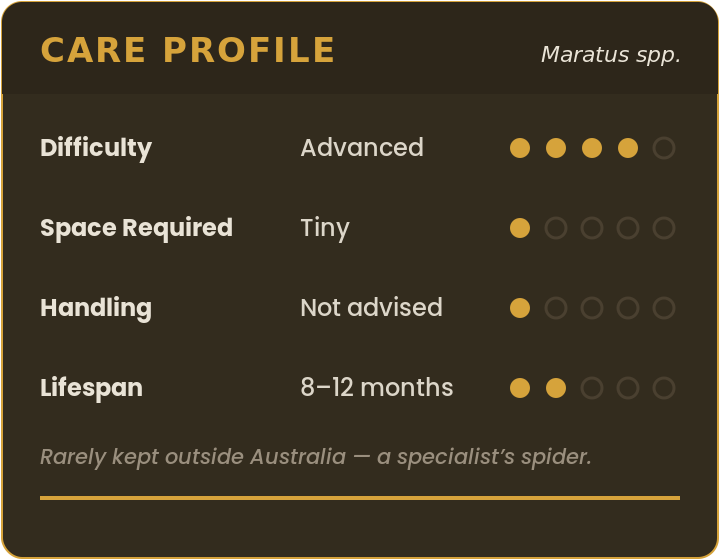
Due to their small size, peacock spiders are typically kept in small, well-ventilated enclosures: deli cups (32 oz or smaller), small mesh cube enclosures, or purpose-built mini arboreal enclosures. Cross-ventilation is essential. Given their short lifespan (under 1 year), investing in a large elaborate setup is less warranted than for longer-lived species.
Temperature and Humidity
Peacock spiders are from Australian eucalyptus scrubland and sandy coastal environments. Most species prefer: temperature 72–82°F (22–28°C); humidity 50–70% with a humidity gradient; similar to North American Phidippus requirements.
Feeding
Due to their tiny size, Maratus require small prey throughout their lives: Drosophila melanogaster for juveniles; D. hydei and very small crickets for adults. Their size makes feeding management more delicate than larger species. Prey must be removed promptly — a cricket can seriously injure or kill a Maratus.
Challenges of Keeping Peacock Spiders
Short lifespan: under 1 year even in captivity; males often die within weeks after first mating display
Small size: spiderlings are nearly microscopic; prey management and escape prevention are challenging
Limited availability: primarily available from specialist Australian breeders; international availability is improving but remains inconsistent
Sex ratio challenge: distinguishing sexes before adulthood is difficult; breeding projects require patience
Peacock spiders are best approached as an advanced species after gaining experience with Phidippus or Hyllus. The reward — watching a male’s full courtship display in your own enclosure — is extraordinary, but the path to that moment requires commitment.
Where to Find Peacock Spiders
The primary sources for captive peacock spiders:
Australian specialist breeders (export to some countries; check your country’s import regulations)
US and European hobbyist breeders through Morphmarket and dedicated jumping spider Facebook groups
Arachnoboards classified section
Note: wild-collecting Maratus is illegal in Australia without appropriate permits. All captive specimens in the hobby should be from verified captive breeding lineages.
Related Articles
Types of Jumping Spiders: 15 Species You Should Know
Regal Jumping Spider: Complete Care Guide — Larger, easier beginner species
Jumping Spiders as Pets: Everything Beginners Need to Know
Frequently Asked Questions
How long do peacock jumping spiders live?
Maratus species live under 1 year in captivity. Males in particular decline rapidly after their first mating season, often dying within weeks to months after reaching adulthood. Females may live slightly longer but rarely exceed 12 months total. This short lifespan is one of the primary challenges of keeping peacock spiders.
Can peacock jumping spiders be handled?
With care, yes — but their small size (3–6mm) makes safe handling very difficult. They can and do jump unexpectedly, and a fall from even a few inches can injure them. Most keeper interaction with peacock spiders is observation rather than handling. This is a watching-not-touching species for most keepers.
Are peacock spiders legal to own?
In most countries, yes — peacock jumping spiders are legal to keep as pets. However, importing wild-caught specimens from Australia may be restricted or require permits. Captive-bred specimens from established breeding programs in your country are always the recommended and safest legal path.
| About the Author Itsy Bitsy Pets Editorial Team The ItsyBitsyPets.com team combines hands-on keeping experience with peer-reviewed arachnology research to produce accurate, practical care guides. We update our content when new scientific evidence or community findings warrant revision. Site: itsybitsypets.com | Twitter: @ibp2025 |
| Join 7,000+ Micro-Pet Lovers Get The Micro-Pet Minute — free weekly care tips, species spotlights, and product picks. Subscribe at itsybitsypets.com |