
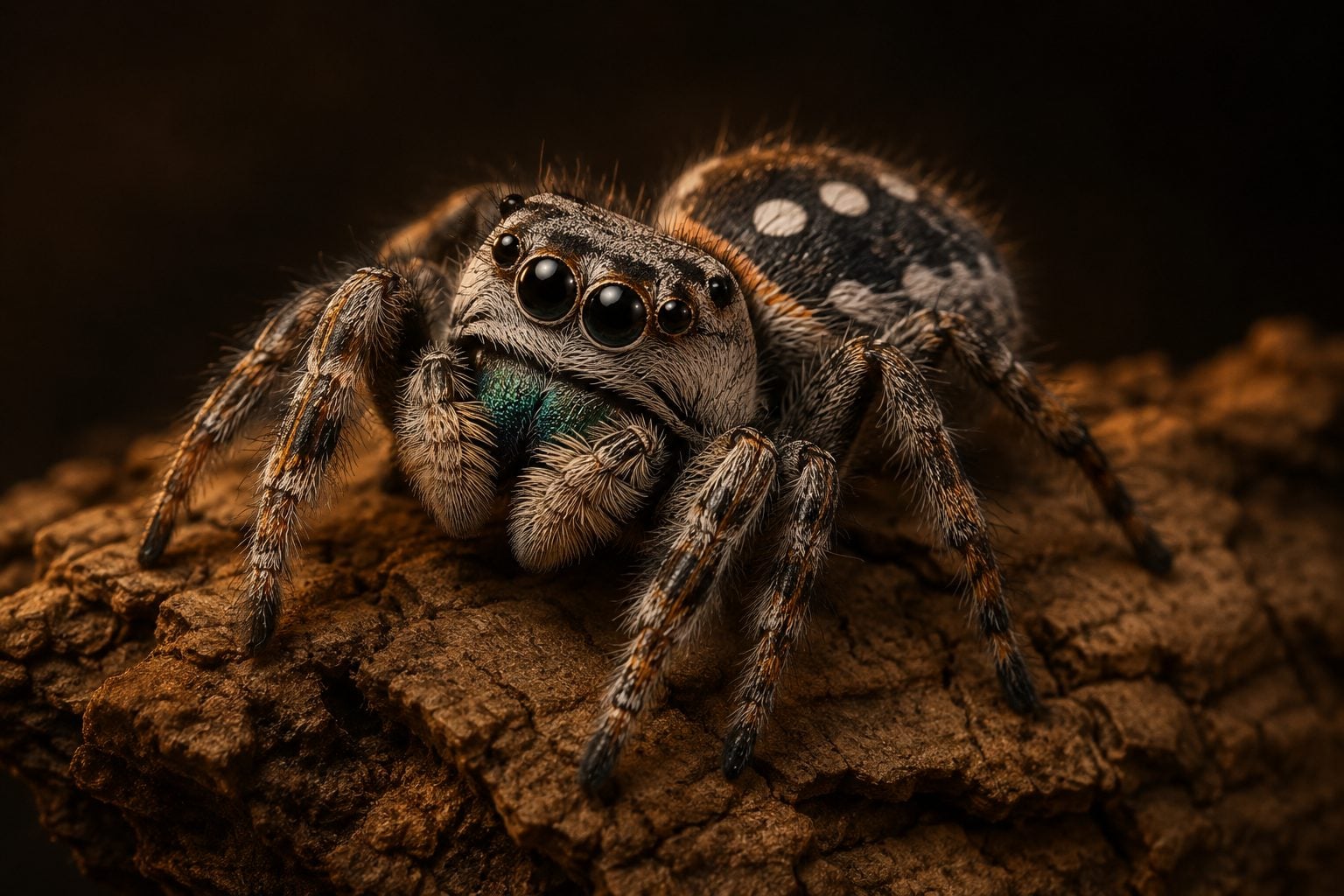
| Quick Answer Are regal jumping spiders good pets? Yes — Phidippus regius is widely considered the best jumping spider species for keeping as a pet. Regal jumping spiders are large, visually stunning, curious, and among the most handleable of any invertebrate. They regularly recognize their keepers, approach hands voluntarily, and show bold personalities that make them genuinely engaging companions. With proper care (correct enclosure, humidity, diet, and molt support), they live 2.5 to 3 years. |
Phidippus regius — the regal jumping spider — is the undisputed star of the jumping spider keeping hobby. Abundant in Florida and the Caribbean, these large, intelligent salticids were among the first jumping spider species to gain mainstream hobby attention, and they remain the most popular for good reason: they are big enough to see clearly, bold enough to approach humans voluntarily, and impressive enough that watching one hunt is genuinely spectacular.

The Beginner Jumping Spider Kit
If you’re setting up your first spider, this is the whole list. Nothing fancy, nothing you’ll outgrow in a month.
- EctoTherm jumping spider enclosure — front-opening, escape-proof, and sized right for an adult
- Magnetic hanging water dispenser — the one thing most beginners skip, and the one they regret skipping
- Exo Terra mini mister — a light misting beats a water bowl your spider can drown in
This comprehensive care guide covers everything you need to keep a regal jumping spider for its full lifespan: enclosure setup, temperature and humidity, feeding by life stage, molt management, handling, health, and breeding basics. Whether you’re getting your first spider or looking to improve on established care, this guide reflects current keeper community consensus and available scientific literature on the species.
Phidippus Regius at a Glance
Common name: Regal jumping spider
Scientific name: Phidippus regius C.L. Koch, 1846
Family: Salticidae (jumping spiders)
Native range: Florida, Georgia, Carolinas, Bahamas, Cuba, and surrounding regions; introduced to the Canary Islands
Size: females 12–22mm body length; males 6–13mm (significant sexual dimorphism)
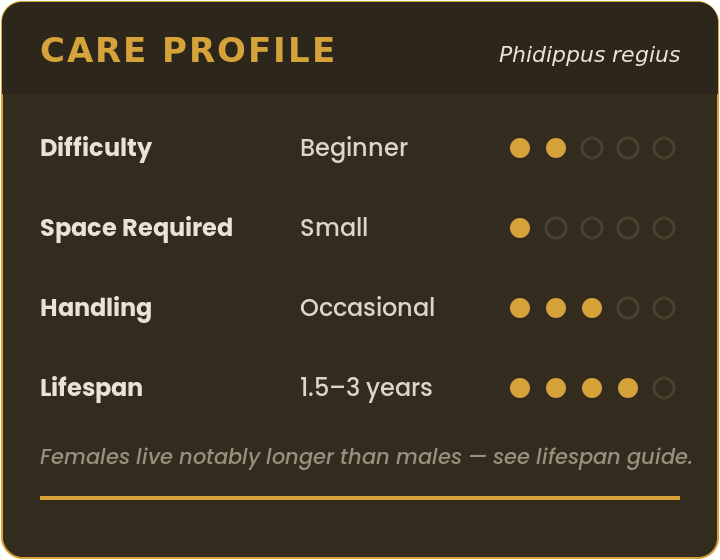
Lifespan: females 2.5–3 years in captivity; males 1–1.5 years
Difficulty: beginner-friendly (easiest of the Phidippus species)
Temperament: bold, curious, highly exploratory; one of the most handleable spider species
Appearance and Sexual Dimorphism
Regal jumping spiders exhibit striking sexual dimorphism — males and females look quite different, a fact that surprises many new keepers who purchase spiderlings without knowing what to expect.
Female Appearance
Females are significantly larger (12–22mm), with a predominantly black body covered in white to orange hairs. The abdomen shows a variable pattern of white spots and bands. The chelicerae (fangs) are brilliant iridescent green — one of the species’ most distinctive features. When adult, the eyes appear large and forward-facing, giving the characteristic “big-eyed” expression that makes Phidippus regius so photogenic.
Male Appearance
Males are smaller (6–13mm) and show more variable coloration: typically black with white banding on the abdomen, but the Florida Panhandle population shows notably different coloration (more orange-red hairs) than the peninsular Florida population. Males have the same iridescent chelicerae as females. They mature faster than females and begin courtship display behaviors (vibrating abdomen, waving legs) as soon as they encounter a female’s scent or visual presence.
Color Morphs
Color morphs in captive-bred populations have been selectively developed by hobbyist breeders: “fire” morphs show increased orange coloration; “melanistic” morphs show nearly solid black coloring; regional wild-type populations from different parts of Florida and the Caribbean show natural variation. Color morphs are more expensive than standard specimens but functionally identical in care requirements.
Enclosure Requirements
Enclosure Size and Style
Phidippus regius is an arboreal (tree-dwelling and wall-climbing) species that uses height extensively. The enclosure should be taller than it is wide:
Minimum for an adult female: 8 x 8 x 12 inches (20 x 20 x 30 cm)
Recommended: 10 x 10 x 16 inches or larger for an adult female; more space enables more natural behavior
Spiderlings through instar 5: deli cups or small containers (4–8 oz) prevent prey from overwhelming small individuals; move up in size with each molt
Ventilation
Cross-ventilation is non-negotiable. The enclosure must have mesh ventilation on at least two faces — ideally the top and front, or top and one side. Single-top-vent enclosures do not provide adequate air exchange and result in stagnant, high-humidity conditions that encourage mold. The combination of top and front mesh is the community standard for Phidippus care.
Substrate and Decor
Substrate: 1–2 inches of coconut fiber in the bottom for moisture retention and fall cushioning. The substrate does not need to be deep — the spider will spend most of its time above the substrate level.
Decor: cork bark pieces at various angles (simulating bark surfaces in the wild), fake or live plants for visual complexity and anchor points for silk, and any clean driftwood or sticks for climbing structure. Avoid sharp objects that could injure a falling spider.
Recommended: VCEPJH Natural Cork Bark Pieces — rough-textured cork bark doubles as climbing surface and hide — regals use every vertical inch you give them.
Temperature and Humidity
Our pick
the hanging water dispenser — regals are big enough to need a reliable water source
Temperature
Optimal range: 72–82°F (22–28°C) during the day. Nighttime drop to 65–70°F is acceptable and may benefit long-term health by mimicking natural temperature cycles. Room temperature in most homes is sufficient for Phidippus regius; supplemental heating is rarely needed unless the room consistently drops below 68°F.
Recommended: AREPK Full-Spectrum LED with Auto Timer — a USB-powered gooseneck light that runs cool and switches itself on and off — a consistent day/night cycle without cooking a small enclosure.
Humidity
Target: 50–65% ambient humidity with a gradient (one side slightly wetter). Mist one corner or wall every 2–3 days with dechlorinated or distilled water. During pre-molt, increase misting slightly to ensure the substrate retains adequate moisture for exoskeleton pliability.
For detailed temperature and humidity management, see: Jumping Spider Temperature & Humidity: The Ideal Setup
Feeding Phidippus Regius
Prey by Life Stage
Spiderlings (instar 1–3): Drosophila melanogaster (flightless fruit flies). This is the only appropriate prey at this stage.
The Beginner Jumping Spider Kit
If you’re setting up your first spider, this is the whole list. Nothing fancy, nothing you’ll outgrow in a month.
- EctoTherm jumping spider enclosure — front-opening, escape-proof, and sized right for an adult
- Magnetic hanging water dispenser — the one thing most beginners skip, and the one they regret skipping
- Exo Terra mini mister — a light misting beats a water bowl your spider can drown in
Juveniles (instar 4–6): D. hydei, pinhead to 1/4-inch crickets, small dubia roach nymphs. Introduce variety as the spider grows.
Sub-adults (instar 7–8): 1/4–1/2 inch crickets, 8–12mm roach nymphs, small bluebottle flies. Gut-load all prey.
Adults: 1/2–3/4 inch crickets, 12–16mm dubia nymphs, full bluebottle flies, occasional waxworm (max 1x per week). Feeding every 3–4 days for females, 4–5 days for males.
Prey Sizing Rule
Always feed prey no longer than the spider’s abdomen. This rule prevents feeding-related injury and stress across all life stages. When in doubt, go smaller.
Handling Phidippus Regius
Phidippus regius is one of the most handleable spider species available to hobbyists. With consistent, gentle interaction over time, most females become remarkably calm on human hands — approaching voluntarily, investigating with their front legs, and showing none of the defensive bolting that characterizes less handleable species.
Building a Handling Relationship
Begin handling only after the spider has been in its enclosure for 2+ weeks and is eating normally
Offer your hand near the enclosure opening and allow the spider to walk on voluntarily — never grab or chase
Handle close to a flat surface for the first several sessions; regal jumping spiders are agile and a fall from height can be fatal
Our pick
natural cork bark bedding — holds a little moisture and looks right in a planted setup
Keep sessions short initially (5–10 minutes) and increase as the spider becomes more comfortable
Never handle a spider that is in pre-molt, during the 7-day post-molt recovery, or showing defensive behavior (raised forelegs, rocking)
Sexing Phidippus Regius
Reliable sexing is possible from instar 4–5 onward. Before this stage, the sexual differences are difficult to distinguish without magnification. Indicators:
Female Indicators
Larger body size at equivalent instar
More complex abdominal patterning (bands and spots)
More rounded carapace profile
Male Indicators
Smaller body size at equivalent instar
Palps (small appendages near the chelicerae) become visibly larger and club-like as the male approaches adulthood
Sub-adult males develop the characteristic black-and-white abdominal banding pattern
Breeding Phidippus Regius
Breeding regal jumping spiders is achievable for intermediate keepers and a natural next step for those who want to close the loop from spiderling to adult. Successful breeding requires:
A healthy, well-fed adult female that has molted at least once as an adult
A healthy adult male, typically introduced only briefly for mating observation
Proper introduction protocol: place male in female’s enclosure briefly while keeper observes; remove male immediately after successful mating or if female becomes aggressive
Post-mating: female will build a silk egg sac 3–6 weeks after mating; increase feeding and humidity slightly during egg development
Egg incubation: 3–5 weeks depending on temperature; female guards the sac actively
Spiderlings emerge as a group and should be separated into individual containers within the first week to prevent cannibalism
Health and Common Issues
Failed Molts (Dysecdysis)
The most common health issue in regal jumping spiders, and almost entirely preventable through correct humidity management and prey removal before molting. See the full molt guide for prevention and emergency response.
Dehydration
A dehydrated regal jumping spider shows a shrunken, wrinkled abdomen (rather than the normal round profile). Correct by increasing misting frequency and ensuring water droplets are available on enclosure walls.
Recommended: Daerky Jumping Spider Water Dispenser — the easiest insurance against dehydration — a magnetic hanging dispenser that keeps clean water available around the clock.
Mites
A heavy mite infestation (visible as tiny moving dots on the spider’s body) requires cleaning the entire enclosure, replacing substrate, and in severe cases, carefully removing mites from the spider with a soft brush while in a clean container. Most mite infestations in jumping spider enclosures are benign substrate mites rather than parasitic mites, but both warrant investigation.
Recommended: EctoTherm Jumping Spider Enclosure — Purpose-built for arboreal spiders like the regal. Cross-ventilated sides and a front-opening door make feeding easy and escape-proof.
Recommended: Josh’s Frogs Flightless D. hydei Fruit Fly Culture — D. hydei flies are the ideal feeder size for juvenile and adult regal jumping spiders — no escape risk compared to crickets.
Frequently Asked Questions
How big do regal jumping spiders get?
Adult female Phidippus regius reach 12 to 22mm body length, making them one of the largest jumping spider species commonly kept as pets in North America. Males are considerably smaller at 6 to 13mm. Both sexes are stocky and robust in appearance, making them very visible and photogenic compared to smaller jumping spider species.
Where can I buy a regal jumping spider?
The Beginner Jumping Spider Kit
If you’re setting up your first spider, this is the whole list. Nothing fancy, nothing you’ll outgrow in a month.
- EctoTherm jumping spider enclosure — front-opening, escape-proof, and sized right for an adult
- Magnetic hanging water dispenser — the one thing most beginners skip, and the one they regret skipping
- Exo Terra mini mister — a light misting beats a water bowl your spider can drown in
Phidippus regius is widely available through reputable invertebrate breeders on Morphmarket, specialty Facebook groups (“Jumping Spider Sales and Trades”), and some specialty reptile stores. Captive-bred specimens from known breeders are strongly preferred over wild-caught — they are healthier, better acclimated to captivity, and their hatch date is typically known (allowing accurate age tracking).
Do regal jumping spiders jump far?
Yes — all jumping spiders can jump many times their body length. Phidippus regius can easily jump 4 to 6 inches horizontally. They silk-drag before every jump (attaching a safety line to the surface they’re on) so a fall from a jump is cushioned. Handle close to surfaces and be aware of this jumping capacity when the spider is on your hand.
Can regal jumping spiders be kept together?
No. Phidippus regius are solitary and territorial. Adults kept together will fight, and the loser will be killed or seriously injured. Spiderlings can be kept together briefly (a few days after hatching while you prepare individual containers), but separate them as soon as possible. Each individual needs its own enclosure for its entire life.
| About the Author Itsy Bitsy Pets Editorial Team The ItsyBitsyPets.com team combines hands-on keeping experience with peer-reviewed arachnology research to produce accurate, practical care guides. We update our content when new scientific evidence or community findings warrant revision. Site: itsybitsypets.com | Twitter: @ibp2025 |
| Join 7,000+ Micro-Pet Lovers Get The Micro-Pet Minute — free weekly care tips, species spotlights, and product picks. Subscribe at itsybitsypets.com |