
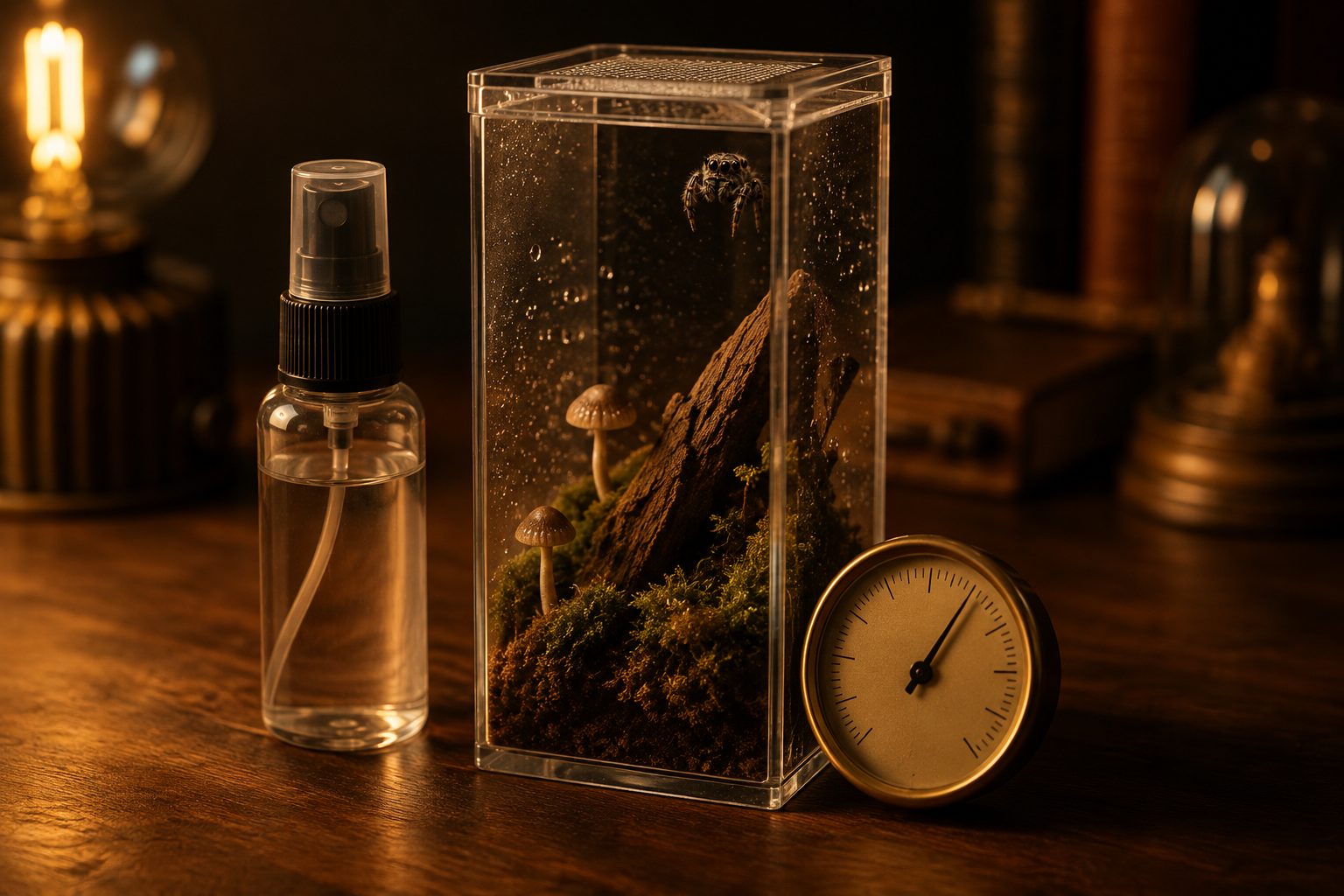
| Quick Answer What temperature and humidity do jumping spiders need? Most jumping spider species thrive at 72 to 82°F (22 to 28°C) with a humidity range of 50 to 70%. North American species like Phidippus regius and Phidippus audax do well at 50–65% humidity; tropical species like Hyllus diardi need 60–75%. Nighttime temperatures can drop 5–10°F without harm. Maintaining accurate readings requires a digital hygrometer/thermometer inside the enclosure — guessing leads to chronic husbandry errors. |
Temperature and humidity are the invisible foundation of everything in jumping spider keeping. Feed the best prey, buy the nicest enclosure, handle with perfect technique — and if your temperature and humidity are wrong, your spider will still struggle with failed molts, reduced appetite, immune stress, and shortened lifespan.
The good news: getting this right is not complicated. It requires a basic understanding of what your spider needs by species, a reliable measurement tool, and a simple strategy to maintain conditions within the right range. This guide gives you all three.
Why Temperature and Humidity Matter for Jumping Spiders
Temperature: Driving the Biological Clock
The Habitat & Humidity Kit
The stuff that actually keeps a spider comfortable between molts — cover to hide in, and a way to know what the air is doing.
- Magnetic temp & humidity monitor — made for jumping spider enclosures, sticks on and stays put
- Cork bark pieces (15-pack) — climbing structure and anchor points for a hammock web
- Jumping spider hide — a spider with somewhere to retreat is a spider you’ll actually see
- Coconut fiber substrate (2-pack) — holds humidity without going mouldy on you
Jumping spiders are ectotherms — their body temperature and metabolic rate track their environment. At the correct temperature range, digestion functions properly, immune responses are effective, the molt cycle progresses on schedule, and activity levels are normal. Below the optimal range, metabolic rate drops: appetite decreases, digestion slows, and molt timing delays or fails. Above the optimal range, metabolic rate accelerates faster than the body can sustain, potentially shortening lifespan.
For most temperate and subtropical pet species (Phidippus, Plexippus), 72–82°F represents the sweet spot: warm enough for healthy metabolism but not so warm as to accelerate aging. Tropical species (Hyllus, some Portia) prefer the warmer end of this range, 76–82°F.
Humidity: The Molt Variable
Humidity has a more dramatic effect on short-term health outcomes than temperature. Too low humidity is the primary cause of dysecdysis (failed molts) — a condition where the spider cannot fully shed its old exoskeleton, resulting in trapped limbs, inability to eat, dehydration, and often death.
During a molt, the spider needs the old exoskeleton to be pliable enough to split and shed cleanly. This pliability requires adequate moisture in the spider’s body, which in turn requires adequate environmental humidity in the days before and during the molt. A spider that molts in a dry enclosure is at high risk.
Too high humidity creates a different problem: stagnant, wet conditions encourage mold and bacterial growth in substrate and decorations, which can cause respiratory issues and infections. The target is a humidity range appropriate for your species — not as high as possible.
Temperature and Humidity Ranges by Species
North American Species (Phidippus regius, Phidippus audax, Phidippus johnsoni)
These species are adapted to the varied climates of North America — from Florida scrubland to Pacific Northwest forests. They are the most forgiving of the common pet species in terms of temperature and humidity range.
Temperature: 72–80°F (22–27°C) daily range; nighttime drop to 65–70°F acceptable
Humidity: 50–65% ambient; create a slight gradient with one corner misted and the rest drier
Misting frequency: 2–3 times per week on one side/corner of the enclosure
Tropical Species (Hyllus diardi, Hyllus semicupreus, Chrysilla spp.)
These species come from the humid tropical and subtropical forests of Southeast Asia and require consistently warmer and more humid conditions.
Temperature: 76–84°F (24–29°C); nighttime drop to 70–74°F is acceptable but minimize
Humidity: 65–80% ambient; moisture gradient still important — avoid saturating the entire enclosure
Misting frequency: daily misting on one side; cross-ventilation essential to prevent stagnation
European Species (Salticus scenicus, Evarcha arcuata)
These species from temperate Europe are the most cold-tolerant of common jumping spiders, though they are less frequently kept as pets.
Temperature: 65–75°F (18–24°C); may tolerate lower temps with seasonal cues
Humidity: 40–60%; these species are from drier temperate environments
How to Measure Temperature and Humidity Accurately
Do not rely on room thermometers or general area readings. The microclimate inside the enclosure — particularly with the enclosure lid closed or ventilation restricted — can differ significantly from ambient room conditions. A thermometer/hygrometer placed inside the enclosure, near the spider’s primary resting area, gives you the data you actually need.
What to Look For in a Hygrometer/Thermometer
Digital display: analog gauges are significantly less accurate for humidity
Dual reading: displays both temperature and humidity simultaneously
Remote probe option: allows you to place the sensor inside the enclosure while reading the display outside
Fast response time: cheap sensors can lag by 10–15 minutes; quality gauges respond within 1–2 minutes
Our pick
the magnetic temp & humidity monitor — reads both at once and sticks to the acrylic
Common Temperature and Humidity Problems and Solutions
Problem: Humidity Too Low (Below Optimal Range)
Signs: spider has trouble molting; shed exoskeleton stuck; abdomen appears wrinkled or shrunken. Solutions:
Increase misting frequency — mist every other day instead of twice a week
Cover part of the ventilation mesh with plastic wrap temporarily (for emergencies during pre-molt)
Add a moisture-retaining substrate (coconut fiber, sphagnum moss in one corner)
Verify the hygrometer is accurate by checking it against a reference — some cheap units read 10–15% low
Problem: Humidity Too High (Consistently Above Optimal Range)
Signs: mold or condensation buildup on substrate or walls; spider unusually lethargic; uneaten food molds quickly. Solutions:
Increase ventilation — switch to an enclosure with more mesh surface area
Reduce misting frequency and allow 48–72 hours between mistings
Replace substrate if mold has developed — use coco fiber mixed with sand for better drainage
The Habitat & Humidity Kit
The stuff that actually keeps a spider comfortable between molts — cover to hide in, and a way to know what the air is doing.
- Magnetic temp & humidity monitor — made for jumping spider enclosures, sticks on and stays put
- Cork bark pieces (15-pack) — climbing structure and anchor points for a hammock web
- Jumping spider hide — a spider with somewhere to retreat is a spider you’ll actually see
- Coconut fiber substrate (2-pack) — holds humidity without going mouldy on you
Remove dense decorations that block airflow and trap moisture
Problem: Temperature Too Cold (Below 68°F)
Signs: spider barely moves; refuses food; molt cycle stalls; prolonged pre-molt period. Solutions:
Move the enclosure to a warmer location in the home (near interior walls, away from windows)
Use a low-wattage heat mat under one side of the enclosure (under-tank, never on top, to avoid fire risk)
Use a low-wattage ceramic heat emitter above the enclosure — no light, just gentle radiant heat
Problem: Temperature Too Hot (Above 85°F)
Signs: spider unusually active and restless; reduced appetite; short molt intervals; climbing enclosure walls persistently. Solutions:
Move enclosure away from direct sunlight and heat sources
During heat waves: place a frozen gel pack next to (not inside) the enclosure briefly
Increase airflow with a small USB fan directed near (not at) the enclosure
Setting Up a Humidity Gradient
A humidity gradient — where one part of the enclosure is slightly wetter and the other drier — is more beneficial than uniform humidity throughout. It mirrors natural conditions (spiders in the wild move between microhabitats) and allows the spider to self-regulate by choosing the humidity zone that suits its current needs.
Our pick
a small under-tank heat mat — only if your room genuinely runs cold — most don’t need one
How to create a gradient: mist only one corner or one wall of the enclosure. Allow the rest to dry between mistings. The moistened corner will read 5–15% higher humidity than the opposite side for several hours after misting. If your substrate holds moisture well (coconut fiber is ideal), the gradient will persist longer.
During pre-molt: when you notice pre-molt signs, mist slightly more frequently and ensure the substrate in the entire enclosure retains moisture better — this is when adequate humidity is most critical.
Seasonal Adjustments: Should You Mimic Winter?
Many experienced keepers of North American jumping spider species (particularly Phidippus) implement a mild “winter slowdown” — reducing ambient temperature slightly (68–72°F) and shortening photoperiod (10 hours light instead of 12–14) for 2 to 3 months during fall and winter. The rationale is that it mirrors natural seasonal cues and may support healthier molt cycling and reproductive timing.
This is optional and not required for basic keeping. However, keepers who breed jumping spiders often find that females who experience a photoperiod and temperature reduction produce eggs with better hatch rates when conditions return to “spring” settings. For companion keeping only, simply maintaining year-round optimal temperatures is sufficient.
Related Articles
Jumping Spider Molt: Signs, Stages & What to Do — Humidity is the #1 molt success factor
Jumping Spider Lifespan: How Long Do They Live?
Jumping Spiders as Pets: Everything Beginners Need to Know
Recommended: TempPro Digital Hygrometer with Probe — Tracks temperature and humidity with a remote probe — essential for monitoring your spider’s enclosure accurately.
Recommended: BN-LINK 6″x8″ Reptile Heat Mat — Keeps the warm side of your enclosure at a stable, programmable temperature. Combo includes heating pad and digital thermostat.
Recommended: Compressed Coconut Fiber Substrate — Expands to fill your enclosure and holds moisture without staying waterlogged — great for spot-misting routines.
Recommended: VIGOR PATH Fine Mist Spray Bottle — The continuous pump delivers an ultra-fine mist, ideal for lightly misting enclosure walls without soaking the substrate.
Frequently Asked Questions
Can a jumping spider survive room temperature?
In most North American and European homes, room temperature (68–76°F) is adequate for Phidippus species without supplemental heating. Temperatures below 65°F cause metabolic slowdown and health issues. If your home drops significantly below 68°F in winter, a small heat mat or ceramic emitter is warranted.
What happens if the humidity is too low during a molt?
Low humidity during a molt causes dysecdysis — the spider cannot shed its old exoskeleton fully. This can trap legs (leading to amputation or death), prevent the spider from freeing its body (leading to exhaustion and death), or leave the new exoskeleton misformed. This is the most common preventable cause of captive jumping spider death.
The Habitat & Humidity Kit
The stuff that actually keeps a spider comfortable between molts — cover to hide in, and a way to know what the air is doing.
- Magnetic temp & humidity monitor — made for jumping spider enclosures, sticks on and stays put
- Cork bark pieces (15-pack) — climbing structure and anchor points for a hammock web
- Jumping spider hide — a spider with somewhere to retreat is a spider you’ll actually see
- Coconut fiber substrate (2-pack) — holds humidity without going mouldy on you
Do I need to mist the enclosure if I have a water dish?
Open water dishes are not an appropriate water source for jumping spiders — they are drowning hazards, and jumping spiders typically don’t recognize them as water sources. Light misting on the enclosure walls is the correct hydration method. Remove the water dish if present and replace with a regular misting schedule.
How do I know if my hygrometer is accurate?
A simple calibration test: place your hygrometer in a sealed bag with a damp sponge for 1 hour. The reading should be 95–100% if accurate. If it reads significantly lower, the unit is reading low — add that correction factor to your readings. Quality digital gauges (SensorPush, Govee, Inkbird) are generally reliable; cheap market gauges often read 10–15% below actual.
| About the Author Itsy Bitsy Pets Editorial Team The ItsyBitsyPets.com team combines hands-on keeping experience with peer-reviewed arachnology research to produce accurate, practical care guides. We update our content when new scientific evidence or community findings warrant revision. Site: itsybitsypets.com | Twitter: @ibp2025 |
| Join 7,000+ Micro-Pet Lovers Get The Micro-Pet Minute — free weekly care tips, species spotlights, and product picks. Subscribe at itsybitsypets.com |