
| Quick Answer How do you care for a pet jumping spider? Caring for a pet jumping spider requires: a well-ventilated arboreal enclosure (at least 8x8x12″ for adults), maintained at 72–82°F and 50–70% humidity, regular feeding with live insects sized to the spider’s abdomen, molt management (remove prey before molts, maintain humidity), and gentle handling that respects the spider’s signals. With correct husbandry, a female jumping spider can live 2 to 3 years and become a genuinely engaging companion. |
You’ve decided you want a pet jumping spider. Maybe you saw one look directly into a camera and felt the unexpected jolt of being truly seen by a creature the size of a thumbnail. Maybe you’ve been reading about their remarkable visual intelligence. Maybe a friend’s spider climbed onto your hand and didn’t run away.
Whatever brought you here: you’re in good company. Jumping spiders have gone from obscure hobby to mainstream micro-pet in just a few years, and the keeper community has developed a robust, well-tested set of best practices that make it easier than ever to succeed with your first spider.
This guide is your complete starting point — from choosing the right species to setting up for day one, feeding correctly, handling safely, and preparing for the molt events that will define your spider’s growth through its life.
Choosing Your First Pet Jumping Spider
Which Species?
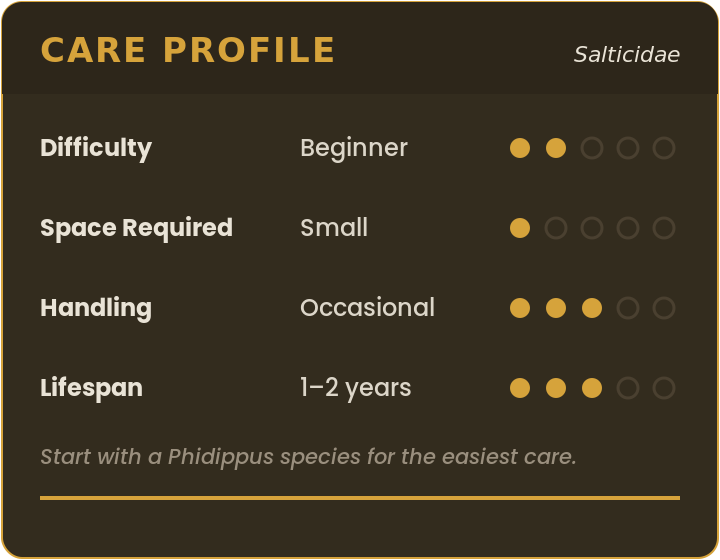
For a first jumping spider, the answer is almost universally: Phidippus regius (regal jumping spider).
Why P. regius? It’s large enough to see clearly and interact with confidently. It’s bold enough to approach hands voluntarily after a short acclimation period. It’s widely available from captive breeders with verified hatch dates. And it’s forgiving of the husbandry learning curve that every first-time keeper goes through.
Full species comparison: Types of Jumping Spiders: 15 Species You Should Know
Male or Female?
Choose female. Female jumping spiders live 2 to 3 years in captivity; males live 1 to 1.5 years. Both are excellent pets, but if you want the longest, most complete companionship, a female is the right call for a first spider.
Sexing guide: Male vs. Female Jumping Spiders: How to Tell the Difference
Where to Buy
Buy from a reputable captive breeder. The best sources:
Morphmarket (spider category): the most organized platform for finding jumping spider breeders
Facebook groups: “Jumping Spider Sales and Trades,” “Phidippus regius Keepers” — active buying communities
Arachnoboards classified section: long-established forum with vetted sellers
Why captive-bred? Known hatch date (you can track the spider’s age and instar throughout its life), established feeding history, no wild-caught stress, and the knowledge that your purchase supports responsible breeding rather than wild collection.
The Complete Setup: What You Need Before Day One
Enclosure
Arboreal enclosure with cross-ventilation: mesh on both top and front. Minimum 8x8x12 inches for an adult female P. regius. Have the enclosure fully set up and stable (24 hours at correct temperature and humidity) before the spider arrives.
Substrate
1 to 2 inches of coconut fiber in the enclosure floor. Provides moisture retention, fall cushioning, and a natural-looking base.
Decor
Cork bark pieces at various angles for climbing structure and hiding. Fake or live plants for visual complexity and silk anchor points. Avoid anything sharp.
Measurement and Misting
Digital hygrometer/thermometer with probe inside the enclosure. Fine-mist spray bottle for regular misting (one side of the enclosure every 2–3 days).
Feeding Tools
10–12 inch stainless steel feeding tongs for delivering prey without putting bare hands near the spider during feeding sessions.
Feeding: The First Week and Beyond
For the first 1 to 2 weeks in its new enclosure, your spider is acclimating to a new environment. Don’t be alarmed if it refuses food during this period — stress-related appetite suppression in a new home is normal. Leave it undisturbed and try again in a few days.
Once eating normally, the feeding rhythm: offer appropriately sized prey (no longer than the abdomen) every 3 to 4 days for an adult, every 2 to 3 days for juveniles. Remove any uneaten prey within 24 hours. For a full species, stage, and frequency breakdown:
Complete feeding guide: What Do Jumping Spiders Eat? Complete Feeding Guide
Your Spider’s First Molt in Your Care
At some point — anywhere from weeks to months depending on the spider’s age when you acquired it — your spider will molt. Recognizing the signs and responding correctly is one of the most important things you’ll learn as a new keeper.
Pre-molt signs: sealed silk cell, appetite stops entirely (sometimes 1 to 4 weeks before the molt), duller coloring. Your response: remove all prey immediately. Ensure humidity is correct (mist slightly more if pre-molt is imminent). Do not disturb the enclosure for 7 days after the spider emerges.
Full molt guide: Jumping Spider Molt: Signs, Stages & What to Do
Building a Relationship Through Handling
After 2 weeks of acclimation and once the spider is eating normally, you can begin gentle interaction. Offer your open hand near the enclosure opening and allow the spider to walk on voluntarily. Don’t grab. Handle close to a surface. Keep sessions short initially.
Over weeks and months of consistent gentle interaction, most P. regius females become remarkably relaxed — approaching hands voluntarily, investigating faces, and showing the head-tilting curiosity that makes these spiders uniquely compelling.
Personality and handling guide: Are Jumping Spiders Friendly? Personality & Temperament Explained
How Long Will Your Spider Live?
A female P. regius with good care: 2 to 3 years. This timeline means you’ll experience multiple molts, a complete transition from juvenile to adult, and a gradual personality that deepens as the spider habituates to you and its environment. It’s a meaningful timeline for an invertebrate companion.
Complete lifespan guide: Jumping Spider Lifespan: How Long Do They Live?
First Week Checklist
Enclosure set up and stable at 72–80°F, 50–65% humidity for 24+ hours before arrival
Feeder insects (age-appropriate) available and ready
Hygrometer reading confirmed accurate
Spider introduced to enclosure; enclosure left undisturbed for 48 hours
First feeding attempt at day 3–5
Observe daily from outside the enclosure; note behavior and activity level
Begin reading your spider’s body language — curious/neutral vs. defensive displays
Recommended: EctoTherm Jumping Spider Enclosure — Designed specifically for jumping spiders with cross-ventilation and a front-opening magnetic door. The ideal home for your first spider.
Frequently Asked Questions
Are pet jumping spiders safe for children?
Yes — jumping spiders are safe around children of all ages from a venom/bite perspective. The practical concern is the spider’s safety: young children may inadvertently harm a jumping spider through rough handling or dropping. Supervised, gentle interaction is the appropriate approach.
Can a pet jumping spider be left alone for a week?
An adult jumping spider can safely fast for 1 to 2 weeks, so a week’s absence with no feeding is manageable. However, ensure humidity is maintained (the enclosure won’t dry out catastrophically in a week, but check before leaving), and have someone check on the spider if possible. Do not leave live prey in the enclosure while you’re away.
How much does a pet jumping spider cost?
A captive-bred Phidippus regius spiderling from a reputable breeder is typically inexpensive. Adult females cost a bit more depending on lineage, color morph, and breeder reputation. Setup costs (enclosure, feeder cultures, substrate, tools) are a modest one-time investment for a quality first setup. Ongoing costs are minimal — feeder insects and occasional substrate replacement.
Do pet jumping spiders need companionship?
No — jumping spiders are solitary animals. They do not benefit from the company of other jumping spiders and will fight if housed together as adults. The companionship they provide is one-directional: they interact with their keeper, not with each other. Each spider needs its own enclosure.
| About the Author Itsy Bitsy Pets Editorial Team The ItsyBitsyPets.com team has been keeping jumping spiders since the hobby’s mainstream emergence and has guided thousands of new keepers through their first setups. This guide reflects our current best practices, updated regularly as community knowledge evolves. Thank you for being part of the IBP community. Site: itsybitsypets.com | Twitter: @ibp2025 |
| Join 7,000+ Micro-Pet Lovers Get The Micro-Pet Minute — free weekly care tips, species spotlights, and product picks. Subscribe at itsybitsypets.com |