
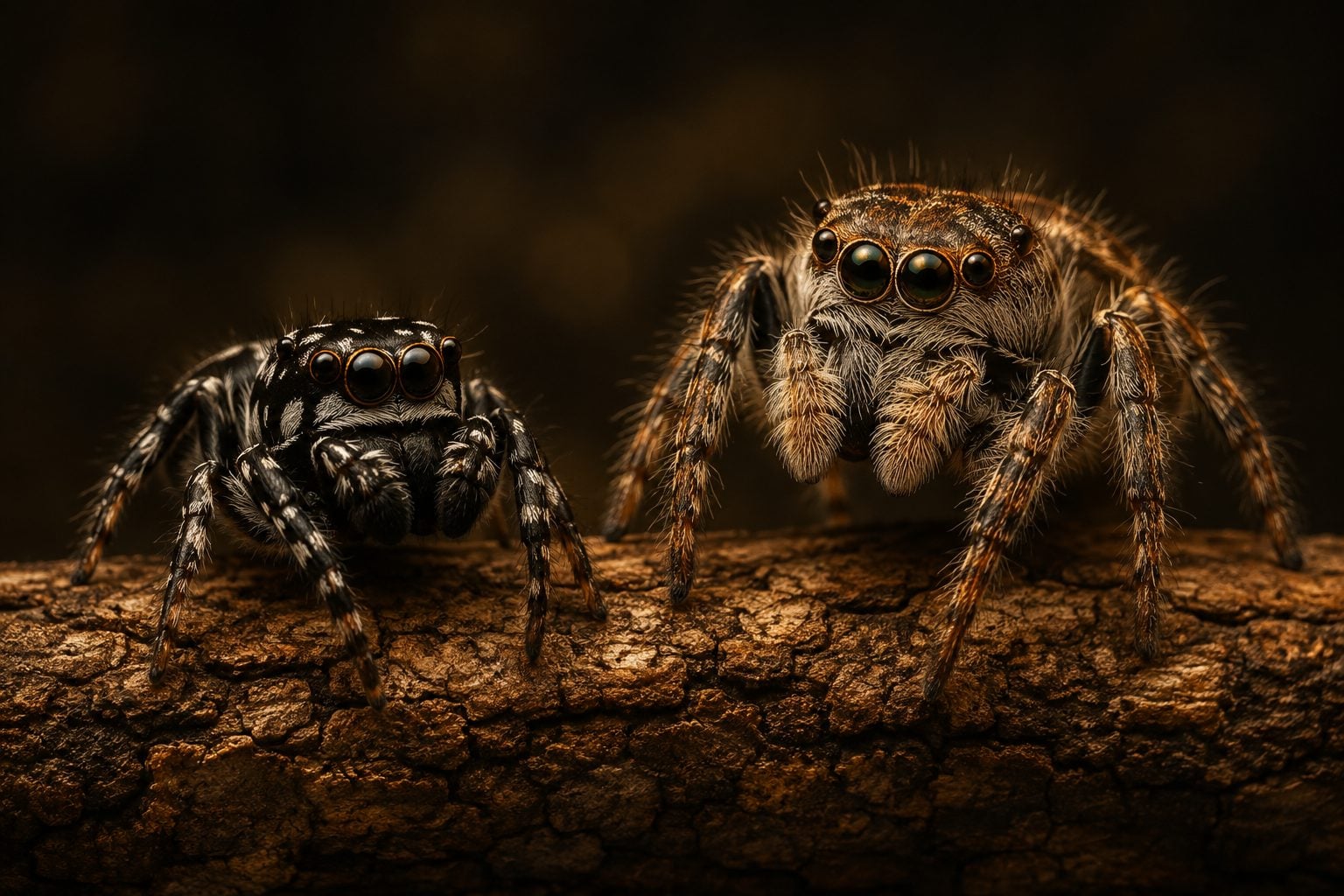
| Quick Answer How do you tell male and female jumping spiders apart? Male and female jumping spiders can be distinguished by size, coloration, pedipalp shape, and abdominal pattern. Females are larger, often with more complex abdominal patterns. Males are smaller, have visibly enlarged club-shaped pedipalps (the small appendages near the face) as adults, and often show different color patterns than females of the same species. Reliable sexing is possible from instar 4–5 onward with magnification; adult specimens can usually be sexed visually without magnification. |
The Beginner Jumping Spider Kit
If you’re setting up your first spider, this is the whole list. Nothing fancy, nothing you’ll outgrow in a month.
- EctoTherm jumping spider enclosure — front-opening, escape-proof, and sized right for an adult
- Magnetic hanging water dispenser — the one thing most beginners skip, and the one they regret skipping
- Exo Terra mini mister — a light misting beats a water bowl your spider can drown in
Knowing whether your jumping spider is male or female matters for multiple reasons: lifespan expectations differ significantly (females live 2+ years; males typically 1 to 1.5 years), feeding requirements are different, behavioral tendencies vary, and if you’re considering breeding, you need to be sure of what you have.
This guide explains how to sex jumping spiders reliably, by both visual characteristics and behavior, across life stages from juvenile to adult — with detailed notes on the most commonly kept species.
The Reliable Indicators: What to Look For
1. Pedipalps — The Most Reliable Adult Indicator
Pedipalps are a pair of small appendages near the chelicerae (fangs), one on each side of the “face.” In both sexes, they look like small legs in juveniles. In adult males, the pedipalps develop a visibly enlarged, club-like or bulb-like tip (the palpal bulb or embolus) that contains the reproductive organ. This transformation occurs during the final juvenile molt to adulthood.
Adult male palps: visually obvious even without magnification in larger species like Phidippus regius. Look for the thickened, rounded tip that is clearly larger than the pedipalp shaft. In smaller species, a 10x loupe makes this much easier to confirm.
Adult female palps: slender and pointed throughout — no bulb development. The pedipalps remain the same shape from juvenile to adult.
Recommended: 10x Foldable Pocket Loupe with LED Light — pedipalp details are hard to judge on a 10 mm spider — a lit 10x loupe makes the difference obvious in seconds.
2. Size — A Reliable Indicator After Instar 4
Female jumping spiders are significantly larger than males of the same species at the same instar. In Phidippus regius, an adult female can be nearly double the body length of an adult male. This size difference is detectable from instar 4–5 onward: females will be noticeably larger than males at the same developmental stage.
Caveat: size alone can be misleading if you don’t know the instar — a large male might be the same size as a small female if they are at different instars. Use size as a supporting indicator alongside pedipalp and pattern observations.
3. Abdominal Pattern — Species-Specific
Abdominal pattern differences between sexes are species-specific but reliable within a species:
Phidippus regius (Regal Jumping Spider)
Female: predominantly black body with white banding and spots on the abdomen; variable orange/red hairs; complex patterning
Male: black body with clear white lateral bands on the abdomen; less complex pattern; tends to look more “striped” than the female’s “spotted” appearance
Phidippus audax (Bold Jumping Spider)
Female: similar to regius female — black with white spots; often shows orange spot on upper abdomen in juveniles that may fade with age
Male: slimmer black body with less variable patterning; the three white spots on the abdomen (two lateral, one medial) are a consistent male identifier in adults
Hyllus diardi
Female: larger, brown-gray coloration with complex banding; more cryptic coloration overall
Male: similar but slightly darker with more defined pattern contrast; significantly smaller than females
The Beginner Jumping Spider Kit
If you’re setting up your first spider, this is the whole list. Nothing fancy, nothing you’ll outgrow in a month.
- EctoTherm jumping spider enclosure — front-opening, escape-proof, and sized right for an adult
- Magnetic hanging water dispenser — the one thing most beginners skip, and the one they regret skipping
- Exo Terra mini mister — a light misting beats a water bowl your spider can drown in
4. Behavior — Useful Supporting Indicator
Males actively search for mates and display characteristic courtship behavior once sexually mature:
Males frequently rock or vibrate their abdomen — this is courtship display behavior that occurs even without a female present, triggered by female pheromones or visual cues
Males tend to be more restless and wide-ranging in their enclosure exploration compared to females
Females tend to be more deliberate in their movements and spend more time in the silk sleeping sac
Sexing Spiderlings and Young Juveniles (Instars 1–3)
Reliable sexing at this stage is not practical without specialized microscopy equipment. The pedipalp bulb does not develop until sub-adult or adult stages. Size differences exist but are subtle in early instars. For practical purposes, assume unknown sex until instar 4–5.
If you need to sex early instars (for breeding projects, space management, etc.), the shed exoskeleton from a molt can sometimes be examined under magnification for genital structures — but this requires experience and a stereo microscope, making it impractical for most keepers.
Why Sex Matters: The Practical Implications
Lifespan
Females live 2 to 3 years in captivity; males live 1 to 1.5 years. If your spider is male, adjust your lifespan expectations accordingly — and don’t be surprised by appetite decline and reduced activity after the spider reaches adulthood and its first potential mating season.
Diet
Adult males require less food than females — feed adult males every 4–5 days with slightly smaller prey portions. Overfeeding an adult male can cause obesity-related health issues.
Housing
Males are more active explorers and may benefit from slightly larger horizontal territory than an equivalent female. Both sexes must be housed individually as adults — territorial aggression between same-sex adults is common.
Breeding
If you’re interested in breeding, identifying the sex of your spiders before adulthood gives you time to plan pairings and prepare the female’s enclosure for potential egg sac production.
Recommended: SE Professional 10x Illuminated Loupe — A 10x loupe with dual LED illumination makes it easy to spot the male’s enlarged pedipalp bulbs or the female’s slimmer palps.
Frequently Asked Questions
Can you tell male from female jumping spiders without a magnifying glass?
For adult specimens of larger species (Phidippus regius, Hyllus diardi), yes — the male’s palpal bulbs and smaller body size are visible to the naked eye. For smaller species and all juvenile stages, a 10x loupe significantly improves accuracy.
Do male jumping spiders die after mating?
Not immediately — unlike some spiders where males are killed after mating, jumping spider males typically survive and may mate multiple times. However, males often show progressive physical decline after their first mating season (reduced appetite, reduced activity) and have shorter total lifespans than females regardless of mating history.
The Beginner Jumping Spider Kit
If you’re setting up your first spider, this is the whole list. Nothing fancy, nothing you’ll outgrow in a month.
- EctoTherm jumping spider enclosure — front-opening, escape-proof, and sized right for an adult
- Magnetic hanging water dispenser — the one thing most beginners skip, and the one they regret skipping
- Exo Terra mini mister — a light misting beats a water bowl your spider can drown in
Are female jumping spiders better pets than males?
For most people’s goals, yes. Females live 2 to 3 years vs. 1 to 1.5 years for males, handle the same well, and don’t decline as rapidly after adulthood. Male jumping spiders can be excellent pets but require adjusted lifespan expectations.
| About the Author Itsy Bitsy Pets Editorial Team The ItsyBitsyPets.com team combines hands-on keeping experience with peer-reviewed arachnology research to produce accurate, practical care guides. We update our content when new scientific evidence or community findings warrant revision. Site: itsybitsypets.com | Twitter: @ibp2025 |
| Join 7,000+ Micro-Pet Lovers Get The Micro-Pet Minute — free weekly care tips, species spotlights, and product picks. Subscribe at itsybitsypets.com |