
| Quick Answer How do I set up a roly poly (pill bug) enclosure? A roly poly enclosure needs a small, vented container (a plastic deli cup or small storage tub works well), a moisture-retaining substrate like coconut fiber or leaf litter, a moisture gradient (one side wetter than the other), and hiding spots like cork bark or flat stones. Roly polies (Armadillidium vulgare and related species) eat decaying leaf litter, vegetables, and calcium sources. They are among the easiest micro-pets to keep. |
Roly polies — those small round crustaceans that curl into a perfect ball when touched — are one of the most universally recognized micro-animals from childhood nature exploration. As pets, they are beginner-friendly, surprisingly entertaining to observe, and serve as an excellent introduction to the broader isopod-keeping hobby.

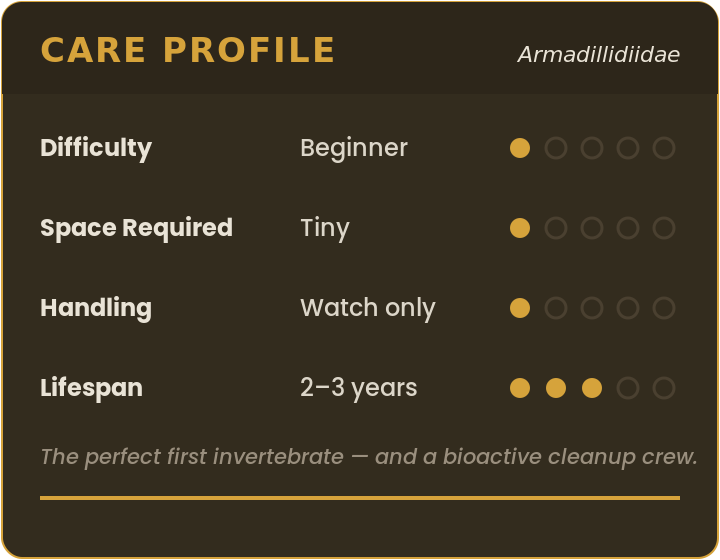
This guide covers everything you need to set up and maintain a roly poly enclosure, whether you’re keeping them as pets in their own right or as the beginning of a more serious isopod collection.
What Are Roly Polies?
“Roly poly” is a common name for pill bugs — specifically Armadillidium vulgare, the most common pill bug species in North America and Europe. Unlike most isopods, Armadillidium species can fully roll into a complete sphere (conglobation) as a defense mechanism. This distinguishes them from pill millipedes (a different animal that looks similar) and from other isopod species like Porcellio that cannot fully roll.
Roly polies are terrestrial crustaceans, not insects — they’re more closely related to crabs than to beetles or ants. They breathe through gill-like structures that must stay moist, which is why they’re found in damp places: under rocks, in leaf litter, under logs.
Enclosure Setup
Container Choice
A clear plastic container with a secure ventilated lid is the standard roly poly enclosure. Options:
Deli cups (32 oz to 1 quart): excellent for a small starter group of 10–25 individuals
Clear plastic storage tub (6–12 quart): for a larger colony or more elaborate setup
Purpose-built isopod display containers: acrylic enclosures with mesh ventilation; more attractive but higher cost
Ventilation is essential. Add several small holes (1/8″ or smaller, covered with mesh) near the top of the container. Without ventilation, CO2 accumulates and humidity becomes stagnant.
Substrate
A 2 to 3 inch layer of moisture-retaining substrate is the foundation:
Coconut fiber (coco coir): holds moisture well, resists mold, provides excellent burrowing medium
Leaf litter: dried oak, magnolia, or beech leaves as the top layer; both a food source and a hide structure
Organic topsoil mixed with coco coir: good alternative if straight coco coir is unavailable
Moisture gradient: keep one corner or side slightly moist (spray with distilled water every 2–3 days) and let the other side dry out between mistings. Armadillidium species are more tolerant of drier conditions than Porcellio species but still need access to moisture.
Hides and Structure
Roly polies need hides for molting, moisture regulation, and the natural congregation behavior they exhibit. Options:
Cork bark flat pieces: excellent; provides humid microclimate underneath
Flat rocks or slate pieces: simulate the rocks they’re found under in nature
Dried leaves: layer generously over the substrate surface
Feeding Your Roly Polies
Roly polies are detritivores — they eat decomposing organic matter. In captivity:
Leaf litter: the primary continuous food source; replenish as leaves are consumed
Vegetables: cucumber slices, carrot pieces, sweet potato; remove uneaten fresh food after 48 hours
Dried mushrooms: a favorite supplement; nutritious and consumed enthusiastically
Cuttlebone: essential calcium source; keep one piece in the enclosure permanently
Overfeeding is the most common mistake: excess food molds in the humid enclosure. Feed small amounts and remove uneaten fresh food promptly.
Temperature and Humidity
Temperature: 65–78°F (18–26°C); room temperature is adequate in most homes
Humidity: moist corner 70–80%; dry corner 50–60%; Armadillidium tolerates drier conditions than most isopods
No supplemental heating required in most home environments
Starting Your Colony
Start with 10 to 25 roly polies. They can be:
Wild-caught from your garden: collect from under rocks, logs, or leaf litter in pesticide-free areas
Purchased from isopod hobbyist breeders: captive-bred colonies are cleaner and disease-free
Available from some pet stores (reptile sections) as “cleanup crew” isopods
Armadillidium vulgare has a slower reproduction rate than Porcellio species — don’t expect a population explosion in the first months. The colony will grow steadily over 6 to 12 months.
Roly Polies in Bioactive Terrariums
Armadillidium vulgare is used as a bioactive cleanup crew in terrarium setups, particularly in temperate-origin enclosures and arid setups where higher-humidity Porcellio species wouldn’t thrive. Their stable, moderate population growth rate means they won’t overrun an enclosure the way faster-breeding species can.
For bioactive terrarium use, see: Bioactive Terrarium Isopods: The Ultimate Setup Guide
Recommended: Compressed Coconut Fiber Substrate — Coco coir makes the ideal base layer for pill bug enclosures — holds moisture without waterlogging, and isopods love burrowing through it.
Frequently Asked Questions
Can roly polies be kept as pets?
Yes — roly polies (Armadillidium vulgare) are low-maintenance, interesting micro-pets that are particularly popular with children and naturalist hobbyists. They are harmless, easy to care for, require minimal space, and exhibit fascinating natural behaviors including the distinctive rolling-into-a-ball defense response.
Do roly polies need a heat lamp?
No — roly polies do not require supplemental heating in typical home temperatures. They thrive at room temperature (65–78°F) without any heat lamp or heat mat.
Can I keep roly polies with other isopods?
Yes — Armadillidium vulgare coexists well with other isopod species (particularly Porcellio species) and with springtails. Multiple isopod species in a bioactive terrarium create a more complete cleanup crew with broader ecological roles.
| About the Author Itsy Bitsy Pets Editorial Team The ItsyBitsyPets.com team combines hands-on keeping experience with peer-reviewed arachnology research to produce accurate, practical care guides. We update our content when new scientific evidence or community findings warrant revision. Site: itsybitsypets.com | Twitter: @ibp2025 |
| Join 7,000+ Micro-Pet Lovers Get The Micro-Pet Minute — free weekly care tips, species spotlights, and product picks. Subscribe at itsybitsypets.com |