
Turn the lights off over a planted tank, come back an hour later with a flashlight, and you’ll meet a whole second cast. Shrimp working the moss. A snail plowing a clean trail up the glass. Something small and orange backing out from under a piece of driftwood with its claws up. The fish get the credit, but the freshwater aquarium creatures that aren’t fish are what turn a box of water into an ecosystem — and most of them cost less, ask less, and do more genuine work than the fish do. This guide covers twelve species worth keeping on purpose, the microfauna that will show up whether you invite them or not, and how to tell the harmless ones from the two that actually matter.
ItsyBitsyPets is reader-supported. As an Amazon Associate we earn from qualifying purchases — at no extra cost to you. See our affiliate disclosure.
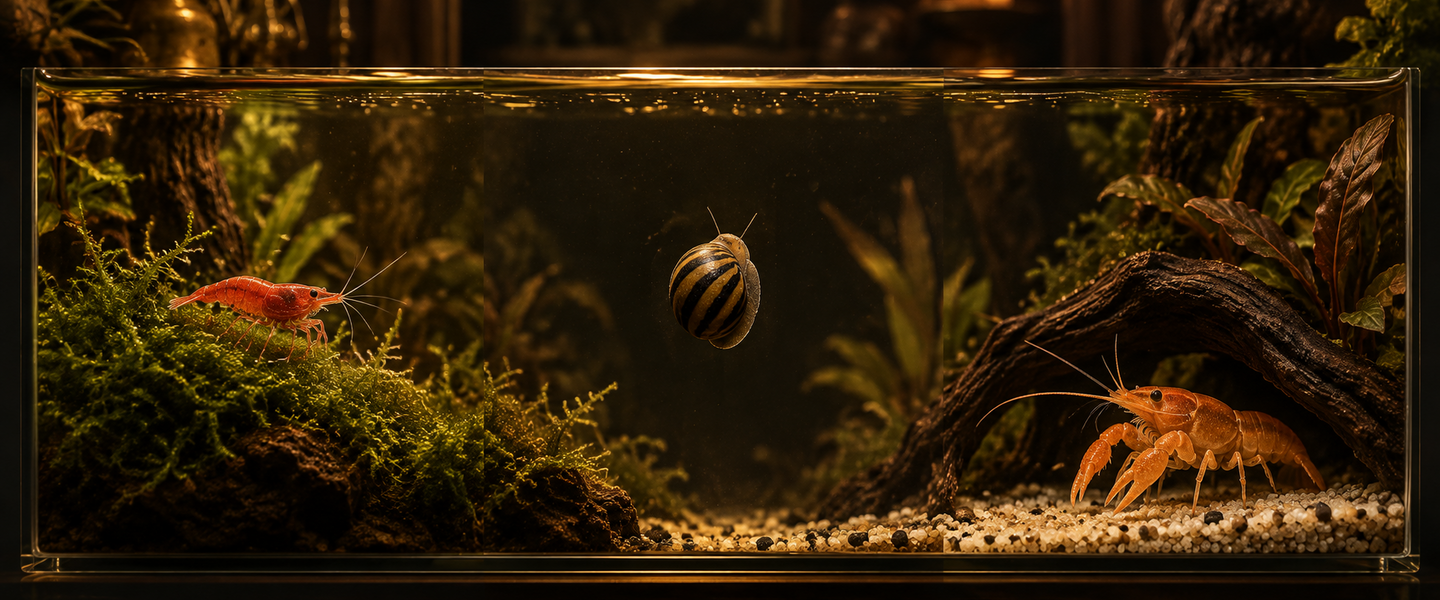
The four groups of freshwater aquarium creatures
Set fish aside and the non-fish livestock in a freshwater tank sorts into four groups. Crustaceans — shrimp, dwarf crayfish, the handful of genuinely aquatic crabs. Molluscs — snails and, with reservations, clams. Amphibians, which in practice means African dwarf frogs. And the microfauna, the worms and pods and stranger things that arrive on a plant leaf and set up house without asking. The first three you choose. The fourth chooses you, which is why it gets its own section further down.
Two rules apply to almost all freshwater aquarium creatures, and they’re worth learning before you buy anything. The first is copper. Copper turns up in fish medications, in some plant fertilizers, and in old household plumbing, and it is lethal to invertebrates at doses that barely inconvenience a fish. If you keep shrimp or snails, read every label, and treat sick fish in a separate hospital tank. The second is minerals. Every crustacean and every mollusc builds a shell or an exoskeleton out of calcium pulled from the water, so soft, mineral-poor water produces pitted shells and failed molts no matter how clean it is. General hardness matters more than pH here.
One more piece of context: freshwater aquarium creatures are more sensitive to ammonia and to sudden swings than the fish sharing their water. They belong in a tank that is fully cycled and has been running predictably for a few weeks, not in a brand-new setup. If you’re not there yet, our step-by-step guide to starting an aquarium covers cycling properly, and a freshwater test kit will tell you when the tank is genuinely ready rather than merely old.
Shrimp: the four worth keeping
Cherry shrimp (Neocaridina davidi). The default among freshwater aquarium creatures, and deservedly so. About an inch and a half, comfortable in a five-gallon, tolerant of anything from 65 to 80°F and pH 6.5 to 8, and — the part that sells them — they breed freely in an ordinary freshwater tank. Buy ten, keep the tank stable, and in a few months you have a self-sustaining colony that grazes biofilm all day and costs nothing to run. They’re colony animals; a lone cherry shrimp hides constantly and shows poor color.
Amano shrimp (Caridina multidentata). Roughly two inches, ten gallons and up, and the single most effective algae eater in the hobby — an adult amano will strip hair algae that nothing else touches. The catch is that they will not breed in your tank: the larvae require brackish water, so every amano you own was wild-caught or farmed elsewhere. They’re also bold enough to wrestle food away from fish, which makes them entertaining and occasionally rude.
Ghost shrimp. The cheapest way into the hobby, around an inch and a half, fine in five gallons. Because they’re sold as feeders, quality is a lottery and losses in the first week are common. There’s also a genuine identification problem: larger “ghost shrimp” are sometimes whisker shrimp, a bigger predatory species that will kill small fish and other shrimp. If a ghost shrimp keeps growing past two inches, watch it.
Bamboo or vampire shrimp (Atyopsis moluccensis). The most impressive of the freshwater aquarium creatures in this category and the one people most often kill by accident. Four inches, twenty gallons minimum, and a filter feeder — it perches in the current and unfolds fans to strain food from the water. That means it needs real flow and finely powdered food, not wafers. A bamboo shrimp scavenging on the substrate or hanging at the front glass isn’t being friendly; it’s starving because there’s nothing in the water column to catch.
Snails: cleanup crew and showpiece
Nerite snails are the best algae snails available and the tidiest choice for a small tank, because they cannot reproduce in fresh water — their eggs need brackish conditions to hatch. They will still deposit hard white eggs on driftwood and glass, which is cosmetic and permanent-ish, and the trade-off most keepers accept happily.
Mystery snails (Pomacea bridgesii) are the showpiece: two inches of gold, ivory, jade or deep blue-black shell, plant-safe, and personable in a way snails aren’t supposed to be. Budget about five gallons each, keep calcium available, and leave a gap of air between the waterline and the lid, because they surface to breathe and lay egg clutches above the water. A shell that starts pitting or eroding at the spire is a calcium and pH problem, not a disease.
Malaysian trumpet snails are the invisible workers. They spend daylight buried, turning the substrate over and keeping anaerobic pockets from forming in deep sand. Their population is a direct readout of how much you overfeed. Ramshorn snails do the same job in the water column and on plant leaves, breed fast, and are best controlled by feeding less rather than by picking them out — a job you will never finish. For the full roster and how to choose between them, we go deeper in the freshwater snails guide.
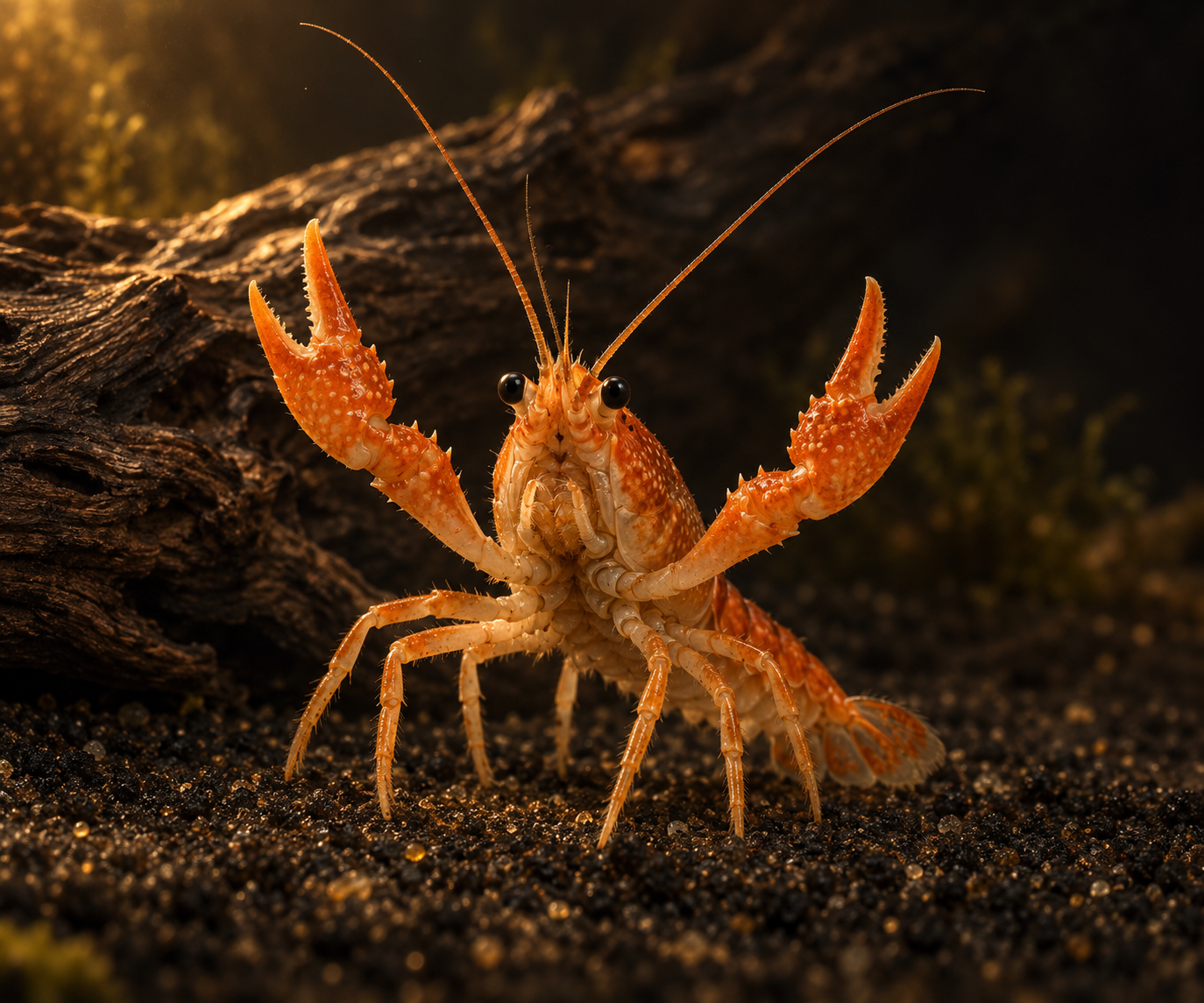
Dwarf Mexican orange crayfish: a lobster that fits in a nano
Among freshwater aquarium creatures with real personality, this is the one that fits anywhere: everything people love about crayfish and none of the destruction. Cambarellus patzcuarensis, universally called the CPO, tops out between 1.2 and 1.6 inches — occasionally two — in a blaze of pumpkin orange, and it behaves like a miniature of its full-size cousins without shredding your plants or rearranging your aquascape overnight. The Shrimp Farm’s care sheet puts it in a five-gallon tank kept alone, or ten gallons in a community, which makes it one of the very few crustaceans with real presence that suits a small setup.
Care at a glance: pH 6.0–8.0, temperature 60–75°F, kH 1–15, gH 3–25, TDS 100–500. That temperature range is the detail most people miss — the CPO is a cool-water animal, and a heater set to tropical 78°F shortens an already brief life of roughly two years. It needs caves, driftwood and dense planting, because a crayfish mid-molt is soft, blind to danger and entirely defenseless. A piece of aquarium driftwood with an overhang under it is worth more to this animal than any ornament.
One compatibility caveat, and it’s the reason plenty of keepers regret their stocking order. The CPO is too small to threaten most tankmates, but it has been documented hunting dwarf shrimp. If you have a cherry colony you care about, don’t add a crayfish to it. Pick one or the other and commit.
Thai micro crabs — and the crab warning nobody gives you
Limnopilos naiyanetri, the Thai micro crab, is about the size of a pea, hairy, translucent grey, and one of the strangest things you can put in a nano tank. It clings to moss and filter intakes and sifts food from the current with fringed claws. Keep them in five to ten gallons with dense moss, no predators, and stable water — almost any fish large enough to notice one will eat it. They’re peaceful, entirely aquatic, and easy to lose track of for weeks at a time.
Here’s the warning that belongs on the wall of every fish store. Most “aquarium crabs” sold alongside them are not fully aquatic. Fiddler crabs, red-claw crabs and vampire crabs are semi-terrestrial: they need land, humid air, and a way out of the water, and housing them in a fully submerged tank drowns them slowly. Several of them also need brackish water. If you’re buying a crab for a standard fish tank, the Thai micro crab is one of the very few honest answers.
African dwarf frogs: the amphibian that lives in a fish tank
African dwarf frogs (Hymenochirus spp.) are fully aquatic, permanently, and among the most charming freshwater aquarium creatures available to a beginner. They hang in the water column with their arms out, sprint to the surface for air, and eat with a comic lack of coordination that makes feeding them a spectator sport. Plan on three to five gallons per frog: one or two are fine in a five-gallon, but sharing with fish pushes you to twenty gallons, as AquariumStoreDepot’s care guide lays out.
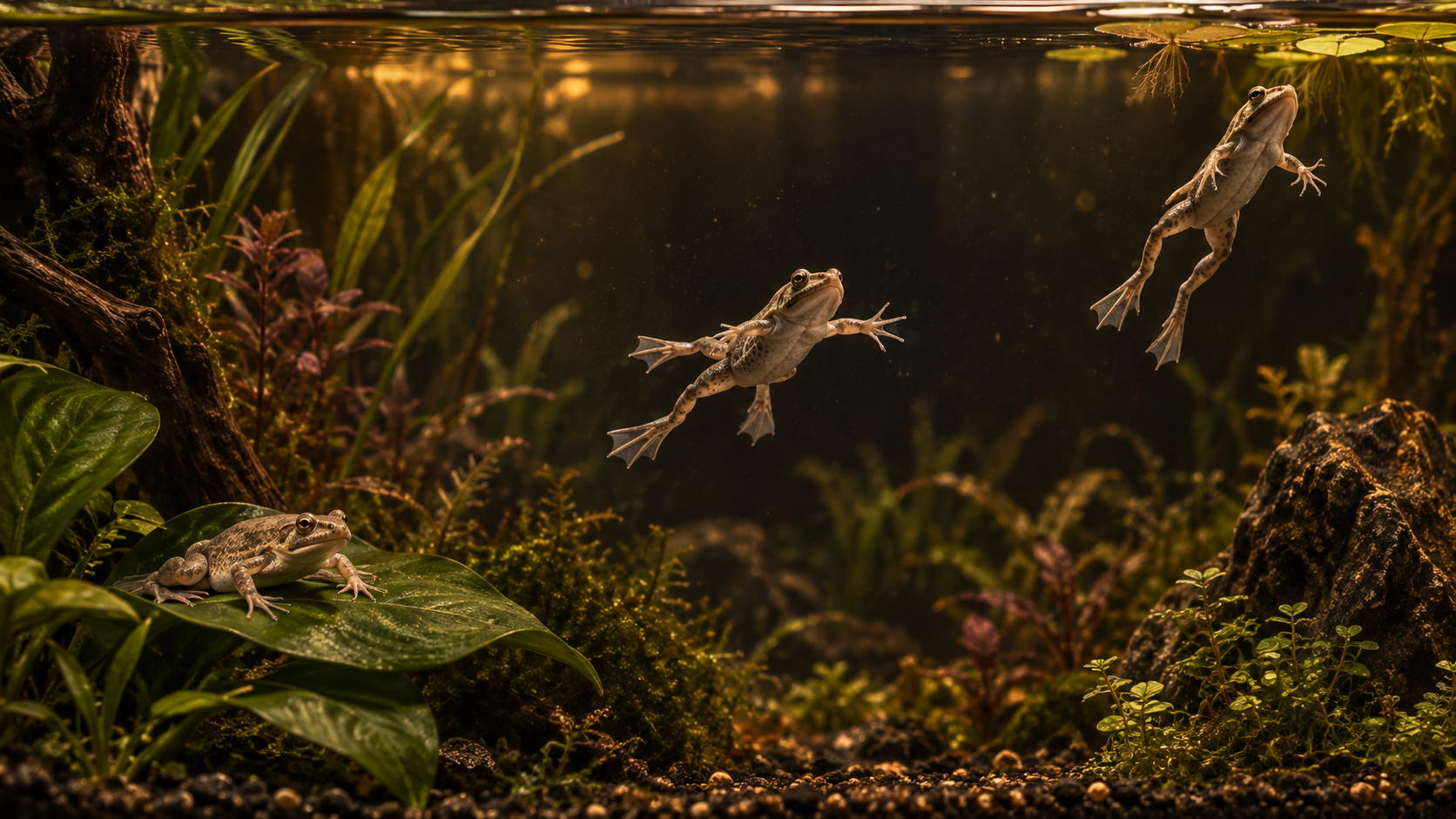
Care at a glance: 72–78°F, pH 6.5–7.8, general hardness around 5–10. Long, low tanks beat tall ones, because these frogs must reach the surface to breathe and a deep column is a daily marathon. Sand is the ideal substrate, or gravel with pieces too large to swallow — impaction from swallowed gravel is a real cause of death. Live plants give them cover and a place to rest partway up. They’re social, so keep three or four, and expect five to eight years of life with reports running to ten.
Two practical notes. First, they are slow, near-sighted feeders that lose every race to fish, so target-feed them sinking food at the bottom rather than trusting a community feeding to reach them. Second, do not confuse them with the African clawed frog, which is sold young at similar size, grows to five inches, and eats everything in the tank. The tell is the front feet: dwarf frogs have webbed front feet, clawed frogs don’t.
Freshwater clams: the one to think twice about
Freshwater clams get sold as living filters, and the biology is sound — they bury in the substrate and strain suspended particles out of the water all day. The problem is that a well-maintained planted tank is exactly the environment with too little suspended food to sustain one. Clams in clean tanks starve slowly over months, and because they die buried, the first sign is usually an ammonia spike from something you can’t see. They make sense in larger, well-fed systems with green water or heavy feeding. In a tidy nano, they’re a slow-motion accident. Included here for completeness, not as a recommendation.
The uninvited creatures: a hitchhiker ID guide
Sooner or later you will spot freshwater aquarium creatures moving that you did not buy. Almost all of it is harmless, and panicking about it causes more damage than the animal ever would. Here’s how to tell them apart.
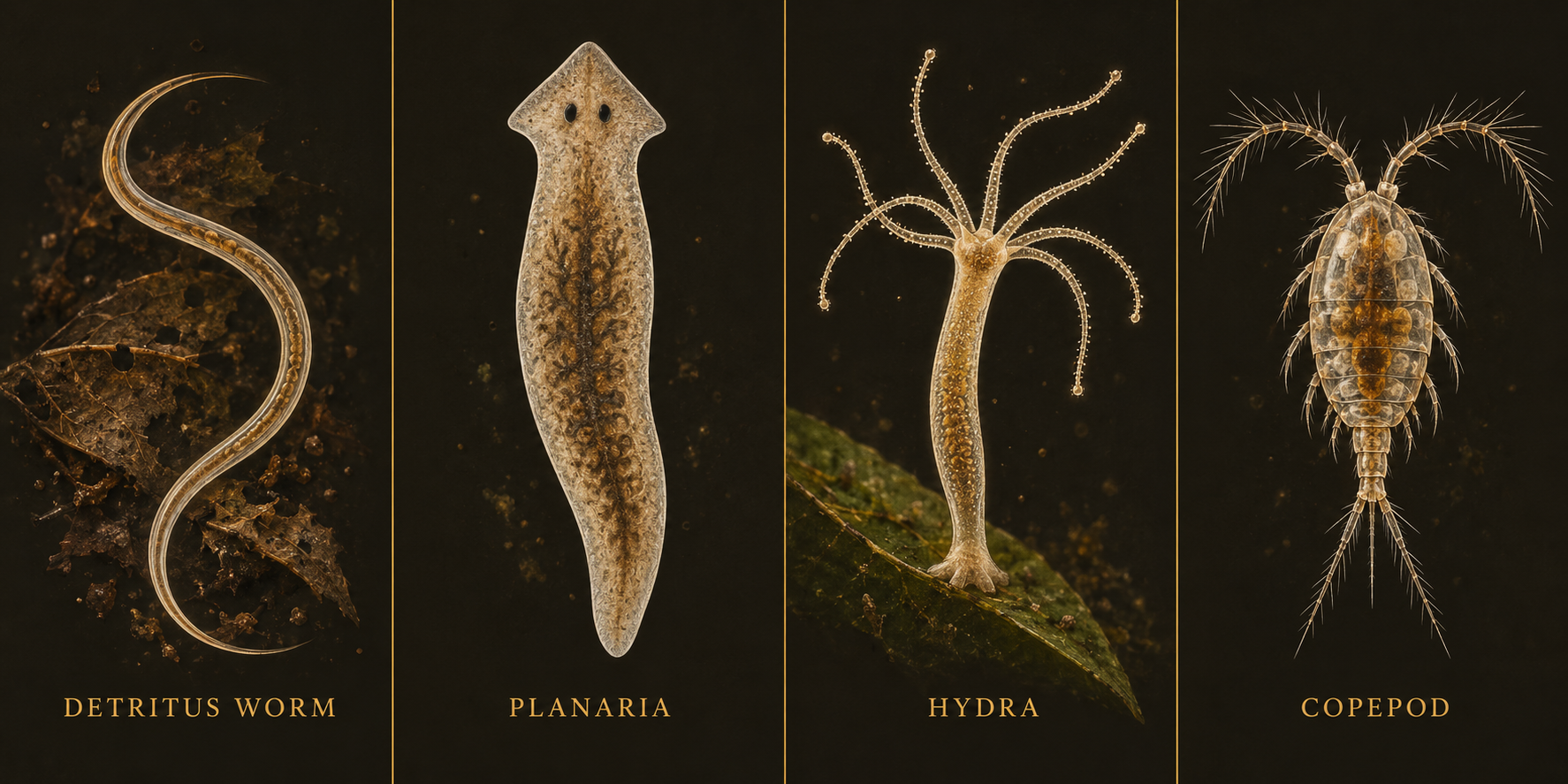
Detritus worms are thin, thread-like, and wiggle in the gravel or drift in the water column. They’re harmless detritivores and their numbers track how much you overfeed — cut back on food and vacuum the substrate, and they recede. Planaria look superficially similar and are not the same thing: Blackwater Aquatics’ comparison nails the tell — a distinct arrowhead-shaped head with two dark eye spots, and a smooth gliding motion rather than a wiggle. Planaria hunt shrimplets and fry, and they’re one of only two hitchhikers worth acting on.
Hydra is the other. It’s stationary rather than swimming: a tiny stalk anchored to the glass or a plant leaf by a sticky foot, with tentacles fanned out. It stings and eats baby shrimp and fry. Like planaria, it blooms on excess food, so the first treatment is always to stop feeding so heavily. Copepods look like moving dust with a jerky, darting motion — completely harmless and a sign of a healthy biofilm, plus free live food for small fish. Scuds or amphipods are fast grey-tan mini-shrimp that swim on their sides and hide in moss; they’re strong detritivores and excellent live food, and Aquarium Science’s pest overview agrees they’re a net positive in most tanks.
The short version: copepods, limpets, detritus worms and scuds are harmless and often useful. Only hydra and planaria need a response, both respond to feeding less plus manual removal, and both are far more of a threat to a shrimp colony than to fish. Before you dose anything, remember that most invertebrate treatments are as hard on your shrimp as on the pest.
Freshwater versus saltwater aquarium creatures
It’s worth being honest about the comparison, because anyone browsing invertebrates eventually wonders whether the saltwater side is worth the jump. It is a wider and much stranger catalogue: cleaner shrimp that pick parasites off fish, hermit crabs in borrowed shells, sea stars, urchins, feather duster worms, and corals that are technically animals too. Nothing in fresh water looks quite like a healthy reef cleanup crew at work.
What you pay for that variety is stability. Saltwater aquarium creatures need salinity held within a narrow band, and a careless top-off can kill an entire cleanup crew in an afternoon. The economics differ too: a cherry shrimp colony costs thirty dollars once and then breeds itself indefinitely, while a saltwater crew is a recurring purchase because most of it will not reproduce in a home tank. For a first tank, freshwater is not the lesser option — it’s the one where mistakes cost you a snail instead of a season.
The biology, though, is shared. Saltwater creatures and freshwater ones alike are copper-sensitive, molt to grow, need slow acclimation over an hour or more, and hate rapid parameter swings above all else. Learn your husbandry on freshwater aquarium creatures and every bit of it transfers to the reef later.
A stocking plan by tank size
Five gallons. Pick one direction and stay there: a cherry shrimp colony, or a single CPO crayfish, or one to two African dwarf frogs, or a few Thai micro crabs. Not a combination. At this volume, our nano tank guide covers why stability, not stocking, is the limiting factor.
Ten gallons. A shrimp colony plus a couple of nerites is the classic, and amano shrimp become viable here. A CPO works if its tankmates are fast mid-water fish that stay off the bottom. Add a sponge filter rather than a hang-on-back at this scale — it can’t suck up shrimplets, and it grows the biofilm that half of these animals actually eat.
Twenty gallons and up. Now you can run a full non-fish cast: amano and cherry shrimp together, a mixed snail crew, a trio of frogs in a long low tank, and a bamboo shrimp if your flow is strong enough to feed it. This is also where fish selection starts to matter more than invertebrate selection — see our roundups of hardy beginner freshwater fish and nano species for small aquariums for tankmates that leave invertebrates alone. Keepers coming at this from the shrimp side will find our pet shrimp guide goes further into colony management.
Whatever the size, add invertebrates last, at least a month after the cycle completes, and acclimate them slowly — 45 to 60 minutes of drip or repeated small additions of tank water. Shrimp and snails dropped straight in from a bag frequently die two days later, and the delay is why the cause gets missed.
Feeding and long-term care
Most freshwater aquarium creatures eat biofilm, algae and whatever the fish miss, which is why an established tank supports them so cheaply. Supplement two or three times a week with sinking algae wafers, blanched vegetables — zucchini and spinach are reliable — and, for snails and crustaceans, a dedicated calcium source. A cuttlebone or mineral supplement in the tank or a handful of crushed coral in the filter keeps shells smooth and molts clean, and it’s the single cheapest upgrade most keepers are missing.
Learn the warning signs and you’ll catch problems weeks early. A snail shell that pits, thins or erodes at the tip means low calcium, low pH, or both. A shrimp that fails to complete a molt and dies half-shed had unstable minerals. Shrimp sitting motionless in the open instead of grazing are stressed by something — check ammonia, temperature and any recent medication first. Frogs that stop coming up to breathe, or hang at the surface constantly, are telling you about water quality. In nearly every case the answer is a water change and a look at what changed recently, not a treatment bottle.
Where to start
If you want one recommendation: ten cherry shrimp and two nerite snails in an established planted tank. It costs very little, it teaches you invertebrate husbandry with forgiving animals, and within a few months you’ll have shrimplets grazing the moss and a colony that maintains itself. From there the rest of the list opens up — a CPO if you want personality, dwarf frogs if you want an animal that looks back at you, a bamboo shrimp once you’ve got flow figured out.
What all these freshwater aquarium creatures share is that they reward patience rather than intervention. They want a tank that’s been running long enough to grow biofilm, water that stays where you put it, minerals in the column, and no copper anywhere near the building. Get those four things right and the non-fish half of your tank will quietly outlast most of the fish — and it’s the half you’ll find yourself watching at midnight with a flashlight.