
There’s a moment every saltwater keeper remembers. A fish stops in open water, flares its gills, and holds perfectly still while a shrimp climbs onto its face and picks it clean. Nothing about it looks like an aquarium anymore — it looks like the reef. That single behavior is the best argument anyone can make for reef aquarium shrimp, but it isn’t the only one. These animals hunt the pest anemones that plague new tanks, patrol the rock for bristleworms, turn over the sand bed, and eat the scraps your fish miss. They are working livestock with a job description, and this guide covers the seven species worth stocking, what each one actually does, and the handful of husbandry rules that separate a shrimp that lives for years from one that’s dead by Thursday.
ItsyBitsyPets is reader-supported. As an Amazon Associate we earn from qualifying purchases — at no extra cost to you. See our affiliate disclosure.
Why reef aquarium shrimp earn their place
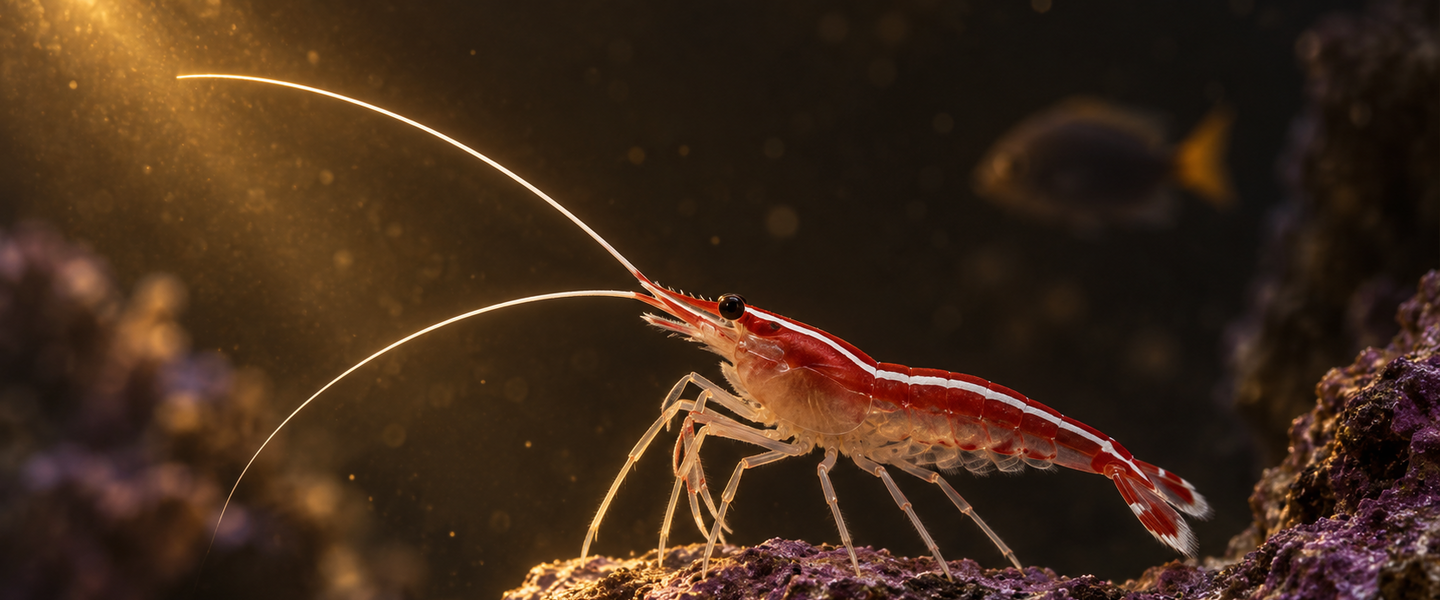
A snail eats algae and a hermit crab eats leftovers, and both are useful. Shrimp are something else. Each species on this list occupies a genuine ecological niche, which is why experienced keepers stock them deliberately rather than as an afterthought. Cleaner species in the genus Lysmata establish cleaning stations and remove parasites and dead tissue from fish. Peppermint shrimp hunt aiptasia, the weedy pest anemone that arrives on live rock and spreads until it stings your corals. Coral banded shrimp eat bristleworms. Pistol shrimp excavate and constantly rework the sand bed, which keeps anaerobic pockets from forming. That’s four real maintenance problems solved by animals that also happen to be beautiful.
There’s a second, quieter reason to keep them. Reef aquarium shrimp are the most parameter-sensitive animals most reef keepers will ever own — more sensitive than fish, and in some ways more sensitive than corals. They react to copper, to salinity swings, and to unstable water long before anything else in the tank shows symptoms. A healthy shrimp out grazing in the open is a live readout that your chemistry is holding. When one starts hiding, refusing food, or failing to molt cleanly, it is telling you something is wrong that your test kit hasn’t caught up to yet. That early-warning function alone justifies the space.
One term needs defining before the roster. “Reef safe” as applied to reef aquarium shrimp means the animal will not eat your corals — and by that standard nearly every shrimp below qualifies. It does not mean the animal is safe for every tankmate. A coral banded shrimp is reef safe and will still hunt down and kill every other shrimp you own. Read each entry for what it does to its neighbors, not just to your corals.
1. Scarlet skunk cleaner shrimp (Lysmata amboinensis)
If you only ever keep one of the reef aquarium shrimp on this list, keep this one. The scarlet skunk cleaner grows to about two inches, wears two candy-red stripes down a golden body, and carries a pair of white antennae nearly as long as it is. It picks a prominent rock, sets up shop, and waves those antennae like neon signage until fish come to be serviced. Tangs, wrasses, angels and clownfish learn the station within days. Saltwater Aquarium Blog calls it the single most useful invertebrate you can put in a reef tank, and after watching a hospital-worthy clownfish get worked over for ten minutes and swim off looking better, it’s hard to argue.
Care at a glance: adult size around 2 inches; absolute minimum 10 gallons, but a well-established 30-gallon tank is the realistic recommendation for one or a group; temperature 76–78°F, with tolerance from 72–82°F; specific gravity 1.023–1.025; pH 8.1–8.4. It needs live rock with caves and overhangs to molt in safely. It is completely peaceful, poses no threat to corals or other invertebrates, and — because the species is a protandric hermaphrodite — any two individuals will eventually pair up. The only complaint worth registering is that an underfed cleaner will help itself to food you meant for your corals.
2. Peppermint shrimp (Lysmata wurdemanni)
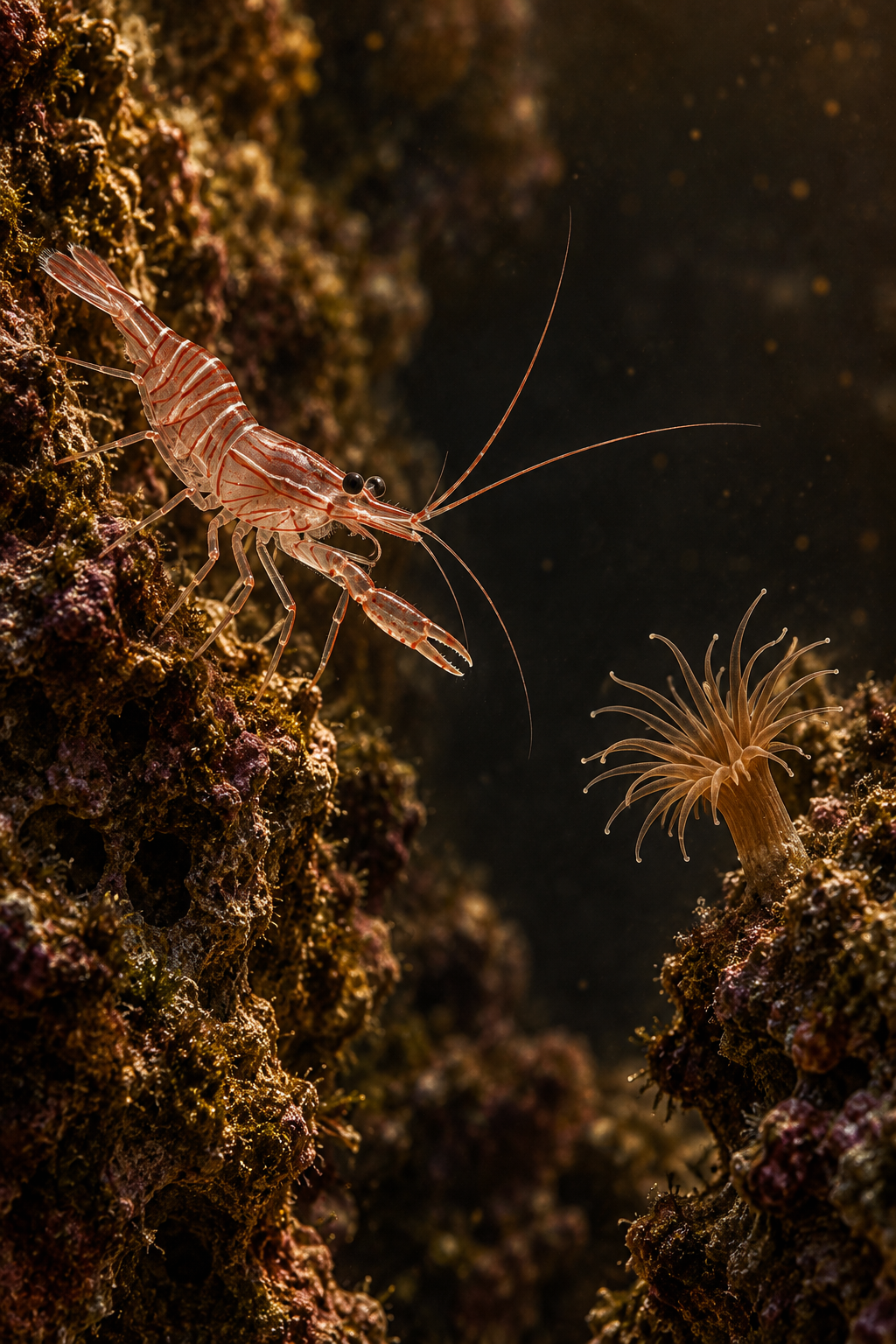
Most people buy peppermint shrimp for one reason: aiptasia. These small translucent-pink shrimp are natural predators of the pest anemone, and a couple of them turned loose in a tank with a light infestation will often clear it in a few weeks with no chemicals, no syringes, and no scorched rock. AlgaeBarn makes the case well, and it’s the cheapest aiptasia control on the market. They also scavenge constantly and will occasionally pick parasites and loose scales off sleeping fish.
Care at a glance: a single peppermint does fine in a 10-gallon nano; a group prefers 20 gallons or more with plenty of live rock caves and crevices to claim. Standard reef conditions apply — 76–80°F, pH around 8.2, specific gravity near 1.025, nitrate low, copper absolutely zero. In a young tank without much detritus, feed them two or three times a week or they’ll go looking for trouble. Two honest caveats: appetite for aiptasia varies by individual, so buy three rather than one and let the keen ones do the work; and the look-alike Lysmata californica gets sold as peppermint shrimp constantly, doesn’t touch aiptasia, and grows bigger and rougher. Buy from a shop that knows the difference.
3. Blood red fire shrimp (Lysmata debelius)
The fire shrimp is what happens when you take the cleaner shrimp’s job description and wrap it in the best color in the hobby: deep blood red, scattered white spots across the carapace, white antennae and white-tipped legs. It cleans fish like its skunk cousin, it keeps the same water parameters, and it costs noticeably more. The trade-off is temperament. Fire shrimp are shy in a way skunk cleaners are not. Drop one into a bright, busy tank with no deep overhangs and you will pay a premium for an animal you see twice a month.
Care at a glance: around 2 inches; 20 gallons and up, mature and stable, with genuinely deep caves — not decorative crevices, but shaded rock work it can retreat into completely. Temperature and salinity match the skunk cleaner exactly. It comes out more readily in tanks with calm fish and dimmer, more shadowed aquascapes, and it will learn to associate a feeding stick with dinner and start meeting you at the glass. If you want the color and can build the rock work, it’s worth it. If your scape is open and airy, buy the skunk instead.
4. Coral banded shrimp (Stenopus hispidus)
The coral banded is the one everybody sees at the fish store — bold red-and-white barber-pole banding, absurdly long white antennae, oversized claws it waves like a boxer. Of all the reef aquarium shrimp sold, it’s among the hardiest — cheap, eats anything, and a genuinely effective bristleworm predator, which matters if your rock has developed a population. Fishlore’s species profile is right that it’s one of the easiest marine shrimp to keep alive.
It is also the reason a lot of keepers lose their other shrimp. Coral banded shrimp are aggressive toward other shrimp species and will hunt them down even in large tanks. They have effectively zero tolerance for their own kind outside a bonded male-female pair, and fights end in death. They’ve been documented going after peppermint and sexy shrimp. Toward corals they’re technically safe — they’ll steal coral food and clamber over polyps, but they don’t eat them — and toward fish they’re mostly harmless, though very large predatory fish like triggers will eat them without hesitation.
Care at a glance: up to 3 inches of body with antennae far longer; 20+ gallons; standard reef parameters. The stocking rule is simple and non-negotiable: one coral banded shrimp per tank, or a bonded pair bought together, and no other shrimp species. If you want a shrimp community, this animal isn’t in it.
5. Sexy shrimp (Thor amboinensis)
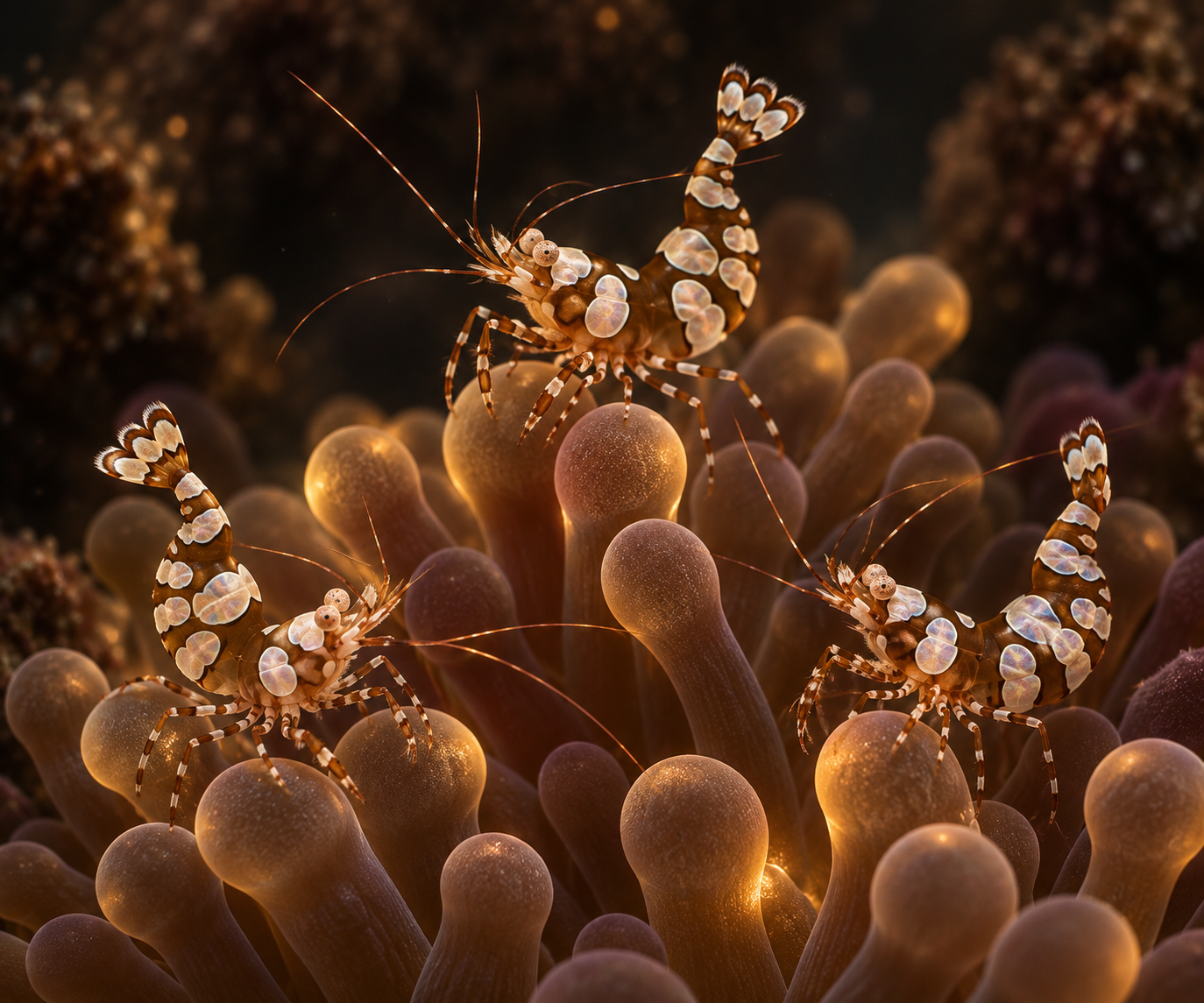
At roughly an inch fully grown, the sexy shrimp is the nano-reef answer to the whole category. They’re brown-gold with white saddles, they hold their abdomens curled up over their backs, and they wag constantly — which is where the name comes from and why a small group is more entertaining than fish twice their size. Keep three or more; solo animals are timid and you lose the group behavior entirely. They frequently host in bubble-tip anemones or perch on large-polyp corals the way clownfish do.
Care at a glance: about 1 inch; happy in a 10-gallon nano and up with stable parameters; standard reef temperature and salinity. They’re peaceful with cleaner and peppermint shrimp and must never be housed with coral banded or harlequin shrimp, which treat them as food. The one caution is corals: a group of sexy shrimp perching and picking on the same LPS colony can irritate it enough that the polyps stop opening. If you see a coral sulking, watch where the shrimp are sleeping. For a small tank, they’re the best value on this list — genuine reef aquarium shrimp behavior in a footprint that fits a cube.
6. Pistol shrimp and goby pairs (Alpheus spp.)
This is the most interesting animal relationship you can put in a home aquarium. A pistol shrimp is nearly blind and digs obsessively; a watchman or shrimp goby has excellent eyesight and no ability to build anything. So they partner. The shrimp excavates and maintains a burrow while the goby stands sentry at the entrance, one antenna resting on the fish’s flank so a flick of the tail sends the shrimp underground. Practical Fishkeeping covers the biology in depth, and watching it happen in your own tank does not get old.
The practical payoff is a sand bed that never goes stagnant. Constant burrowing aerates the substrate, prevents anaerobic pockets from forming, and drags detritus into circulation where your filtration can deal with it. The famous snapping noise — a cavitation bubble fired from the oversized claw — is loud enough to hear across a room and completely harmless to fish and corals.
Care at a glance: 20 gallons is the practical minimum, mostly for parameter stability, with 30+ preferred. The substrate requirement is the one people get wrong: the shrimp needs about four inches of depth, and fine sand alone collapses. Mix in coarser material — crushed shell, coral chips, small rubble — so the tunnels hold their shape. Critically, seat your rock work directly on the tank glass rather than on the sand, because a pistol shrimp will happily excavate under a rock pile and bring it down. Pair species matter less than most people think; many gobies will partner with many pistols, though buying an already-bonded pair removes the guesswork.
7. Harlequin shrimp (Hymenocera picta) — the specialist
Harlequin shrimp look painted: flat, petal-like claws in cream and purple-blue blotches, moving in slow deliberate steps. They’re also on this list with an asterisk, because they eat starfish and only starfish. Not frozen mysis, not pellets, not a “mostly starfish” diet — sea stars, exclusively, which they flip over and consume alive over several days. They do best in mated pairs that hunt cooperatively, and despite the grisly menu they’re shy, retiring animals that spend most of their time tucked into rock work.
Keeping one honestly means committing to a supply chain: a steady rotation of chocolate chip stars or a farmed Asterina population, ordered and paid for indefinitely. Plenty of keepers buy a harlequin on impulse, run out of stars in two months, and watch it slowly starve. It’s included here so that decision gets made with eyes open rather than at the checkout counter. If the supply and the ethics both sit right with you, it’s one of the most extraordinary animals in the trade. If not, buy a fire shrimp and admire harlequins in other people’s tanks.
The four rules that keep reef aquarium shrimp alive
Species choice is the fun part. These four rules are what actually decide whether reef aquarium shrimp survive their first month with you. Nearly every “my shrimp died for no reason” thread on every forum traces back to one of them.
Rule one: drip acclimate, and take longer than you think. Sixty to ninety minutes minimum, and two hours is better. Shrimp are far more sensitive to shifts in salinity and pH than fish are, and a shrimp that’s bag-acclimated and dropped straight into the display frequently dies within 48 hours from osmotic shock — often after appearing fine for a day, which is why the cause gets missed. A cheap drip acclimation kit costs less than the animal and removes the single most common cause of new-shrimp death. Kill the lights during acclimation and release the shrimp by hand into the rock work rather than pouring shipping water into your tank.
Rule two: no copper, ever. Copper-based medications are the standard treatment for marine ich and are lethal to every invertebrate you own. This is not a dosage question — there is no reef-safe copper level for shrimp. If a fish needs copper treatment, it goes into a separate hospital tank, and any equipment that has ever seen copper stays out of the display permanently. Copper also binds to rock and substrate and leaches back for years, which is why tanks with a copper history can kill shrimp long after the treatment ended.
Rule three: hold your salinity still. Target a specific gravity of 1.023–1.025 and, more importantly, keep it there. A sudden jump during a top-off makes shrimp cells shrink or swell faster than they can compensate, which can kill outright or force a fatal molt. Two habits fix this: top off evaporation with fresh RO/DI water only — salt does not evaporate, so topping with saltwater ratchets salinity upward — and measure with a proper refractometer rather than a swing-arm hydrometer. For anyone serious about shrimp, an automatic top-off system is the cheapest insurance in the hobby, because it makes stability the default instead of a chore you remember on good days.
Rule four: understand molting. Shrimp grow by shedding their exoskeleton, and the discarded shell is a perfect ghostly replica that has convinced thousands of keepers their shrimp just died. Leave it in the tank — they often eat it back for the minerals. A molting shrimp is soft, defenseless, and hiding; do not move rock, do not chase it, do not “check on it.” Stable calcium and alkalinity support clean molts, and if a shrimp gets stuck halfway through a shed, unstable parameters are almost always the reason. Targeted iodine dosing gets recommended a lot for molting and is genuinely contested; in a tank getting regular water changes with a quality salt mix, it isn’t necessary, and overdosing it causes more problems than it solves. As RateMyFishTank puts it, stability beats supplementation with marine invertebrates almost every time.
A stocking plan that actually works
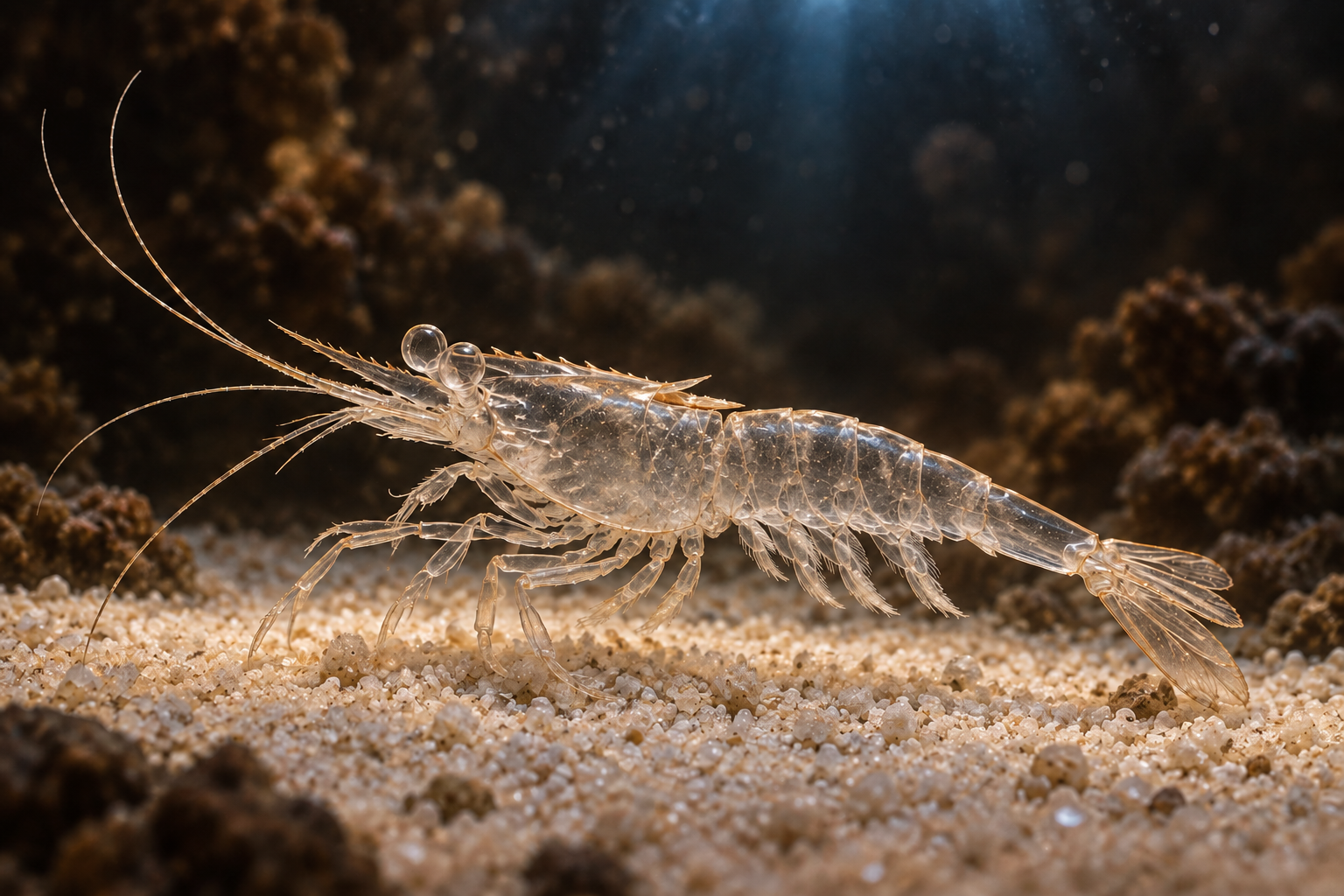
Compatibility is where most shrimp tanks come apart, and it’s almost always the coral banded. Here’s how to combine reef tank shrimp by tank size without setting up a fight.
Nano, 10–20 gallons. Pick one direction: a trio of sexy shrimp, or a single peppermint, or a single skunk cleaner. Not all three, and never a coral banded. If you’re building at this scale, our nano reef tank setup guide covers the stability problem that makes small volumes unforgiving, and the cube saltwater tank guide gets into aquascaping a small footprint so there’s actually somewhere for a shrimp to molt.
Mixed reef, 30–75 gallons. This is the sweet spot for a shrimp aquarium with real variety: one skunk cleaner, one to three peppermints, and optionally a pistol shrimp and goby pair working the sand. That combination covers parasite cleaning, aiptasia control, and substrate turnover with no overlap and no aggression. Add a trio of sexy shrimp if you have an anemone or a large LPS colony for them to claim. Stock your fish with the same care — our roundup of reef-safe fish that won’t harm corals flags which species also leave invertebrates alone, since a hawkfish or a large wrasse will eat small shrimp regardless of how well the shrimp get along with each other.
Any size, with a coral banded. It’s the only shrimp in the tank, or a bonded pair, and that’s the whole plan. Decide up front which experience you want.
Timing matters as much as combination. Add reef aquarium shrimp only after the tank has been running stably for several months — not just cycled, but through the ugly algae phase and into predictable weekly numbers. Introduce one species at a time and give it a couple of weeks before the next. If saltwater is new to you altogether, the saltwater aquarium setup guide walks the build from empty glass forward, and keepers coming over from freshwater will find the freshwater pet shrimp guide a useful comparison — cherry and amano shrimp share the copper sensitivity and the molting biology, just at a fraction of the price per mistake.
Feeding and long-term care
An established reef supplies a surprising amount of what reef aquarium shrimp need. Detritus, uneaten fish food, film on the rock, and the odd hitchhiking worm add up, and in a mature system a cleaner shrimp can look plump on scavenging alone. That said, “surprising amount” isn’t “enough,” and a hungry shrimp is a shrimp that starts raiding corals for their food. Two or three targeted feedings a week is the right rhythm: frozen mysis shrimp is the standard, supplemented with sinking pellets and the occasional scrap of nori.
Shy species need help getting their share. A fire shrimp will let bolder tankmates take everything if you broadcast-feed, so deliver food directly to its cave with a feeding stick. Within a few weeks most shrimp learn what the stick means and will come out to meet it, which is both practical and one of the small pleasures of keeping them.
Watch for the warning signs. A shrimp sitting listless in the open on bare sand is not behaving normally. Missing legs or antennae mean aggression — check whether something in the tank is hunting. A cloudy, opaque body, or a shed that comes off incomplete, points at water chemistry. When any of that shows up, check salinity, temperature, and any possible copper source before you reach for a treatment, because in nine cases out of ten one of those three is the answer.
Quick comparison: the seven species
| Species | Size | Min. tank | Job | Watch out for |
|---|---|---|---|---|
| Scarlet skunk cleaner | 2 in | 10 gal (30 recommended) | Cleans parasites off fish | Steals coral food if underfed |
| Peppermint | 1.5–2 in | 10 gal (20+ for groups) | Eats aiptasia, scavenges | Look-alike species sold in error |
| Blood red fire | 2 in | 20 gal | Cleans fish; showpiece | Very shy; needs deep caves |
| Coral banded | 3 in + antennae | 20 gal | Bristleworm control | Kills other shrimp |
| Sexy shrimp | 1 in | 10 gal | Nano showpiece; group behavior | Can irritate LPS corals |
| Pistol (with goby) | 1.5–2 in | 20 gal (30+ better) | Aerates and turns the sand bed | Undermines rock set on sand |
| Harlequin | 2 in | 20 gal | None — display specialist | Eats live starfish exclusively |
So which one should you buy?
If this is your first saltwater invertebrate and the tank is thirty gallons or more, buy a scarlet skunk cleaner. It’s hardy, it’s out where you can see it, it does the most visibly useful job in the tank, and it will teach you how a healthy invertebrate is supposed to behave. If you’re fighting aiptasia, buy three peppermints instead and let them earn their keep first. If your tank is a ten-gallon cube, buy three sexy shrimp and enjoy the only shrimp on the list that looks properly at home at that scale.
What ties every one of these animals together is that they reward stability over effort. You cannot fuss a shrimp into health — you can only build conditions that don’t swing and then leave them alone. Get the acclimation right, keep copper out of the building, hold your salinity flat, and let them molt in peace, and reef aquarium shrimp will outlive most of the fish you buy alongside them. Newer keepers still assembling a stocking list will find the beginner saltwater fish roundup a good companion to this one, since choosing fish that ignore invertebrates is half of keeping invertebrates successfully.