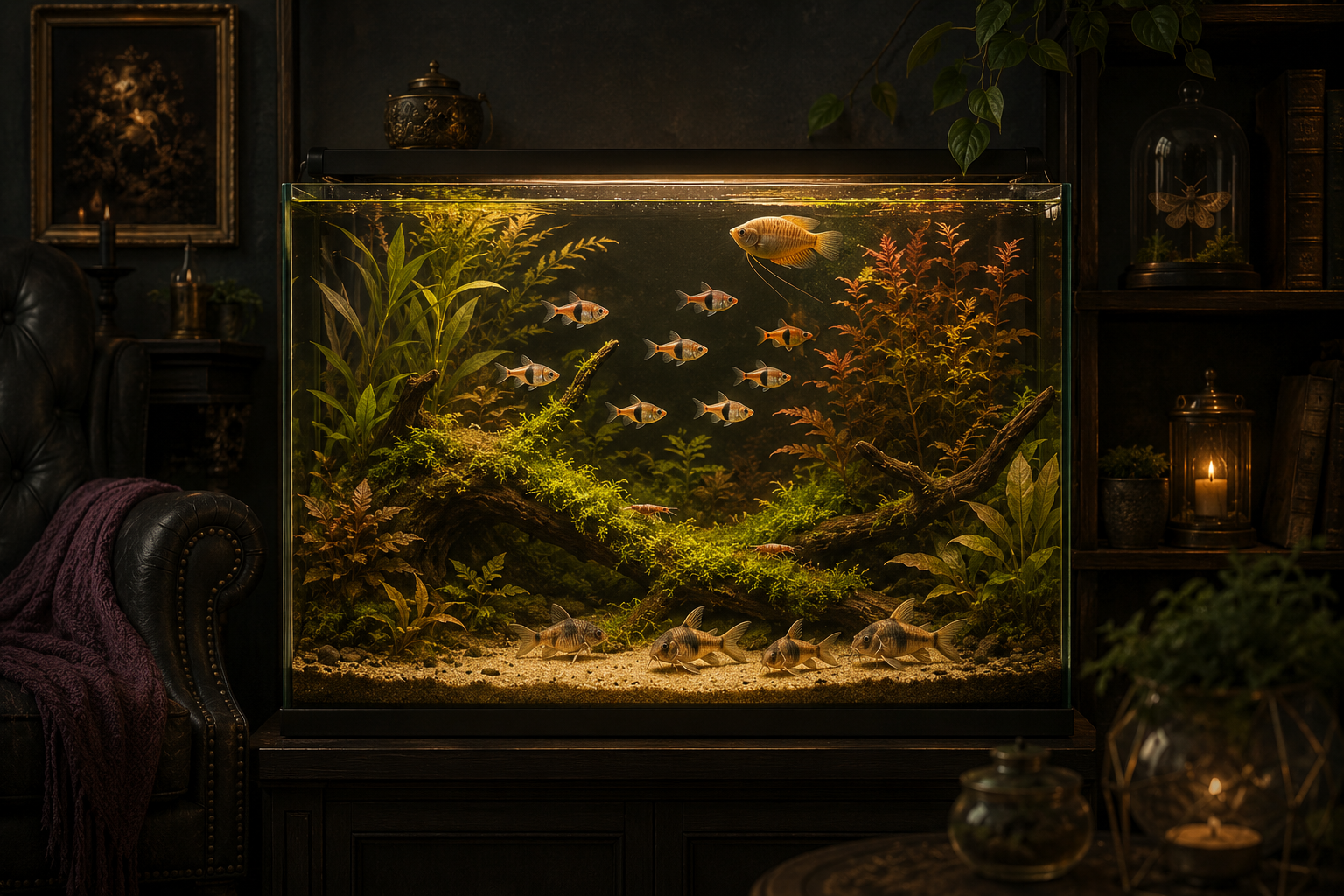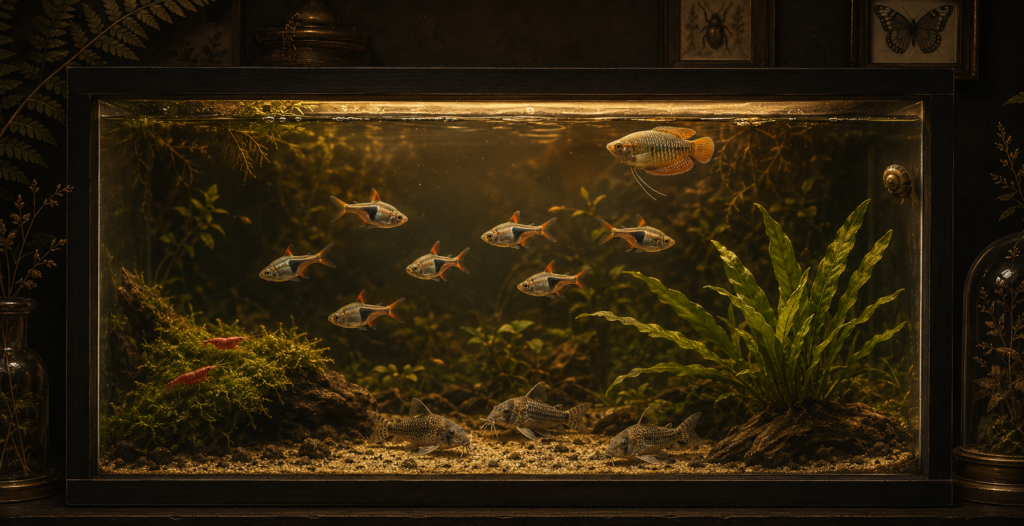
Most stocking advice treats an aquarium like a fish list. But the tanks that actually stay beautiful — the ones that don’t grow algae carpets or crash every few months — aren’t lists at all. They’re little economies, where every resident has a job. The best way to choose aquarium species isn’t to ask “which ones are pretty?” but “which role is still unfilled?” This guide walks through the five roles of a balanced tank — the schoolers, the centerpiece, the bottom crew, the invertebrate cleanup shift, and the plants — with the best aquarium species for each job and three complete stocking plans to copy.
ItsyBitsyPets is reader-supported. As an Amazon
Associate we earn from qualifying purchases — at no extra cost to you. See our
affiliate
disclosure.
How aquarium species fit together: think in roles
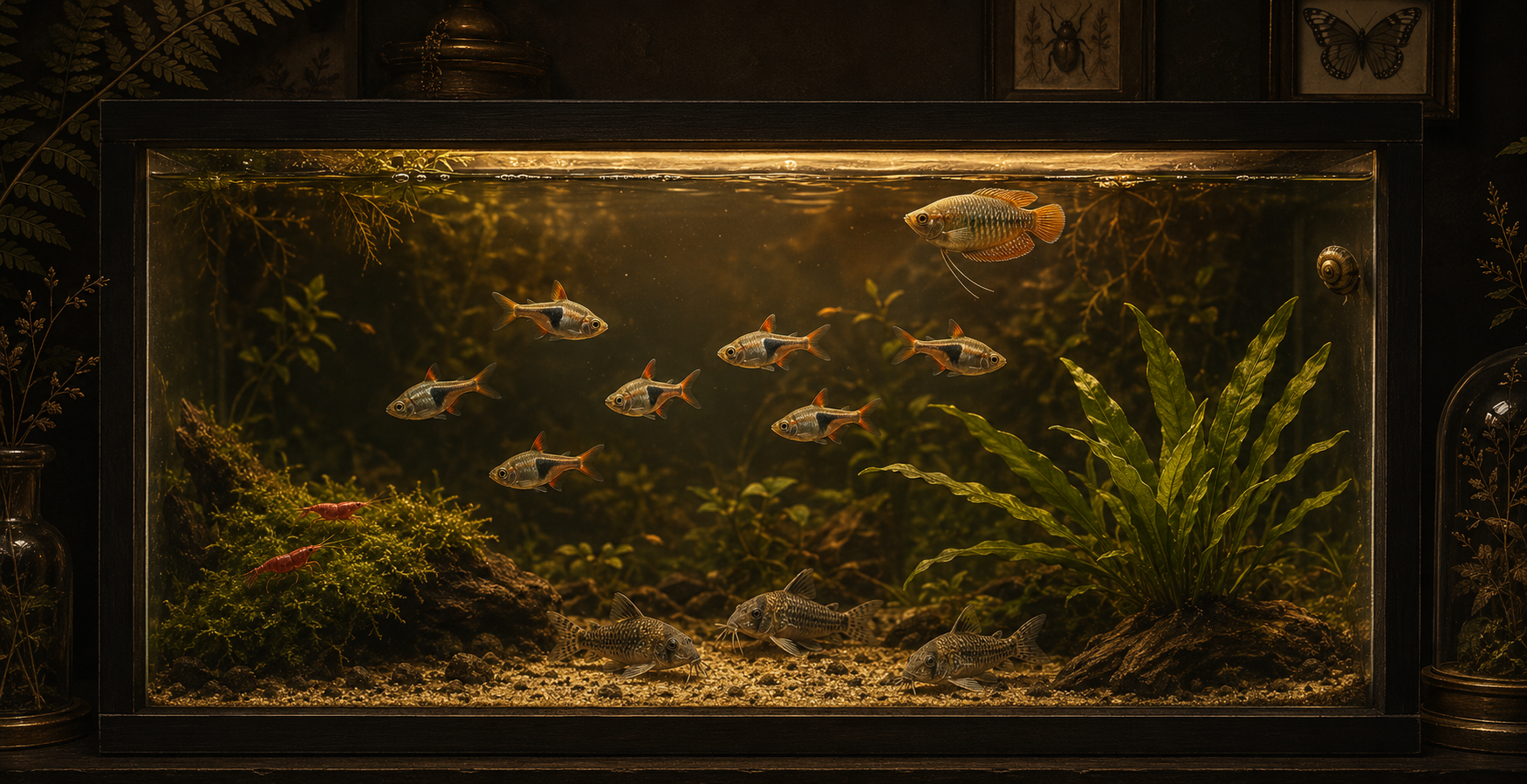
A balanced tank almost always has the same skeleton: one schooling group for movement and color, an optional centerpiece fish for personality, a bottom crew to work the substrate, snails or shrimp on cleanup, and live plants doing quiet chemistry in the background. Five roles. Fill each one once and you get a tank where every level has life and every leftover has a taker; fill one role three times and skip two others, and you get the classic beginner tank — crowded in the middle, dirty at the bottom, green on the glass.
Underneath all five roles runs the machinery: the nitrogen cycle. Everything that eats also excretes, and waste becomes ammonia. Beneficial bacteria convert that ammonia into nitrite and then nitrate — and as Texas A&M AgriLife Extension explains, ammonia and nitrite are toxic while nitrate is the far milder end product, removed by water changes and absorbed by plants. Those bacteria take weeks to establish in a new tank — Oklahoma State Extension covers the same nitrification biology that runs every aquarium filter. Our aquarium startup guide walks through cycling step by step; every role below assumes it’s done.
Schooling species: the moving color
Schoolers are the reason anyone stops in front of a tank. They occupy the middle water as one flickering organism, and they’re the emotional core of most freshwater aquarium species plans — so choose them first and size everything else around them.
Neon tetra — the icon. An inch and a half of electric blue and red, ten or more strong, at 72–78°F in a fifteen-plus gallon tank. Ember tetra — the nano version: under an inch of glowing orange, happy in a ten gallon at 73–84°F, perfect over a shrimp colony. Harlequin rasbora — the diplomat: hardier than a neon, calm enough to live with a betta, schooling tight at eight or more. White cloud mountain minnow — the cold specialist: 60–72°F, no heater, and never mixed into a tropical tank where warm water quietly shortens its life.
Whichever you pick, buy the full school. Six is the floor for minnows and rasboras, ten for the tetras — under-numbered schoolers hide, nip, and fade, and no other species choice fixes it. We profile the tiniest options in our micro fish guide.
Centerpiece species: the personality
The centerpiece is the single fish your eye returns to — bigger presence, slower cruise, an actual personality. It’s also the role beginners overfill: one centerpiece per tank is the rule, because two personalities compete and one of them loses.
The honey gourami is the safest choice in the hobby: two inches of soft amber at 74–82°F, drifting the upper water above a school it completely ignores. The betta is the famous one — 76–81°F, heater mandatory, and community life strictly conditional: calm, short-finned tankmates, no rivals, and an exit plan. In a five gallon he simply reigns alone, which suits him fine.
Bottom-dwelling species: the substrate crew
The bottom third of the tank is a separate neighborhood, and leaving it empty wastes both space and food — everything the mid-water fish miss lands there.
Corydoras catfish are the classic hire: sociable armored catfish in groups of six or more, sifting sand at 72–78°F — pygmy cories for ten gallons, bronze for twenty. Keep them on soft sand; gravel wears down the barbels they hunt with. Kuhli loaches are the night shift — four-inch striped noodles that spend the day under driftwood and emerge after lights-out, six or more in a twenty gallon at 74–80°F. The bristlenose pleco is the glass-and-wood grazer: four to five inches full grown (never confuse it with the eighteen-inch common pleco), needing driftwood to rasp and sinking algae wafers as real food, not leftovers.
Aquarium snails species: the cleanup shift
Snails are the most underrated aquarium species — a slow, silent maintenance department that works while you sleep. The trick is knowing which ones stay hired help and which ones become the infestation.
The nerite snail is the professional. Aquarium Co-Op rates it the best algae eater in the hobby, and its superpower is restraint: nerite larvae need brackish water, so it cannot breed in your freshwater tank. One snail per five to ten gallons, 65–85°F, and your glass stays clean without a population problem.
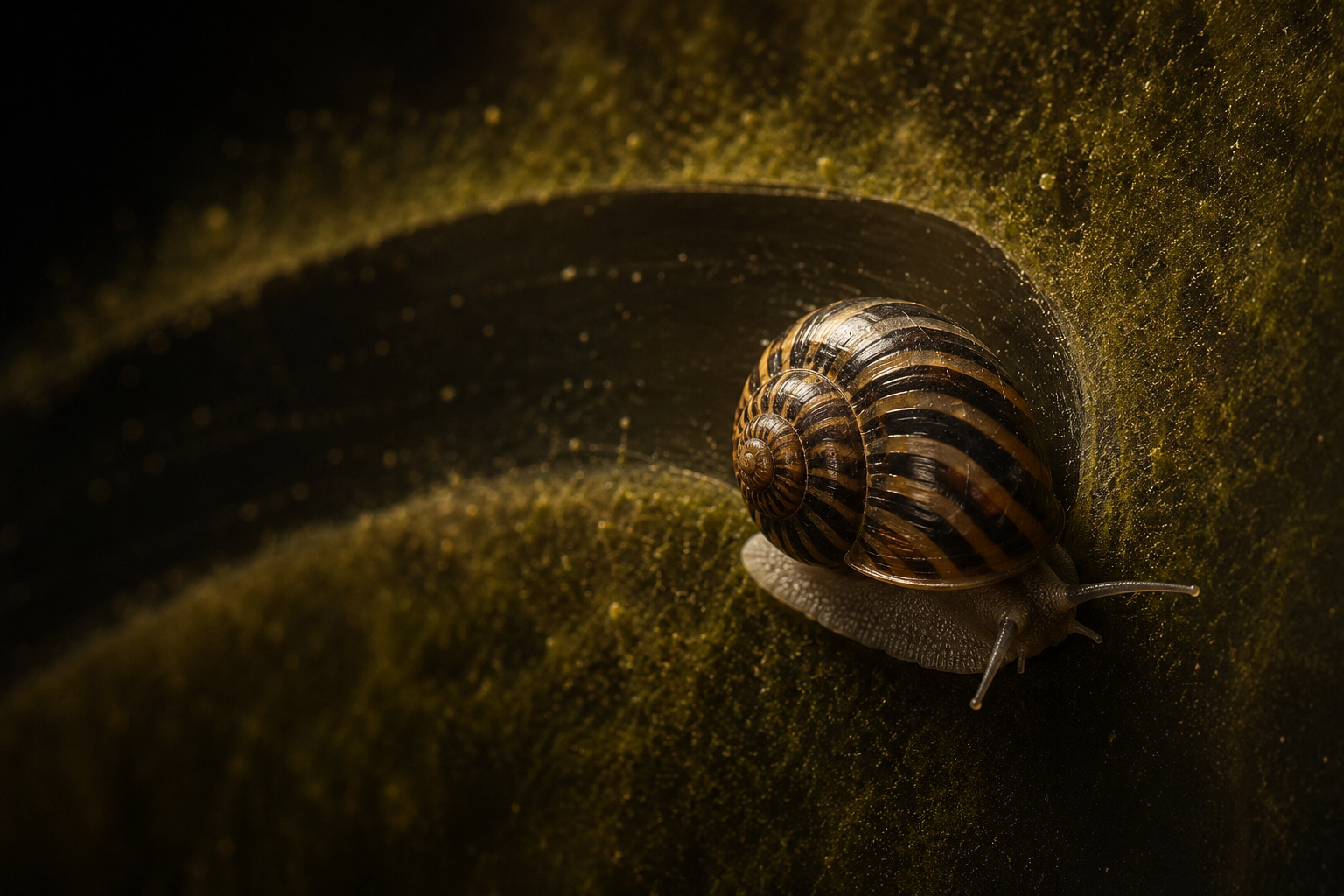
The mystery snail is the pet. Two inches of golden shell cruising the glass at 68–82°F, with a face and an appetite. It wants hard, calcium-rich water — shell erosion means low calcium or acidic water, fixed with crushed coral in the substrate or a cuttlebone or calcium supplement in the tank.
Ramshorn and pond snails are the fine print: prolific breeders that arrive uninvited on plants and scale their population to your overfeeding. A few are harmless workers; a bloom is a message about how much food is hitting the substrate. Our freshwater snail guide compares all the species, and the golden rule for every one of them: copper kills. Many fish medications and some fertilizers contain copper compounds that are lethal to snails and shrimp — read every label before it goes in the water.
Shrimp: the micro workforce
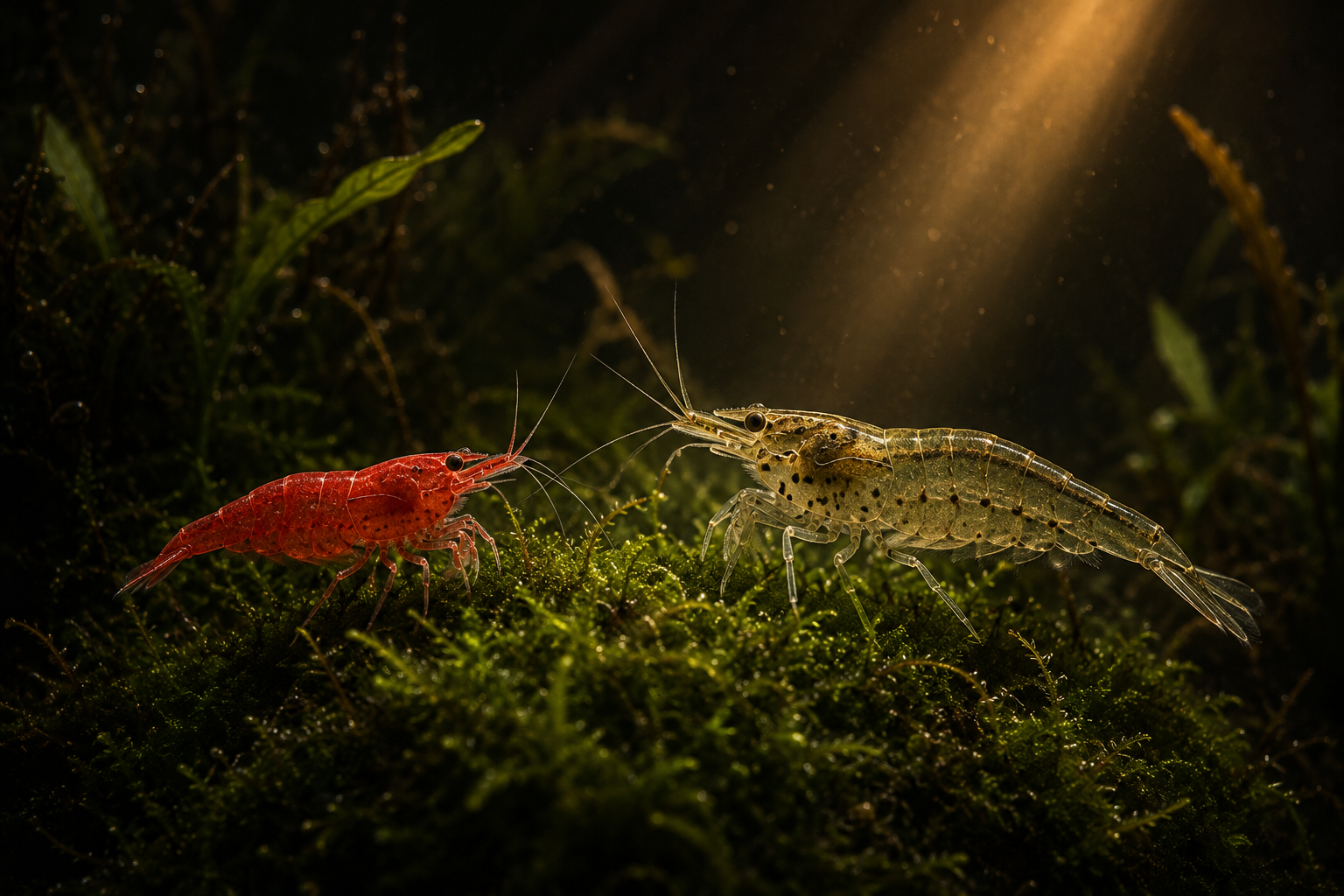
Shrimp do what no fish can: they work surfaces leaf by leaf, grain by grain. Cherry shrimp are the colony builders — bright red, happy at a stable 65–80°F, breeding readily in freshwater until fifty shrimp patrol the tank you bought ten for. Their bioload is close to a rounding error, and like snails they need calcium to molt cleanly. Amano shrimp are the specialists: twice the size, the best hair-algae eater in the hobby, and incapable of breeding in freshwater — the workforce stays the size you chose. They’re more sensitive to sudden parameter swings, so drip-acclimate them and keep the water boring.
Feed a colony a dedicated shrimp food a few times a week, and pick tankmates from the smallest schoolers — anything with a mouth bigger than a shrimp will use it. Our pet shrimp guide ranks every beginner species and their tankmate math.
Aquarium plants species: the living filter
Plants are aquarium species too — the only ones that remove nitrogen instead of adding it. A planted tank runs cleaner at the same stocking level: plants absorb ammonia and nitrate, put oxygen into the water, starve algae by outcompeting it for nutrients, and give shy fish and molting shrimp somewhere to hide. Four species do most of the work in beginner tanks.
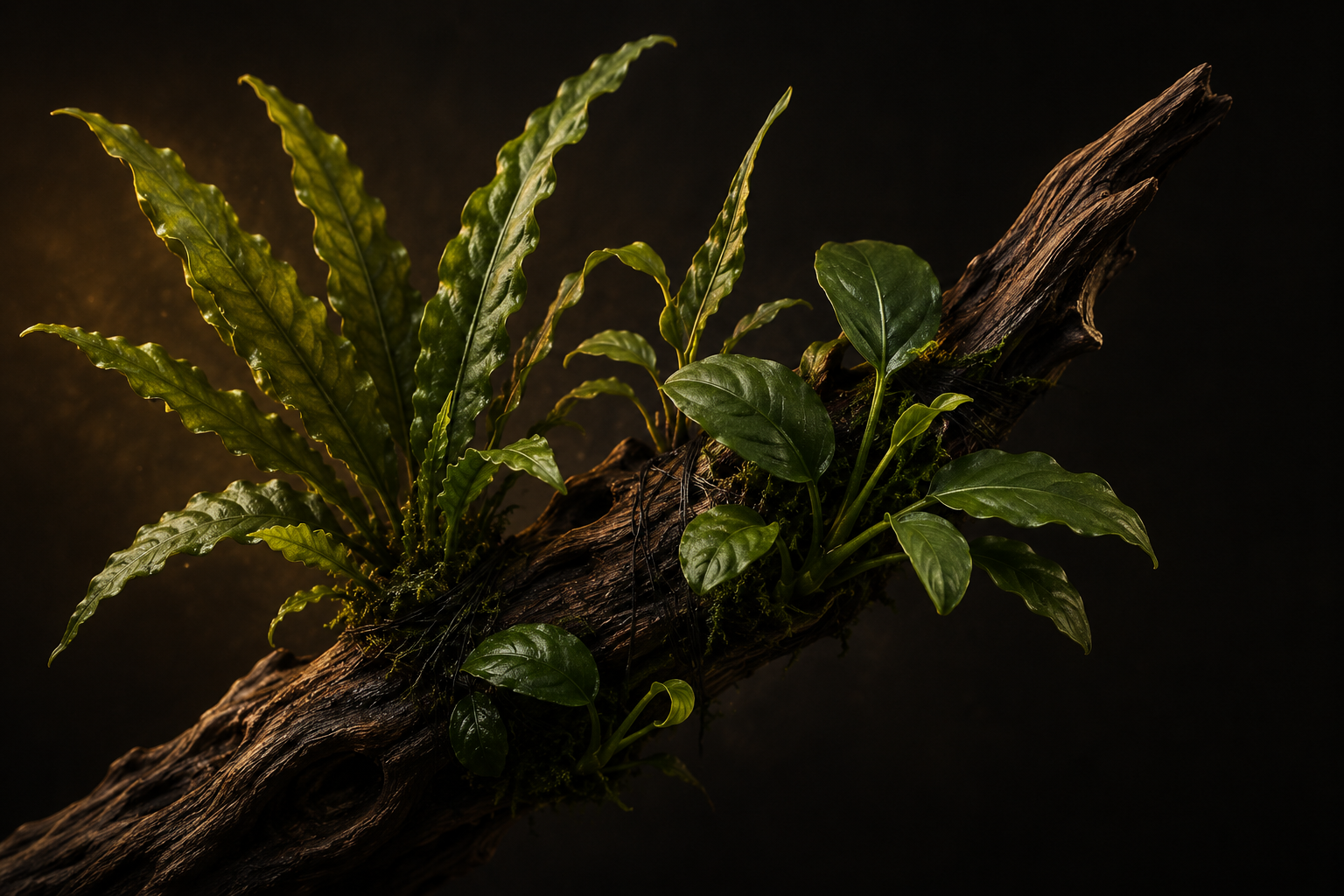
Java fern is the famous survivor. Petco’s care sheet calls it one of the easiest plants in the hobby: low light, slow growth, almost no maintenance. The one rule is the rhizome — that dark root-stem must never be buried, or it rots. Tie it to rock or driftwood and let it grip. Anubias plays by the same rhizome rule and is even harder to kill, with thick leaves that algae-grazing snails keep polished.
Anacharis is the workhorse: a fast-growing stem plant that drinks nitrates and ammonia faster than almost anything else and starves algae through sheer speed. Plant it, float it, forget it — it tolerates nearly any light and temperature a community tank runs. Cryptocoryne is the foreground carpet-builder: a root feeder that wants root tabs under the substrate, and a drama queen about moving — it melts its leaves after transplant, then regrows them within weeks. Don’t panic; that’s the species working as designed. Browse our aquatic plants section for the full green lineup.
Saltwater aquarium species: the same roles, higher stakes
Marine tanks follow the same role logic with a bigger budget line. The beginner trio of saltwater aquarium species — the ocellaris clownfish, the royal gramma, and the firefish goby — covers color and personality, while the marine cleanup crew swaps in trochus and astraea snails plus a cleaner shrimp for the freshwater workforce. Everything costs more, and the stability demands are stricter: saltwater punishes the shortcuts freshwater forgives. Start with our saltwater fish for beginners guide before buying the first grain of marine salt.
Three balanced stocking plans
The five gallon: one betta, warm and alone — or skip fish entirely and run cherry shrimp with a nerite snail and java fern, a nearly silent ecosystem that maintains itself. Not both; five gallons is a one-role tank.
The ten gallon: ten ember tetras mid-water, six pygmy corydoras on sand, one nerite on glass duty, java fern and anacharis doing chemistry. Every role filled, nobody threatening anybody, total bioload well inside the tank’s budget.
The twenty gallon: ten harlequin rasboras, one honey gourami as centerpiece, six bronze corydoras below, cherry shrimp and a nerite on cleanup, planted with anubias, crypts, and anacharis. This is the full five-role system — the tank that looks like the store display, built on purpose instead of by accident.
Scaling the formula up: in a forty gallon and beyond, the roles don’t multiply — they deepen. Run a bigger school of the same species rather than two rival schools, promote the centerpiece to something with real presence like a single angelfish, widen the bottom crew, and keep exactly one grazer. The order of introduction matters as much as the list: plants first, then the bottom crew and cleanup team once the tank has some algae and mulm to work, then the school, and the centerpiece last — the boss arrives after the staff already runs the place, which keeps territorial instincts pointed at nothing.
Rules that keep the system healthy
Cycle before stocking. The nitrifying bacteria take four to eight weeks to establish; a liquid test kit tells you when ammonia and nitrite hold at zero and the tank is ready for its first residents.
No copper where invertebrates live. The medication that saves your fish can exterminate your snails and shrimp in the same dose. Check every bottle — treatments, fertilizers, even some foods — before it touches an invert tank.
Feed the calcium budget. Every shell and every molt is built from calcium. In soft water, crushed coral or a cuttlebone keeps snail shells solid and shrimp molts clean — cheap insurance for the whole cleanup department.
Stock in small batches. The bacteria colony sizes itself to the current waste load, so add one role at a time, a couple of weeks apart. The plants can all go in on day one — they only ever help.
Role-stuffing: the mistakes that unbalance a tank
Once you see the roles, you’ll also see the classic ways beginners break them — usually by hiring three people for one job and nobody for the others.
Too many algae eaters. A bristlenose, an amano squad, and a fleet of nerites sounds like a spotless tank; what it actually produces is a starving one. Algae is a finite crop, and once the grazers clear it, they compete for scraps. One grazer species per tank, chosen for the algae type you actually have, with wafers to cover the gap — that’s the whole cleanup budget.
Two centerpieces. A betta and a gourami in the same twenty gallon isn’t twice the personality — it’s a slow-motion territorial dispute where the loser spends its life behind the filter. One personality per tank; let the school provide the motion.
Treating cleanup crew as a filter. Snails and shrimp relocate waste — they eat leftovers and algae and excrete their own share of ammonia right back into the system. They make a tank tidier, not cleaner: the nitrogen still only leaves through water changes and plant growth. A cleanup crew bought to rescue a dirty tank treats the symptom while the cause — almost always overfeeding — keeps running.
Skipping the plants. Plants look optional and aren’t. They’re the only role that removes nitrogen instead of producing it, and the difference between a planted and a bare tank shows up in every water test you’ll ever run. Even two java ferns and a bunch of anacharis shift the chemistry in your favor.
The weekly routine that keeps every role working
A balanced multi-species tank asks for about fifteen minutes a week. Change 25–30% of the water with dechlorinated, temperature-matched replacement, and vacuum the open patches of substrate while you drain. Test ammonia, nitrite, and nitrate — the first two should read zero forever after cycling, and creeping nitrate tells you when to change more water or grow more anacharis. Trim the fast plants, wipe the glass the nerite hasn’t reached, and count your residents while you’re there; a missing shrimp or a hiding gourami is tomorrow’s problem caught today.
Once a month, rinse the filter media — always in the bucket of water you just removed, never under the tap, because chlorinated water kills the bacteria colony you spent six weeks growing. That’s the entire maintenance bill for a tank where every role is filled. The unbalanced version of the same tank costs hours of algae scrubbing and emergency water changes, which is the quiet argument for stocking by role in the first place.
Aquarium species by role: quick reference
| Role | Species | Key stat | Job |
|---|---|---|---|
| Schooler | Neon tetra | 10+, 72–78°F | Mid-water color |
| Schooler | Ember tetra | 10+, 10 gal OK | Nano mid-water |
| Schooler | Harlequin rasbora | 8+, betta-safe | Hardy mid-water |
| Centerpiece | Honey gourami | 2 in, peaceful | Surface personality |
| Centerpiece | Betta | 76–81°F, solo-ish | Showpiece |
| Bottom crew | Corydoras | 6+, sand | Substrate sifting |
| Bottom crew | Kuhli loach | 6+, nocturnal | Night shift |
| Cleanup | Nerite snail | No freshwater breeding | Algae on glass |
| Cleanup | Cherry shrimp | Breeding colony | Detail work |
| Cleanup | Amano shrimp | No freshwater breeding | Hair algae |
| Plant | Java fern / anubias | Rhizome — never bury | Low-light structure |
| Plant | Anacharis | Fast growth | Nitrate sponge |
| Plant | Cryptocoryne | Root tabs | Foreground |
The verdict: hire a team, not a crowd
Choose aquarium species the way you’d staff a small shop: one team per job, no duplicate managers, and someone responsible for every corner of the place. A school for the middle, a personality up top, a crew on the sand, snails and shrimp on detail, plants running the chemistry — that’s the whole formula, and it scales from a desktop five gallon to a living-room showpiece.
Start with the plan that fits your tank size, add the residents in stages, and let the system prove itself slowly. The aquarium species you choose this carefully won’t just survive together — they’ll do their jobs so well you’ll spend your maintenance time watching instead of scrubbing.