
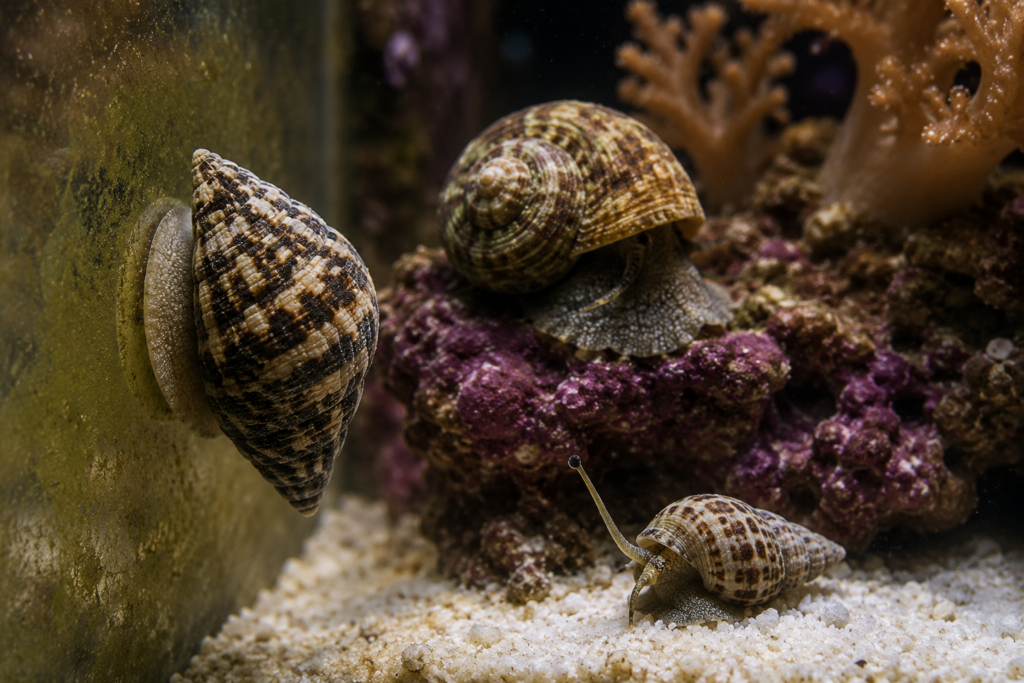
Every healthy reef aquarium employs a janitorial staff, and most of it works the night shift. Reef tank snails are the backbone of that crew: quiet, cheap, and relentless, they graze the film algae off your glass, sift leftovers out of your sand, and mop up the detritus that would otherwise feed every nuisance algae outbreak you’re trying to avoid. But here is what the “cleanup crew packages” rarely tell you — snails are not interchangeable. Each species eats a different thing in a different place, and a crew built from one species leaves most of the tank uncleaned. This guide covers the seven species worth keeping, what job each one actually does, and how many your tank really needs.
ItsyBitsyPets is reader-supported. As an Amazon Associate we earn from qualifying purchases — at no extra cost to you. See our affiliate disclosure.
If you are still planning your first marine tank, start with our guide to saltwater fish for beginners — snails join the story a few weeks after the tank starts growing its first algae. Already running a reef? Then you have seen the film on the glass, and you are exactly who this crew works for.
What reef tank snails actually do
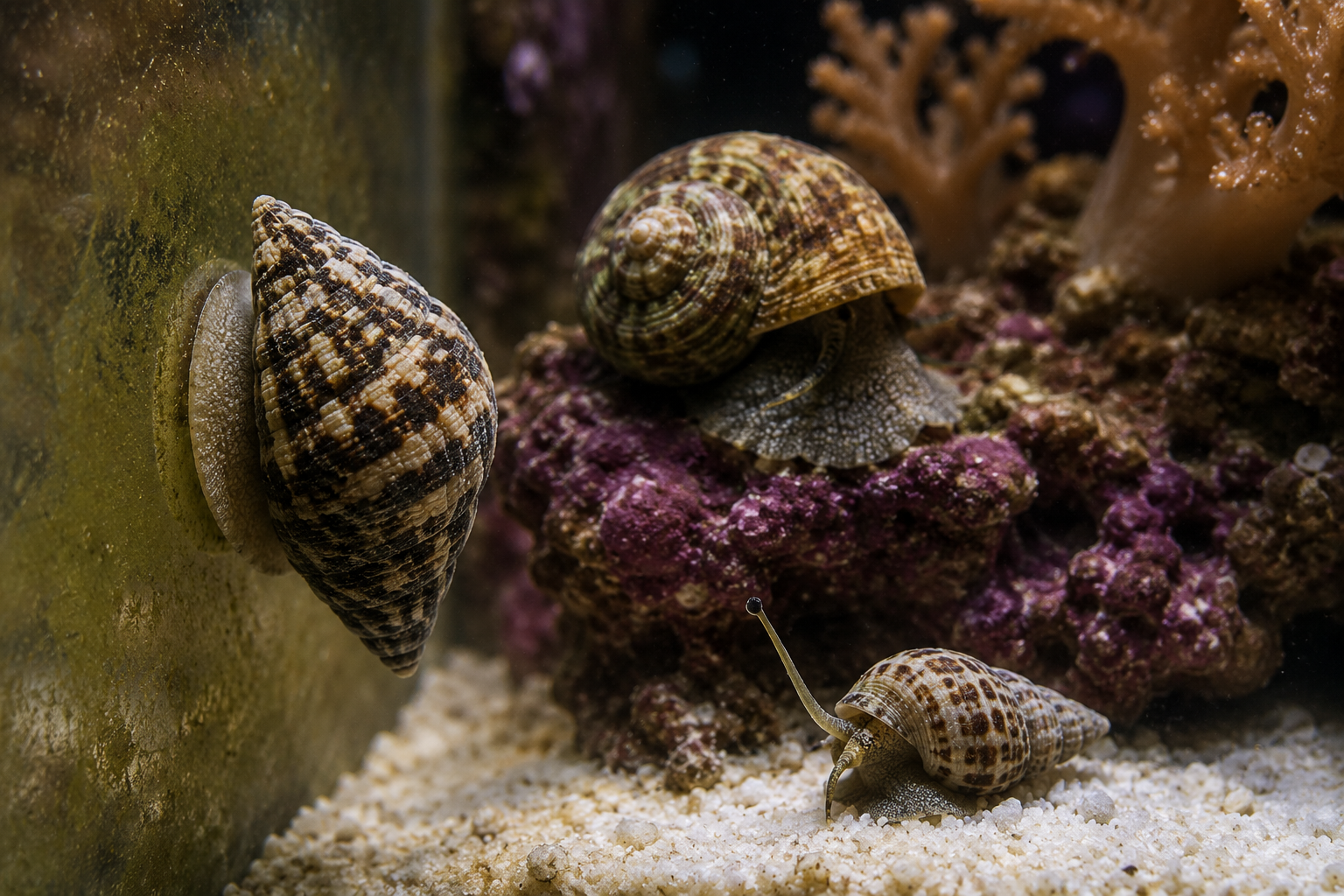
A reef tank produces waste constantly: fish food that sinks uneaten, fish waste breaking down into detritus, and the daily film of diatoms and green algae that grows on every lit surface. Left alone, all of it becomes fertilizer for the ugly stuff — hair algae, cyanobacteria, the brown dust that coats new tanks. Snails intercept that pipeline. As the Petco marine snail caresheet puts it, marine snails are the aquarium’s little cleaning service — and there is a species to feed on just about every kind of algae, plus scavengers that specialize in detritus itself.
The word to hold onto is niche. Trochus and astraea graze film off hard surfaces. Ceriths work the cracks and the sand surface. Nassarius live buried in the sandbed and eat no algae at all — they exist to find leftover food before it rots. Turbos are heavy machinery for heavy algae. Because each species occupies a different feeding niche, they stack together without competing, which is exactly why a mixed crew dramatically outperforms a big bag of any single snail.
How many reef tank snails do you need?
Forget the old “one snail per gallon” rule — it dates from an era of bare tanks and it mostly produces starved snails. Modern stocking advice, like the guidance from Top Shelf Aquatics’ cleanup crew guide, ties the crew to the tank’s actual problems: for glass-and-rock grazers such as trochus, astraea, and cerith, start with roughly one snail per two to three gallons; for sandbed nassarius, plan about one per three to four gallons, scaled to how heavily you feed rather than how much algae you see.
Err on the low side and add later. A cleanup crew that outgrows its food supply doesn’t politely shrink — it starves, and every snail that dies unnoticed behind the rockwork becomes an ammonia spike in a closed system. A slightly undersized crew that you top up after a month is the professional move. Watch the glass: if film returns within a day or two of scraping, the grazers are keeping up; if it never appears at all, you may already have more mouths than the tank can feed.
The 7 best reef tank snails
Organized by the job they do, because that is how you should build the crew.
1. Trochus snail — the all-rounder
If you buy only one snail for a reef, buy trochus. These conical, often banded grazers work glass, rock, and even equipment, mowing film algae and diatoms with a work ethic that puts the rest of the crew to shame. They are hardy, they tolerate the trip home better than most marine inverts, and — the killer feature — a flipped trochus can right itself, which quietly makes it the lowest-maintenance snail in the hobby. The Bulk Reef Supply trochus guide recommends them for tanks of roughly twenty gallons and up, at standard reef conditions.
Trochus also breed readily in captivity — mature tanks often end up with a slow drip of pinhead-sized babies grazing the back glass. Care stats: about 1–3 inches; 20 gallons and up; 75–80°F; peaceful; grazes film algae and diatoms on hard surfaces.
2. Cerith snail — the detail worker
Ceriths are the small, spiral-shelled multitaskers of the crew. At around an inch long they reach the tight spaces bigger snails can’t — between rocks, along the substrate line, into equipment crevices — and they split their diet between algae film and the detritus they find by burrowing into the top layer of sand. That double duty makes them one of the most versatile snails you can buy, and their size makes them the backbone grazer for nano reefs of five or ten gallons where a turbo would be absurd. Care stats: about 1 inch; 5 gallons and up; 75–81°F; peaceful; eats film algae, diatoms, and detritus on glass, rock, and sand.
3. Nassarius snail — the undertaker
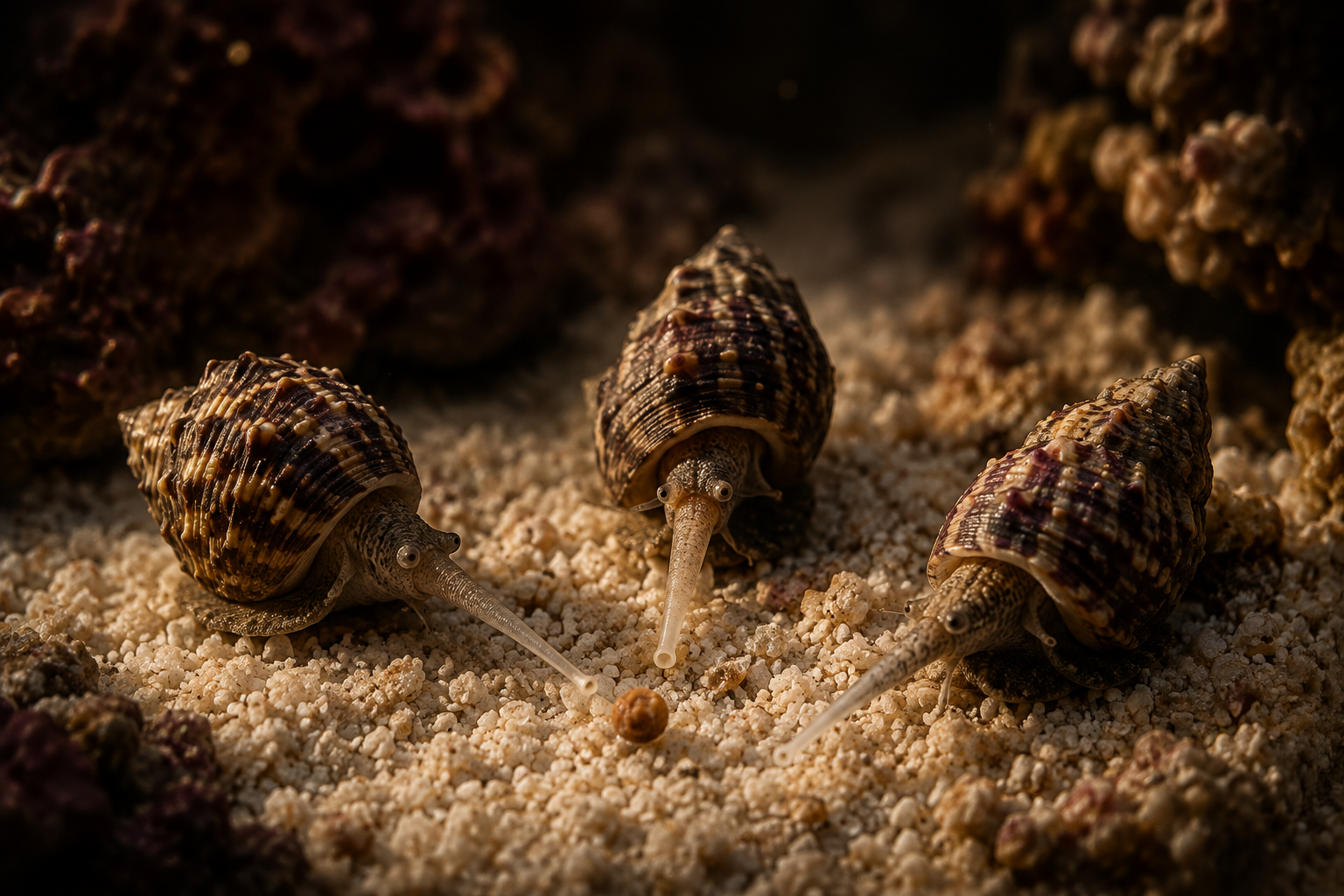
Nassarius snails eat no algae whatsoever, and they still belong in nearly every reef. They live buried in the sandbed with only a periscope siphon exposed, waiting. Drop food in the tank and the sand erupts — nassarius have an extraordinary sense of smell and surface within seconds, racing toward anything edible. Their job is finding the flake that drifted behind a rock and the pellet your wrasse missed, before either one decomposes into nitrate. As a bonus, their constant tunneling keeps the sandbed loose and aerated.
Stock them to your feeding habits, not your algae: heavier-fed tanks with messy eaters justify more. Care stats: about 0.5–1 inch; any tank with a sandbed; 75–80°F; peaceful scavenger; one per three to four gallons.
4. Astraea snail — the film specialist (with one fatal flaw)
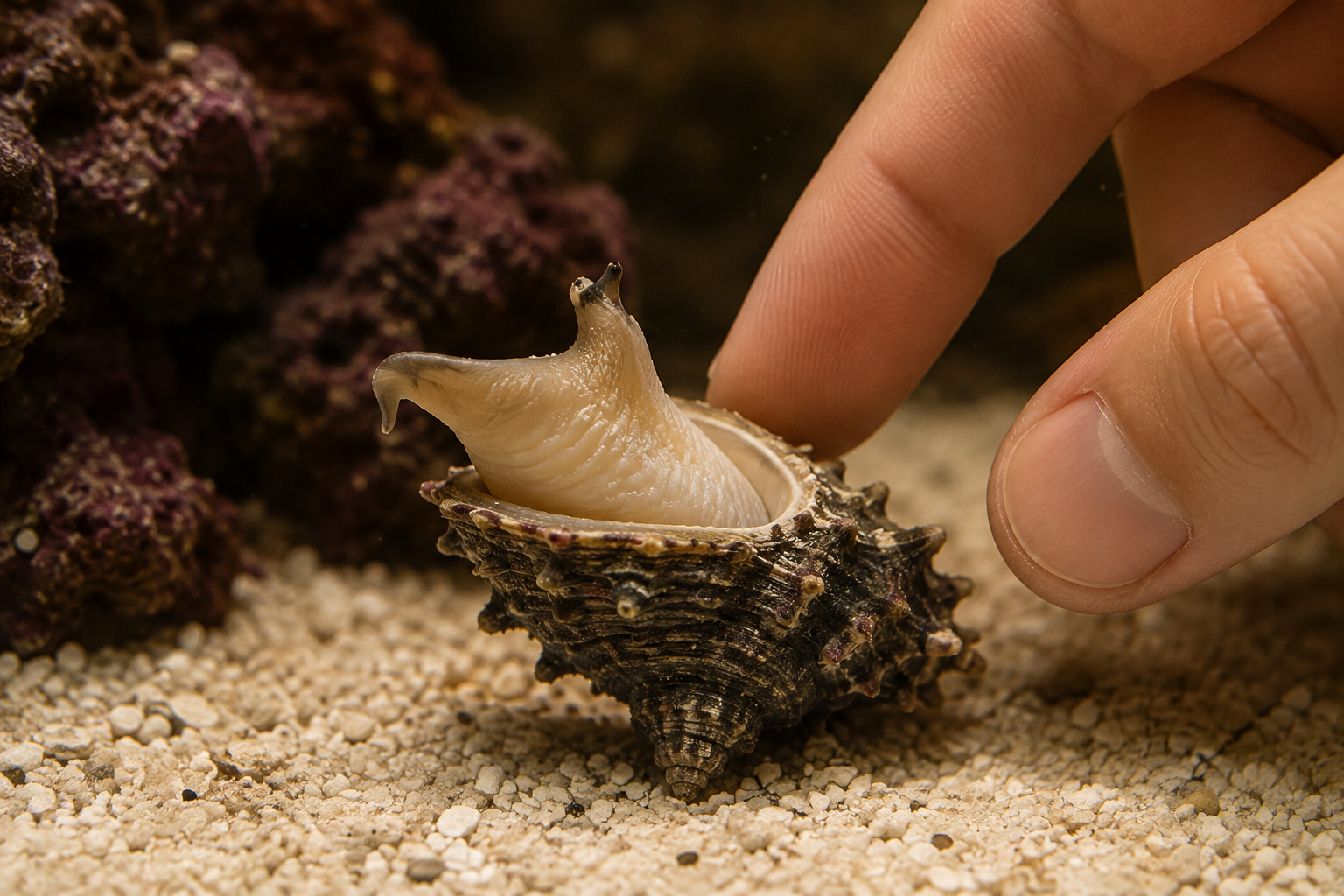
Astraeas are inexpensive, undemanding, and genuinely excellent at one thing: scouring film algae, diatoms, and sometimes even early cyanobacteria off rock and glass. New-tank ugly phase, brown dust on everything? Astraeas clear it. But they carry the hobby’s best-known design flaw — an astraea that falls upside down cannot right itself. On rock it can usually catch an edge; flat on the sand it will lie there until it starves or something eats it. Keep them if you accept the chore: glance at the sandbed when you feed, and flip anyone who needs it. Always place new astraeas upright on rock or glass, never dropped in. Care stats: about 1 inch; 10 gallons and up; 75–80°F; peaceful; film algae specialist for hard surfaces.
5. Mexican turbo snail — the bulldozer
When a tank is losing the algae war — thick green film, hair algae gaining ground — the turbo is the escalation. These are big snails with appetites to match, capable of clearing shocking amounts of growth in days; the Top Shelf Aquatics turbo guide credits them as some of the most powerful algae eaters available during a tank’s ugly phase. The tradeoff is grace: turbos grow to two inches or more and plow through aquascape like the bulldozers they are, knocking over any frag or rock that isn’t secured. One or two per tank is plenty, glue your corals down, and know that a big turbo may go hungry once the heavy algae is gone — be ready to feed it or rehome it.
Care stats: 2+ inches; 30 gallons and up; 75–80°F; peaceful but clumsy; heavy film and hair algae on glass and rock.
6. Fighting conch — the sandbed gardener
Despite the pugnacious name, a fighting conch is a peaceful, comic-faced grazer with eyes on stalks that spends its life plowing the top inch of your sandbed, eating algae, diatoms, and detritus as it goes. In a larger tank it does the work of a dozen smaller sand-stirrers and keeps the substrate white and turned. It needs room and food: give it forty gallons or more with a mature, biofilm-rich sandbed of several months’ standing, or it will slowly clean itself out of a livelihood. Care stats: 3–4 inches; 40 gallons and up with a deep mature sandbed; 75–80°F; peaceful; sand-surface algae and detritus.
7. Stomatella snail — the free hire
You probably won’t buy your stomatellas — they arrive free on live rock and coral frags, and lucky keepers find the tank staffed itself. A stomatella looks like a tiny sliding fingernail: a flattened half-shell over a soft body, quick-moving by snail standards, usually grazing the glass at night. They are completely harmless film-algae eaters that reproduce readily in reef tanks, building a self-sustaining workforce that costs nothing. If you spot one, celebrate. Never remove them, and if a fellow reefer offers you a few from their tank, take them. Care stats: 0.5–1 inch; any reef; harmless film grazer; self-sustaining population.
Water parameters: snails ride on coral chemistry
Here is convenient news: a reef maintained for healthy corals is automatically maintained for snails. The same stable calcium of roughly 400–450 ppm and alkalinity of 8–12 dKH that builds coral skeleton is what snails draw on to build shell, and the standard reef targets — salinity 1.023–1.026, temperature 75–80°F, ammonia and nitrite at zero, nitrate under about 20 ppm — are exactly what trochus care guides prescribe. Test with a reliable reef calcium and alkalinity test kit and keep your salinity honest with a refractometer rather than a swing-arm hydrometer, and the crew’s chemistry needs are covered without a single snail-specific task.
Two warnings earn their own paragraph. First, copper: it is lethal to every invertebrate on this page at concentrations that don’t bother fish, so no copper-based medication may ever touch a tank containing snails — treat sick fish in a separate hospital tank. Second, swings kill faster than values: a snail can adapt to slightly imperfect parameters, but not to parameters that lurch. Top off evaporation daily, mix water changes with a quality marine salt mix to match the tank’s salinity, and stability follows.
Acclimation: the step that kills most snails
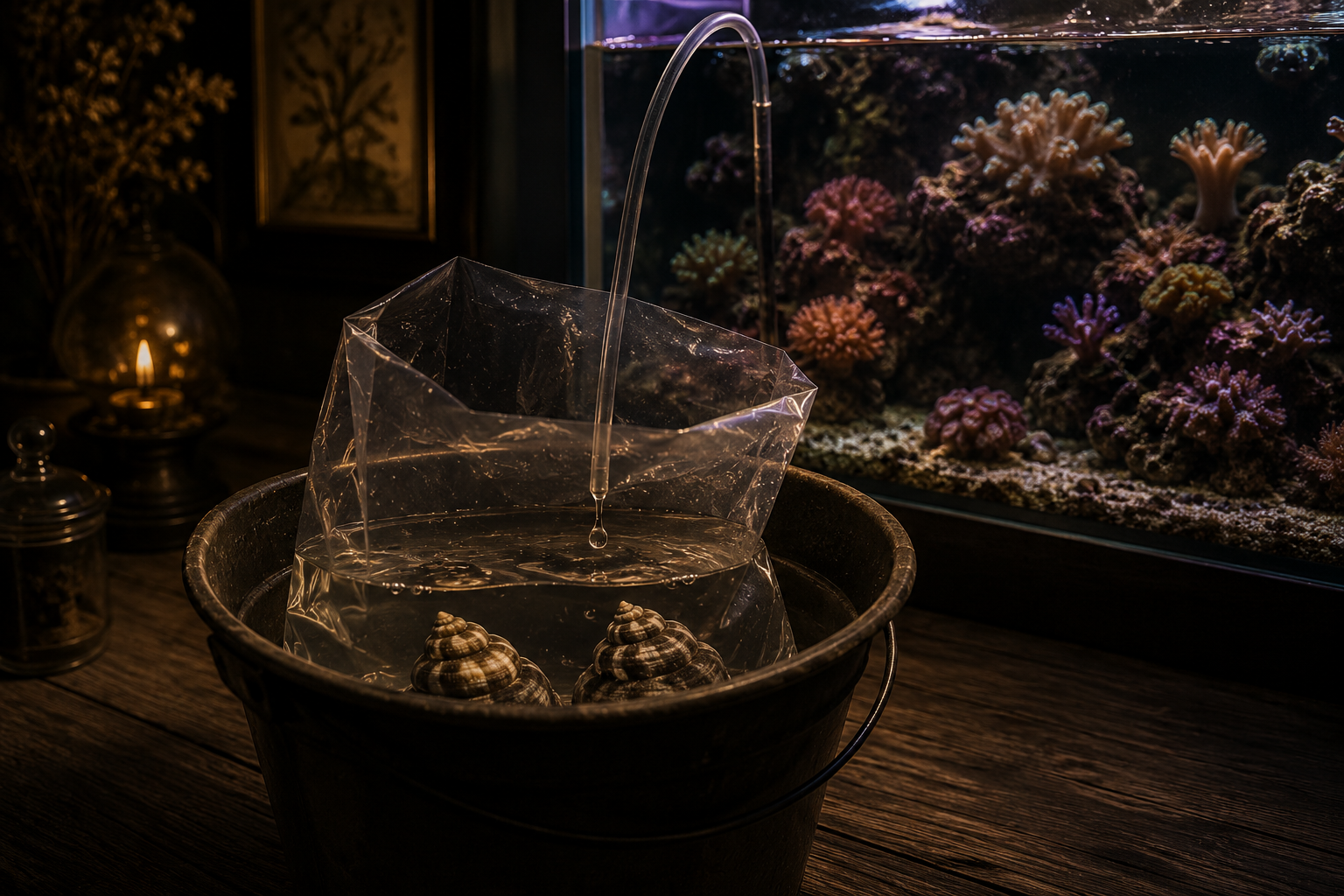
More cleanup-crew snails die in their first 24 hours than in the following year, and almost all of those deaths are acclimation shortcuts. Marine snails have essentially no ability to buffer sudden changes in salinity or chemistry — the water in the shipping bag and the water in your tank must be introduced to each other slowly. Float the bag for 15–20 minutes to equalize temperature, then drip tank water into the bag through airline tubing for one to two hours before the snails go in. A simple drip acclimation kit makes this a set-and-check job rather than a bedside vigil.
Then place — don’t pour. Set each snail foot-down on rock or glass and let it grip before you let go. This matters most for astraeas, which can’t recover from landing upside down, but every species starts life in your tank better attached to a surface than tumbled into the sand. It is thirty seconds of care that protects the whole investment.
Feeding the crew when the algae runs out
A good cleanup crew is a victim of its own success: sooner or later the tank gets clean, and the workforce faces a food shortage. Grazers show it first — trochus and turbos thinning out, astraeas going still. The fix is cheap: clip a strip of dried seaweed on a veggie clip low in the tank a few evenings a week, and the herbivore side of the crew (plus any algae-eating fish from our reef-safe fish guide) will find it. Nassarius need no special menu — normal fish feeding sustains them — though a tank that is fed very lightly supports fewer of them.
Think of supplemental feeding as payroll. A fed crew keeps patrolling and lives for years; an unfed crew shrinks by attrition until the algae returns and you buy replacements. The keepers who complain that snails “always die in a few months” are, more often than not, running an unpaid workforce.
Common mistakes with reef tank snails
The same handful of errors accounts for nearly every “my snails keep dying” thread. The first is buying the whole crew on day one. A brand-new tank has nothing for grazers to eat — the algae film that feeds them takes weeks to establish — so a full crew added at setup simply starves in shifts. Wait until you can see film returning on the glass a couple of days after cleaning, then hire gradually. The second is temperature-only acclimation: floating the bag for twenty minutes equalizes heat but does nothing about salinity, and salinity shock is the silent killer of new snails. Drip, every time, even when the store says the snails are hardy.
The third mistake is blaming the snail for the tank. A snail that wanders up past the waterline, stays sealed in its shell for days, or falls off the glass repeatedly is usually reporting a water problem — test before you replace it. The fourth is hermit crabs: many “cleanup crew packages” pair snails with hermits that will happily kill a snail for its shell. If you keep both, scatter empty shells of assorted sizes so the hermits upgrade peacefully. And the fifth is forgetting that dead snails are ammonia bombs. Count your crew loosely at feeding time; an empty shell behind the rockwork in a nano tank can crash water quality within a day or two, so remove any you find promptly — much as we advise for their freshwater cousins and even pet shrimp, whose molts fool keepers the opposite way.
Reef tank snails at a glance
| Snail | Job | Size | Min tank | Watch for |
|---|---|---|---|---|
| Trochus | Film algae on glass and rock | 1–3″ | 20 gal | Nearly none — rights itself |
| Cerith | Algae + detritus, tight spaces | 1″ | 5 gal | Hides in sand for days — normal |
| Nassarius | Buried leftovers, sand stirring | 0.5–1″ | Any with sandbed | Needs regular feeding of the tank |
| Astraea | Film algae and diatoms | 1″ | 10 gal | Cannot self-right when flipped |
| Mexican turbo | Heavy algae clearance | 2″+ | 30 gal | Bulldozes loose corals; may starve in clean tanks |
| Fighting conch | Sandbed grazing and turning | 3–4″ | 40 gal | Needs mature, deep sandbed |
| Stomatella | Night-shift film grazing | 0.5–1″ | Any | Nothing — free and self-sustaining |
Building your crew: the verdict
For a typical first reef of 20–40 gallons, a sensible starter crew looks like this: a core of trochus (one per three gallons or so), a handful of ceriths for the detail work, nassarius scaled to your feeding, and two or three astraeas if you’re willing to flip them. Add a single turbo only if algae is genuinely winning, and a fighting conch only past forty gallons. Resist the giant pre-boxed “crew packages” sized by gallon count alone — the guidance at AlgaeBarn’s snail guide echoes what experienced reefers keep relearning: a small, diverse, well-fed team beats a large hungry one every time.
Snails are the least glamorous purchase in the saltwater hobby and quietly one of the best. Fifty dollars of mixed grazers and scavengers will do more for your water quality and your glass than any gadget at twice the price — they simply ask to be acclimated slowly, kept away from copper, and fed when their work runs out. Give them that, and the night shift takes care of the rest. And if a marine tank is still a someday project, the same division-of-labor logic runs our freshwater snail guide — the shells change, the janitorial genius doesn’t.