
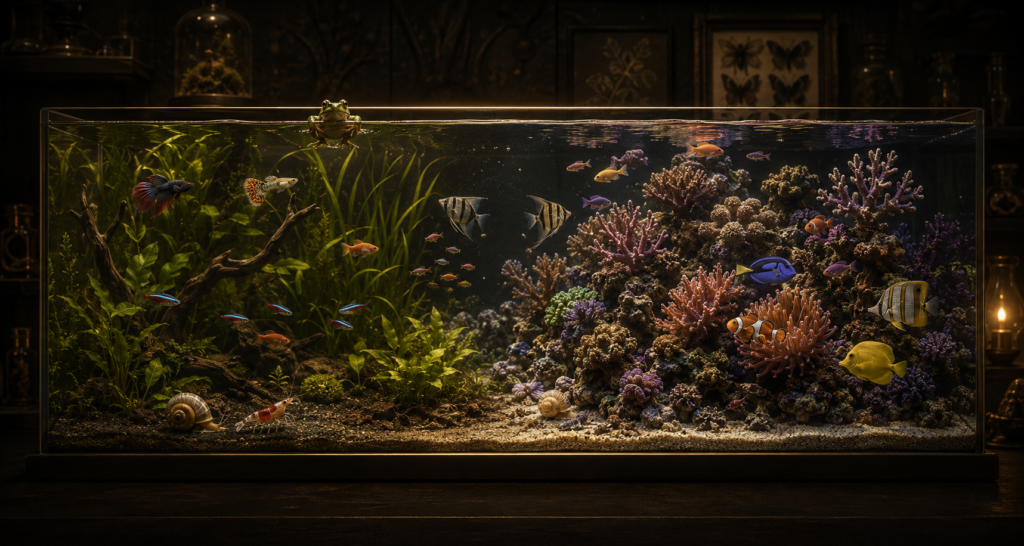
Most people arrive at the aquatic world through a single animal — a betta in a cup, a goldfish from a fair, a friend’s glowing reef tank — and then discover there’s a whole universe behind it. Underwater life is one of the most rewarding corners of the pet-keeping hobby precisely because it’s so varied: fish, shrimp, snails, crabs, frogs, and living plants, spread across freshwater and saltwater, from a five-gallon desktop tank to a coral reef in the living room.
ItsyBitsyPets is reader-supported. As an Amazon Associate we earn from qualifying purchases — at no extra cost to you. See our affiliate disclosure.
This guide is a map, not a checklist. It walks you through every major branch of the aquatic world, shows you the one skill that ties all of them together, and helps you choose the corner that fits your space, budget, and patience. Wherever you end up, the door opens the same way.
Welcome to the aquatic world
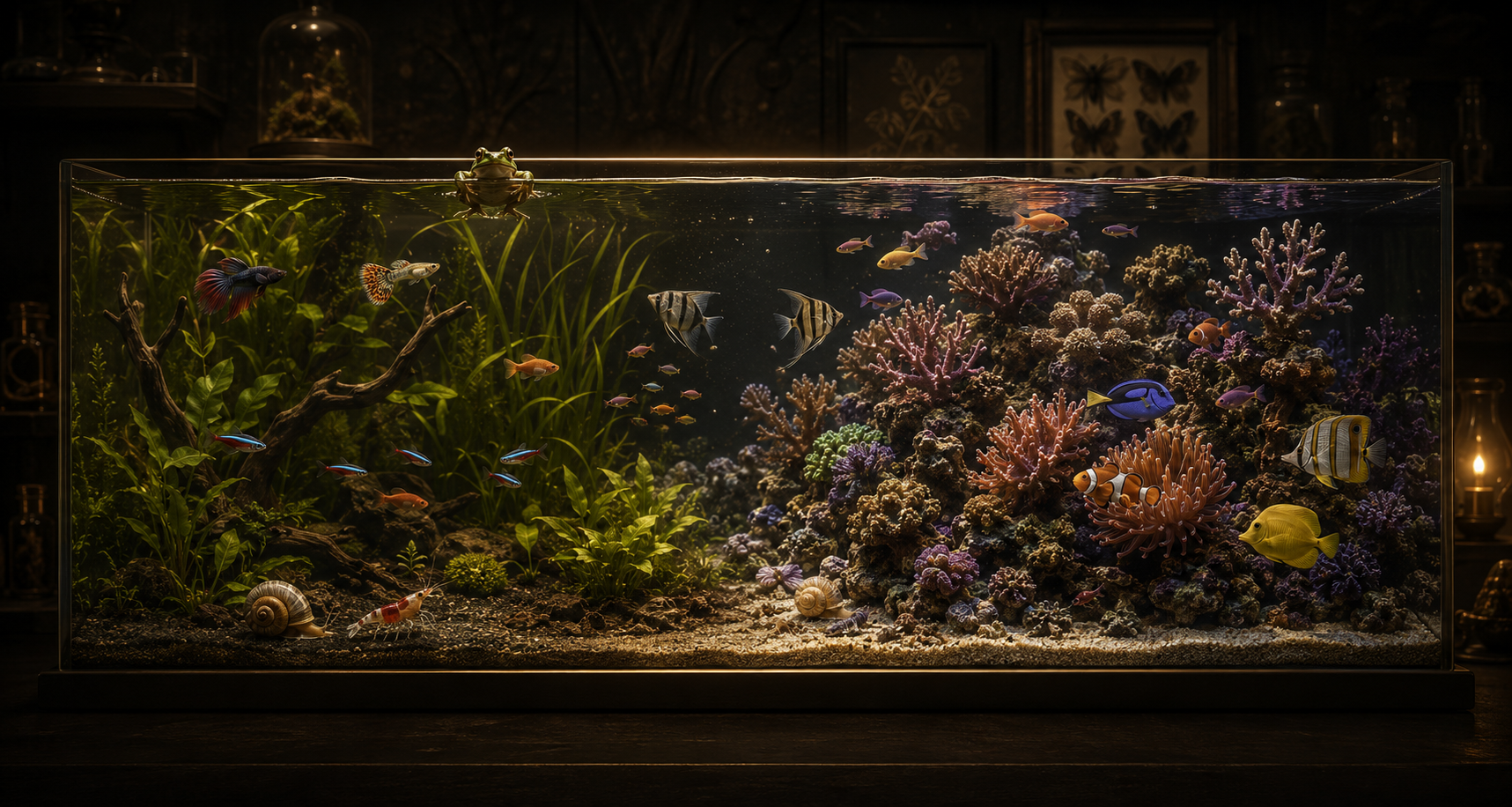
The first thing to understand is that the aquatic world is far bigger than “fish.” It spans freshwater and saltwater, vertebrates and invertebrates, animals and live plants. A shrimp grazing biofilm, a snail cleaning glass, a frog kicking to the surface for air, and a stem plant pulling nitrogen out of the water are all part of the same hobby, and often the same tank.
That world divides first into two great branches. Freshwater is the front door: it’s easier, cheaper, and more forgiving. You fill the tank with tap water treated with a dechlorinator, stock hardy species, and get going. Saltwater is the colorful deep end — reef-bright fish and invertebrates that reward you with spectacle but demand salt mixing, tighter stability, and a bigger budget. General beginner guidance is to start freshwater in a 10 to 20-gallon tank and only step up to saltwater with at least 30 gallons, because bigger volumes are more stable and forgive mistakes. Our step-by-step guide on how to start an aquarium covers that first setup in detail.
The one thing that unifies the whole aquatic world: the nitrogen cycle
Before any animal goes in the tank, there’s a single concept that carries across every corner of the aquatic world. Learn it once and everything below becomes keepable; skip it and nothing survives for long. It’s called the nitrogen cycle, and it’s the invisible engine of every healthy tank.
Here’s how it works. Every aquatic animal produces waste, and decaying food and waste release ammonia, which is highly toxic even in tiny amounts. In a mature tank, colonies of beneficial bacteria convert that ammonia into nitrite — still toxic — and then a second group of bacteria converts the nitrite into nitrate, which is far less harmful. You remove the accumulated nitrate with regular water changes, and live plants absorb some of it directly. According to Aquarium Co-Op’s beginner guide and other hobby sources, this whole biological “cycling” process takes roughly three to eight weeks to establish in a new tank.
You know a tank is cycled when ammonia and nitrite both read zero and nitrate is slowly accumulating — that’s the signature of a working bacterial colony. The only way to see this is to test the water, which is why a liquid master test kit is the first thing every keeper in the aquatic world should own. This single skill is the great equalizer: whether you keep a betta, a reef, or a colony of shrimp, you’re managing the same nitrogen cycle underneath.
Freshwater fish: the front door to the aquatic world
Freshwater fish are where most keepers begin, and with good reason: the species are forgiving, the equipment is cheap, and treated tap water is all you need. A few families cover almost every beginner tank.
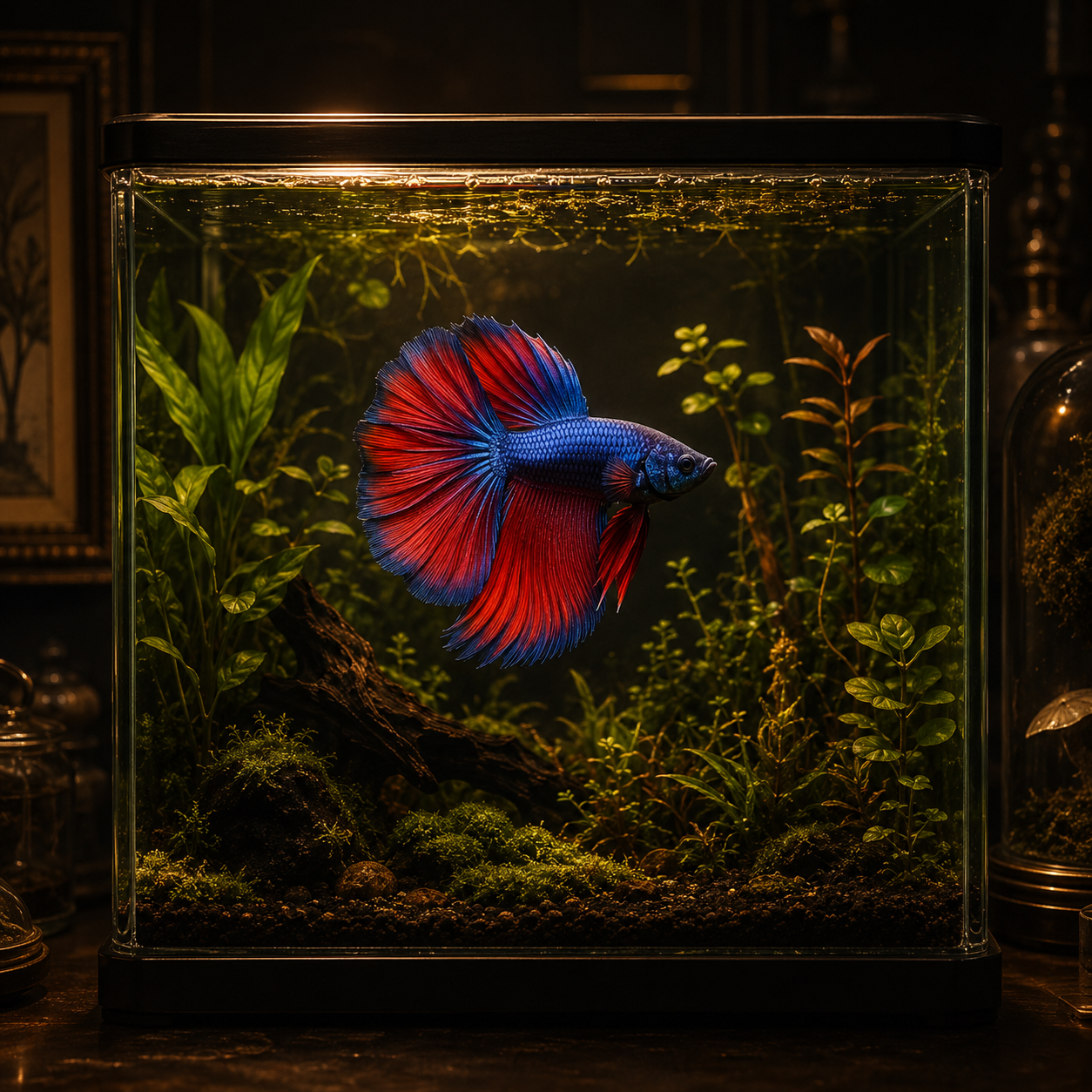
The betta is the classic first fish — a personable, hardy labyrinth fish that wants a heated tank of at least 5 gallons and gets kept as the only male, since two males will fight. Livebearers like guppies, platies, and mollies are colorful, active, and breed so readily you’ll likely end up with fry; they thrive around 72 to 80°F and make superb community fish. Schooling fish such as tetras and rasboras want to be kept in groups of six or more in a 10 to 20-gallon tank, where they shoal and show their best color. And corydoras catfish form the bottom crew, snuffling along a sand substrate in peaceful little gangs of six or more.
Put those roles together and you have a balanced community tank. Our roundup of the best beginner freshwater fish breaks down ten hardy species and the care each one needs.
What makes freshwater such a good starting point is how much it forgives. Most beginner species tolerate a wide range of temperatures and water chemistry, recover from small mistakes, and don’t need specialized equipment beyond a heater and a filter. You can build genuine skill on a betta or a school of tetras before you ever spend real money, and everything you learn — feeding, water changes, reading the animals’ behavior — transfers directly to the more demanding branches. Freshwater isn’t the beginner’s consolation prize; it’s the foundation the entire hobby is built on, and plenty of lifelong keepers never feel the need to leave it.
Saltwater fish: the colorful deep end
Cross into saltwater and the aquatic world lights up. Marine fish carry colors that freshwater simply can’t match, and a reef tank full of coral is one of the most spectacular things you can keep in a home. The trade-off is demand: you mix salt into the water to a precise salinity, hold parameters steadier, and generally spend more at every step.
The beginner marine trio is well established. The ocellaris clownfish — the “Nemo” fish — is the single hardiest starter marine, reef-safe and full of character in a tank of 30 gallons or more. The royal gramma and the firefish round out a peaceful, beginner-friendly marine community. The honest advice from most of the hobby, echoed in beginner comparisons like this freshwater-versus-saltwater overview, is to cut your teeth on freshwater first. Once the nitrogen cycle is second nature, saltwater is far less intimidating. Our guide to saltwater fish for beginners covers the leap in full.
Shrimp: tiny cleanup crews with personality
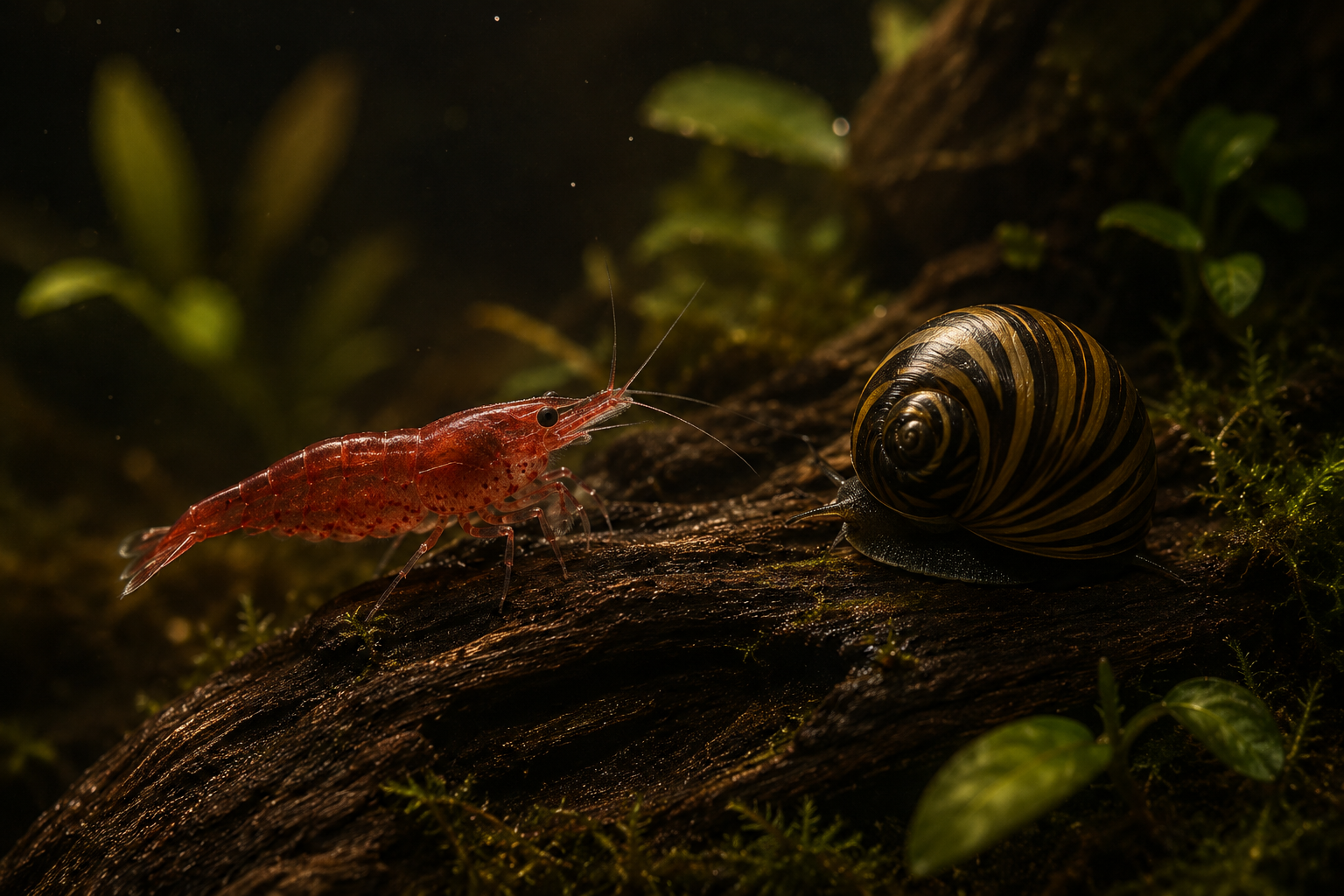
Not everything in the aquatic world has fins. Freshwater shrimp are among the most rewarding animals in the hobby — tiny, colorful, endlessly busy, and genuinely useful. Cherry shrimp are the gateway: hardy, happy in a 5-gallon tank, and they breed right in fresh water so a handful becomes a colony. Amano shrimp are the best algae eaters in the hobby, clearing stubborn growth that nothing else will touch.
Shrimp introduce a new rule that runs through all the invertebrates below: they wear their skeleton on the outside and must molt to grow, so they need calcium to rebuild their shells and water that’s completely free of copper, which is toxic to them. Our full pet shrimp guide covers the details, and it’s the same biology that governs snails, crabs, and crayfish.
Snails: the underrated workhorses
Snails are the quiet janitors of the aquatic world, and a good one earns its place many times over. The nerite snail is the best algae eater in the hobby and has the convenient quirk of being unable to breed in fresh water, so it never overruns a tank. The mystery snail is a big, personable grazer that needs calcium-rich water to keep its shell healthy, while ramshorn and pond snails arrive as hitchhikers and multiply fast if you overfeed.
Like shrimp, snails are sensitive to copper and depend on calcium — shell erosion, that pitted, thinning look, is the classic sign of soft or acidic water. Our guide to freshwater snails for the aquarium covers the seven best species and how to keep their shells strong.
Snails also make a good lesson in reading the hobby’s reputation carefully. Beginners are often warned away from them because of “snail infestations,” but that problem is really an overfeeding problem: pest snails multiply to match the surplus food in the tank, so the fix is feeding less rather than fearing snails altogether. A deliberately chosen nerite or mystery snail is one of the most useful animals you can add, quietly grazing algae that would otherwise cloud the glass and coat the plants.
Crabs and crayfish: the characters of the aquatic world
For personality per gallon, few animals beat the small crustaceans. The dwarf orange crayfish (the CPO) stays around 2 inches yet behaves like a full-size crayfish in miniature — bold, busy, and forever rearranging its territory. The Thai micro crab is one of the very few crabs that lives its entire life fully underwater in fresh water, drifting around a mature nano tank like an animated speck.
A word of warning here, because it trips up more beginners than almost anything else in the aquatic world: most animals sold as “pet crabs” — hermit crabs, fiddler crabs, vampire crabs — are actually semi-aquatic and need dry land to survive. Setting them up in an all-water aquarium will drown them. Always confirm whether a crab is fully aquatic before you buy a tank for it.
Crayfish come with their own honest caveat. Even the small, mostly peaceful dwarf species are opportunists that will pinch or grab a slow, sleeping fish resting on the bottom at night, so they pair best with active mid-water and top-swimming tankmates. And every crustacean molts — shedding its whole shell to grow — which means it spends a day or two soft and completely defenseless after each molt. That’s why hides and dense cover matter so much for this group: caves, driftwood, and plants give a freshly molted animal somewhere to wait out the danger. The empty shed shell you’ll eventually find on the substrate is normal, not a death; the animal will usually eat it back to recover the calcium.
Amphibians: a foot in both worlds
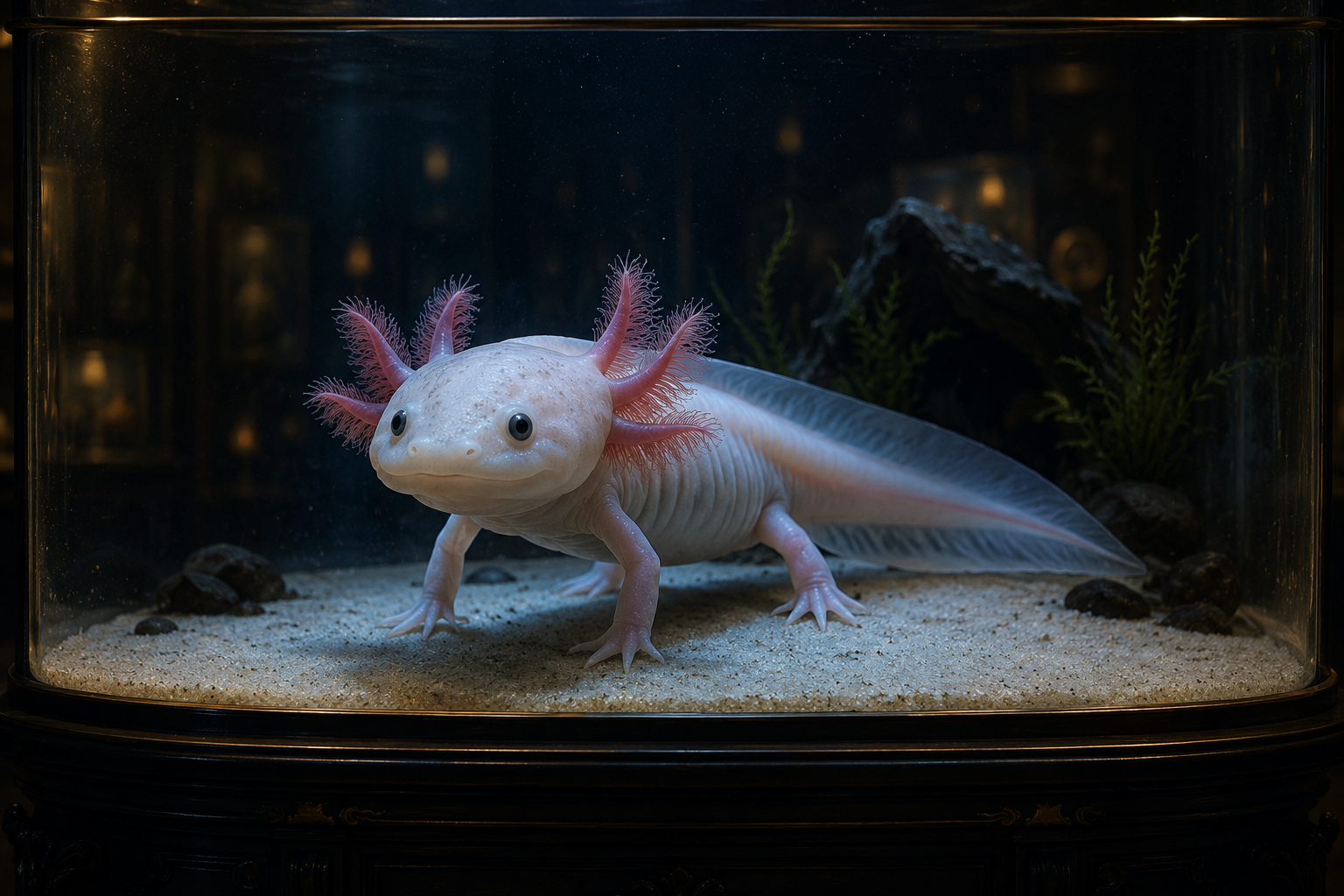
Amphibians blur the boundary between the aquarium and the terrarium, and a couple of them are firmly aquatic pets. The axolotl is the icon: a fully aquatic salamander that keeps its feathery gills for life, wants cold water around 60 to 64°F and a 20-gallon long tank, and has become one of the most beloved animals in the entire aquatic world. It’s an advanced pet — cold water and a big appetite for cleanliness — but an unforgettable one.
At the gentler end, the African dwarf frog is a fully aquatic, peaceful little amphibian that does well in a small heated tank and coexists with calm community fish. Between them they show the range: some amphibians live entirely underwater, while many others need land, so research each species before assuming an all-water setup will suit it.
Amphibians also highlight a habit worth building early: read about the adult animal, not the one in the store cup. A juvenile axolotl looks tiny and undemanding, but it grows to nearly a foot and needs cool, pristine water for years. A froglet at the shop may still be transitioning out of a land phase. The aquatic world is full of animals whose care changes dramatically as they mature, and the keepers who succeed are the ones who set up for the adult from day one rather than scrambling to rehouse an animal that outgrew its tank. A few minutes of research before the purchase saves months of trouble afterward.
Live plants: the living furniture of the aquatic world
The last branch of the aquatic world isn’t an animal at all. Live plants turn a tank from a box of water into a functioning ecosystem. Java fern and anubias are nearly indestructible beginner plants — you tie them to rock or driftwood rather than burying them, because their rhizomes rot if planted in the substrate. Anacharis is a fast-growing stem plant that pulls nitrogen straight out of the water and starves algae of the nutrients it needs.
Beyond looks, plants do real work: they absorb the nitrogen compounds from the nitrogen cycle, compete with algae, oxygenate the water, and give shy fish, shrimp, and fry places to hide. A planted tank is usually an easier tank to keep stable. Our overview of aquatic plants covers the best beginner species and how to grow them.
How to choose your first corner of the aquatic world
With the whole map in front of you, the choice comes down to three honest questions: how much space, how much money, and how much time you have.
Match the tank to your space and budget. A 5-gallon tank suits a single betta or a colony of shrimp and snails. A 10 to 20-gallon opens up a full freshwater community. Thirty gallons or more is the doorway to saltwater and the reef. Match the animal to your time. Some corners of the aquatic world are genuinely low-effort — a betta, a shrimp colony, a few snails — while a densely planted community, a reef, or an axolotl asks for more attention and consistency. There’s no wrong answer, only a wrong mismatch between the animal and the life you can give it. And whatever you choose, the path in is identical: set up the tank, cycle it fully, then add animals slowly.
The pet and aquatic world starter shopping list
Whatever branch you pick, a short list of gear gets you into the aquatic world safely. You’ll want a tank with a lid, a heater sized to the tank — or a chiller if you’re keeping cold-water species like axolotls — and a filter fitted with a pre-filter sponge so it can’t inhale shrimp or fry. Add a bottle of dechlorinator to neutralize tap water, a liquid test kit, food appropriate to your animals, and a light if you plan to keep live plants.
One item on that list is non-negotiable: the liquid test kit, because it’s the only way to actually read the nitrogen cycle and know your water is safe. A properly sized aquarium heater and a good water conditioner round out the essentials that every tropical setup shares. Everything else you can add as your interests narrow.
Beginner mistakes across the aquatic world
The same handful of errors sink new keepers regardless of which animal they chose. The biggest is adding livestock before the tank is cycled — so-called new-tank syndrome — which exposes the animals to toxic ammonia and nitrite while the bacterial colony is still building. Close behind are overstocking and overfeeding, which overwhelm even a cycled tank with more waste than it can process.
The third is dosing copper-based medications in a tank with shrimp, snails, or crabs, which can wipe out the invertebrates overnight. And the fourth is simply buying an animal before researching it — discovering too late that the “crab” needs land, the axolotl needs cold water, or the cute fish grows to a foot long. Every one of these is avoidable with a little patience and a test kit.
Your map of the aquatic world
| Branch | Good starter | Min tank | Effort | Note |
|---|---|---|---|---|
| Freshwater fish | Betta, guppy, tetra | 5-20 gal | Low-medium | The front door |
| Saltwater fish | Ocellaris clownfish | 30 gal+ | High | Colorful, demanding |
| Shrimp | Cherry shrimp | 5 gal | Low | Needs calcium, no copper |
| Snails | Nerite snail | 5 gal | Low | Best algae eater |
| Crabs/crayfish | Dwarf orange crayfish | 10 gal | Low-medium | Check if fully aquatic |
| Amphibians | African dwarf frog | 3-20 gal | Medium-high | Some need land |
| Live plants | Java fern, anubias | Any | Low | Tie down, don’t bury |
The aquatic world is wide enough to hold a lifetime of tanks, but it all rests on the same foundation. Pick the corner that fits your space, your budget, and your patience; set up the tank and cycle it properly before a single animal goes in; and add livestock slowly while you watch the water. Do that, and whichever branch you chose — a single betta, a shrimp colony, a planted community, or a reef — you’ll be a keeper, not just a spectator, in one of the most absorbing hobbies there is. Start small, get the nitrogen cycle right, and let the world open up from there.