
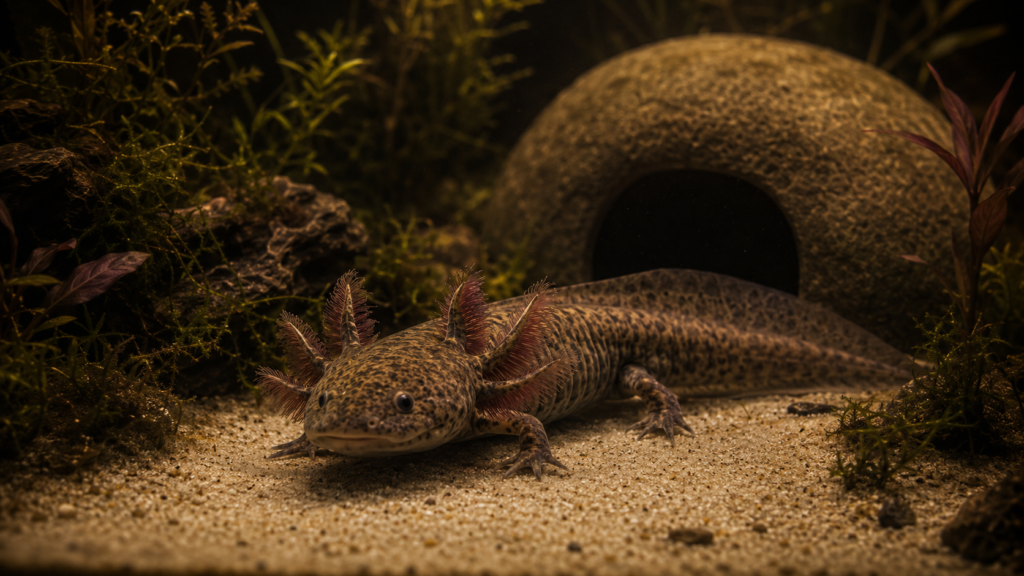
The axolotl might be the most misunderstood pet in the aquarium world:
a cold-water salamander that never grows up, sold in stores that too often keep
it warm, over gravel, next to fish — three strikes before it ever reaches your
home. The good news? Real axolotl care is wonderfully simple once you know the
handful of rules that matter. Get the water cold, the tank cycled, the bottom
safe, and the worms wiggling, and this smiling little dragon will be with you
for the next decade or more. Here’s the complete guide, keeper to keeper.
ItsyBitsyPets is reader-supported. As an Amazon
Associate we earn from qualifying purchases — at no extra cost to you. See our
affiliate
disclosure.
Meet the axolotl: a salamander that never grows up
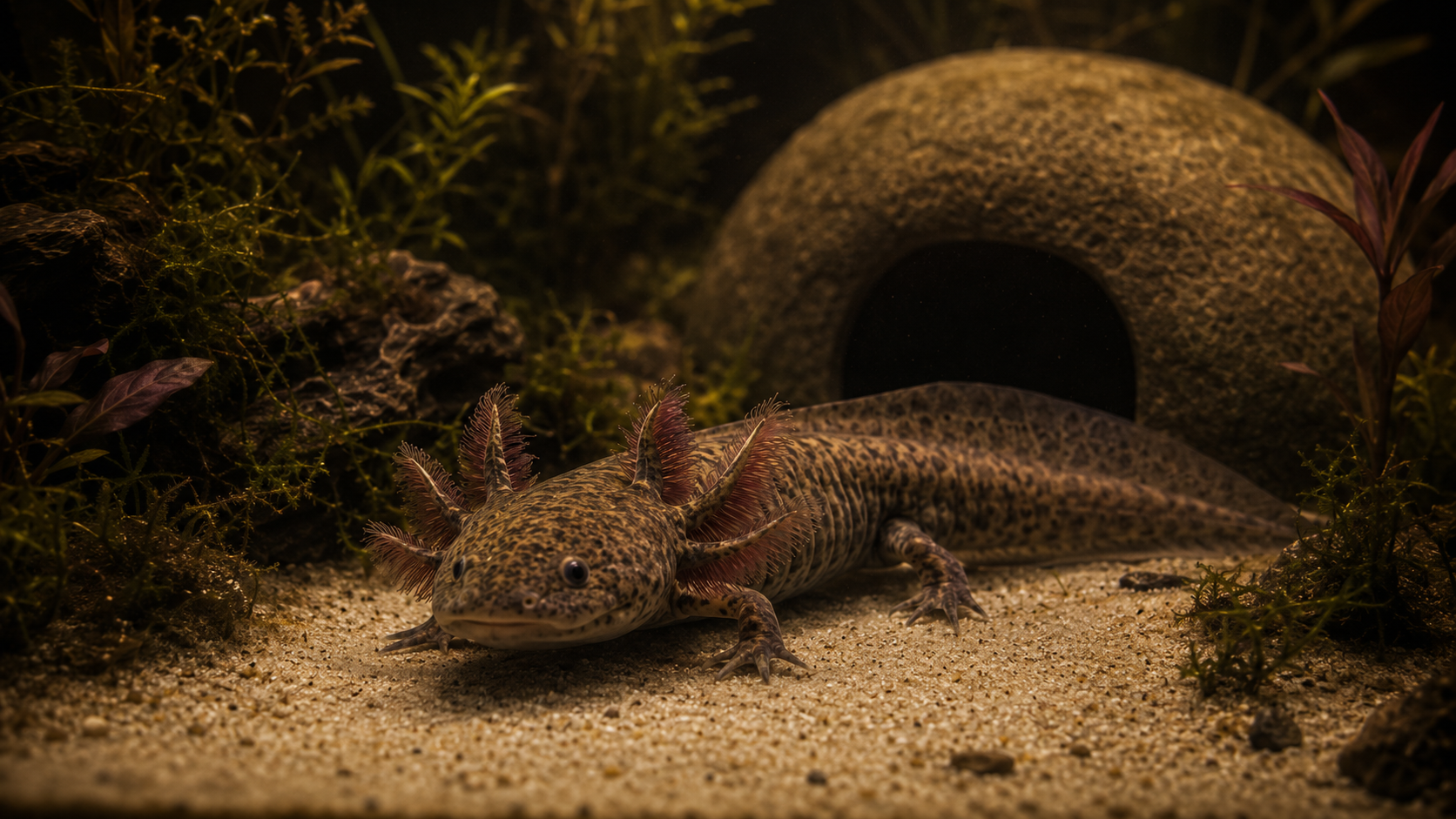
The axolotl (Ambystoma mexicanum) is a fully aquatic salamander
from the lake systems of Mexico City, famous for neoteny — it keeps its larval
features, including those feathery external gills, for its entire life. It
never leaves the water, never wants to, and spends its days patrolling the
tank floor like a slow, smiling vacuum cleaner. Adults reach roughly a foot
long, and with good axolotl care they routinely live 10 to 15 years — a real
commitment, not an impulse buy.
One thing to settle before anything else: axolotls are illegal to keep in
California, Maine, New Jersey, and Washington, D.C., and Hawaii and New Mexico
require permits. If you’re not sure where you stand, our
axolotl laws by
state guide has the full breakdown before you spend a dime on gear.
Tank setup: floor space is everything
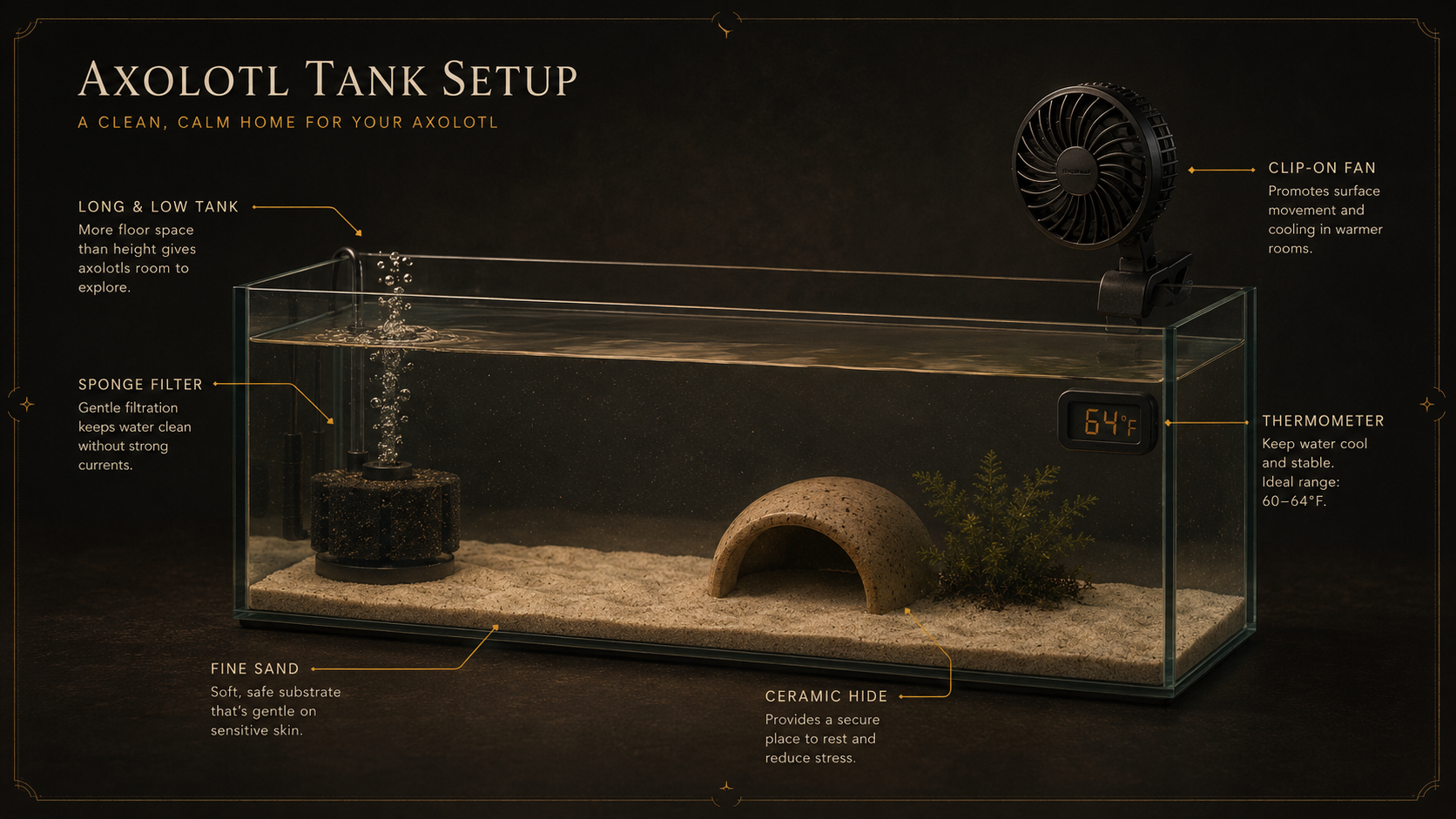
Axolotls are bottom dwellers. They walk more than they swim, and they almost
never use the upper water column — so when you shop for a tank, think floor
area, not gallons of height. A standard 20-gallon long works for a single
adult, and a 29-gallon with a 30-by-12-inch footprint gives welcome breathing
room. A tall, narrow tank of equal volume is nearly wasted on them; long and
wide wins every time, a point the keeper-run
Axolotl Central
care guide hammers home.
Furnish it simply: one or two smooth hides (a ceramic cave, a clay pot on
its side), silk or live low-light plants, and nothing sharp — axolotl skin is
soft and tears easily. Keep lighting dim; axolotls have no eyelids and
naturally avoid bright light. A dark, quiet tank isn’t a sad tank to an
axolotl — it’s home.
Axolotl water temperature: cold is non-negotiable
If you remember one number from this whole guide, make it this: axolotl
water temperature belongs between 60 and 68°F, with the low
60s ideal. There is no heater in axolotl care — ever. These are cold-water
animals, and sustained temperatures above about 72°F cause serious stress,
suppressed appetite, and fungal infections that can spiral quickly.
In most homes, the challenge is summer. An open-top tank in a
air-conditioned room often holds the low-to-mid 60s on its own; if yours runs
warm, a clip-on aquarium cooling fan blowing across the surface can drop the
water several degrees through evaporation, and dedicated aquarium chillers
solve the problem outright in hot climates. Track it daily with a
digital
aquarium thermometer stuck to the glass — guessing is how gills get
fuzzy.
Cycling: the invisible step that keeps them alive
Axolotls are messy. They produce far more ammonia than a fish of similar
size, and ammonia burns their gills and skin at concentrations you can’t see.
The nitrogen cycle — growing the beneficial bacteria that convert ammonia to
nitrite and then to relatively harmless nitrate — is the single most important
piece of axolotl care, and it has to happen before the axolotl
arrives.
Set the tank up two to six weeks ahead, seed it with bottled bacteria, feed
the cycle with a small ammonia source, and test every day or two with a liquid
kit like the API
Freshwater Master Test Kit. You’re cycled when ammonia and nitrite read
zero for several consecutive days while nitrate climbs. From then on, your
targets are simple:
- Ammonia: 0 ppm, always
- Nitrite: 0 ppm, always
- Nitrate: under 20 ppm, managed with water changes
- pH: roughly 7.0–8.0 (7.4–7.6 is the sweet spot)
Change about 20–25% of the water weekly, and treat every drop of new tap
water with a conditioner like
Seachem
Prime — chlorine and chloramine are brutal on external gills. The routine
takes fifteen minutes a week and prevents nearly every common axolotl health
problem before it starts.
Substrate: the gravel rule that has no exceptions
Axolotls eat by suction — they lunge and inhale whatever is in front of
their face, including whatever is under their food. Gravel is how axolotls
die: swallowed pebbles cause impaction, a blocked gut that is frequently
fatal. No gravel, no pebbles, no decorative stones small enough to fit in a
surprisingly large mouth. This rule has no exceptions and no “but my
axolotl…” escape clause.
Safe options are a bare bottom — easy to clean, completely risk-free, a
little slippery — or very fine sand with grains under a millimeter, which
gives their toes traction and passes harmlessly if swallowed. One caveat from
breeders: keep axolotls under about six inches on bare bottom only, since
even fine sand can build up in a small juvenile’s gut. Tile and slate are
fine too, as long as edges are smooth.
Filtration: gentle or nothing
Axolotls evolved in still lake water and hate current. A strong filter
outflow stresses them constantly — the tell-tale sign is gills curled forward
toward the face, the axolotl equivalent of walking into a headwind all day.
The classic solution is an air-driven
sponge
filter: gentle, cheap, and a perfect home for your beneficial bacteria.
If you prefer a hang-on-back filter, baffle the outflow with a spray bar or
decor so the surface barely ripples. Still water, cold water, clean water —
that’s the whole recipe.
Axolotl food: earthworms are the gold standard
Wondering what to feed? The answer that every experienced keeper and the
detailed feeding
guide at Shrimp and Snail Breeder agree on: earthworms. Nightcrawlers and
red wigglers are the ideal axolotl food — over 60% protein with a
calcium-to-phosphorus ratio better than 1, which no fish flake or freeze-dried
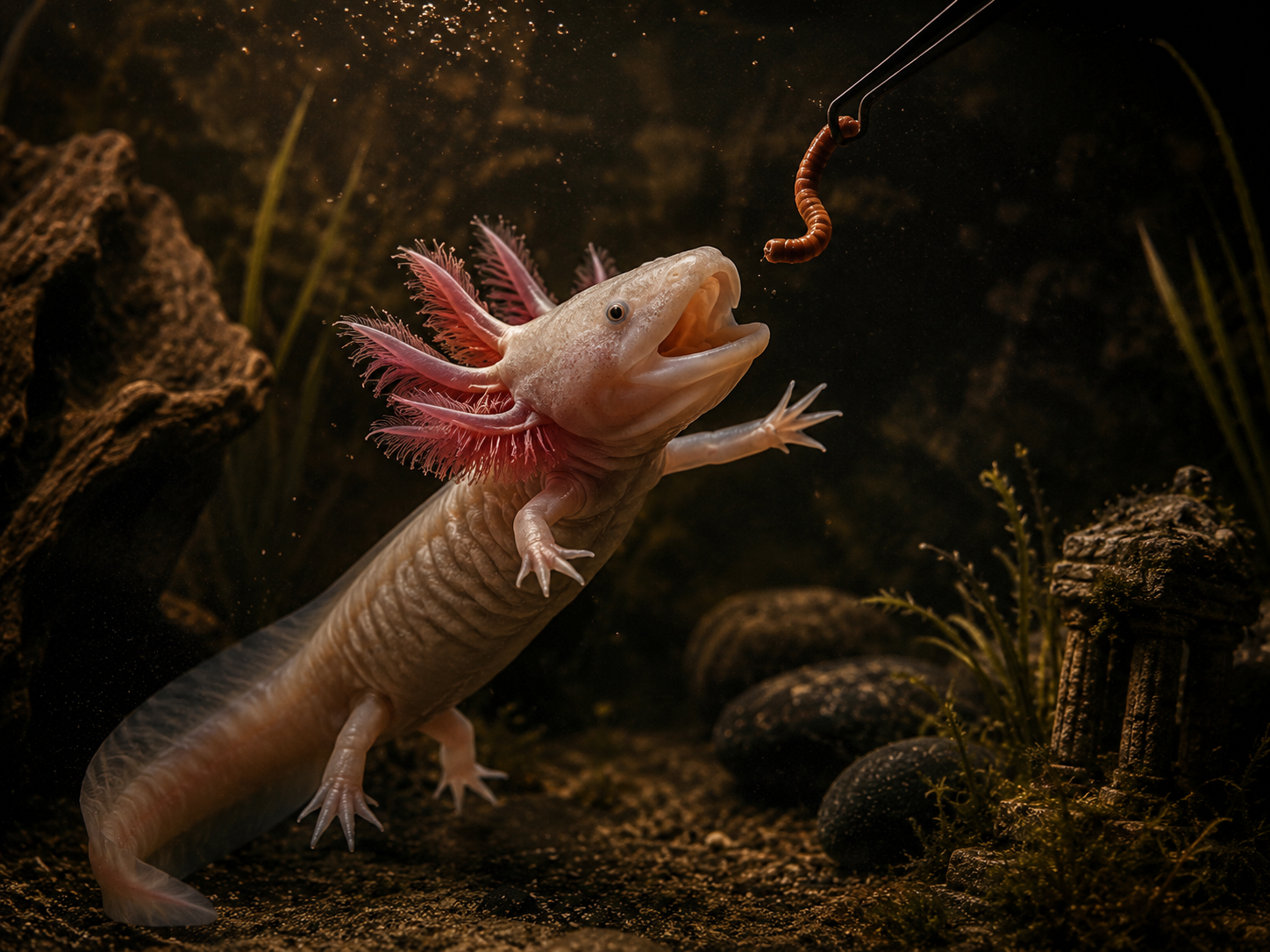
snack can match. A worm cut to face-width, wiggled in front of an axolotl with
feeding tongs, is dinner theater and complete nutrition in one.
Round out the menu with high-quality
sinking
axolotl pellets as a convenient backup staple, with occasional treats like
frozen bloodworms for variety (treats, not staples — they’re nutritionally
thin). Skip feeder fish entirely: they can carry parasites and nip gills while
they wait to be eaten.
Adults eat every two to three days and juveniles daily. Whatever isn’t
eaten within about fifteen to twenty minutes comes out with a turkey baster —
leftover food is an ammonia spike on a timer. A healthy axolotl strikes fast
and begs shamelessly; a refusal to eat for more than a few days is your cue to
check temperature and water quality first, because it’s nearly always one of
the two.
Baby axolotl care: a different game for the first months
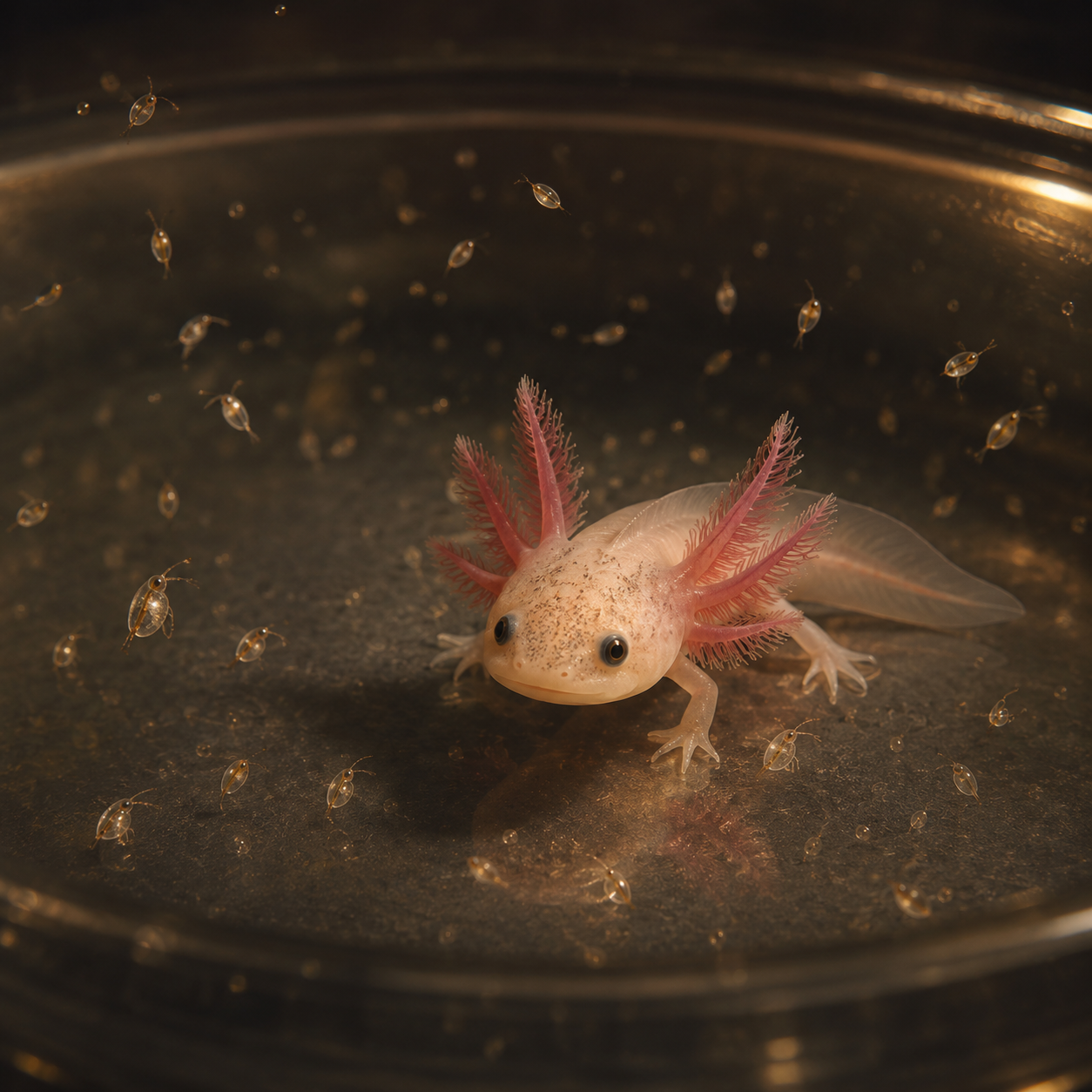
Baby axolotl care runs on one rule: hatchlings only respond to food that
moves. For the first weeks they need live baby brine shrimp, daphnia, or
microworms, offered daily — they’ll ignore anything that doesn’t wriggle.
Breeders raise them in simple bare-bottom tubs with shallow, pristine water,
changed frequently, because larvae are even more sensitive to ammonia than
adults.
As they grow, they graduate to chopped blackworms, then cut earthworm
pieces and soft pellets, usually converting fully to the adult menu by three
to four inches. Raise siblings together only with generous space and constant
food — hungry, crowded larvae nip each other’s limbs (which regenerate,
astonishingly, but better avoided). Most new keepers are better off buying a
3-inch-plus juvenile that’s already past the fragile stage.
Handling and tankmates: the two “don’ts”
Axolotl skin is a permeable mucus-coated membrane, and their skeleton is
largely soft cartilage — hands are for emergencies, not affection. When you
must move one, use a soft fine-mesh net or guide it gently into a cup
underwater. They bond with you at feeding time just fine; they simply do it
from the other side of the glass.
As for tankmates: an axolotl’s ideal companion is nobody. Fish nip at those
irresistible feathery gills, and anything that fits in an axolotl’s mouth —
which is most things — eventually ends up there. Even other axolotls need
matching sizes and generous floor space to cohabit safely. One animal, one
well-run tank is the setup that never causes 2 a.m. emergencies.
Health: what fluffy gills are telling you
Your axolotl’s gills are a live diagnostic readout. Full, fluffy, richly
colored filaments mean the water is cold and clean; thin, curled, or
degraded-looking gills mean something’s wrong — usually temperature or
ammonia. A plump tail base and belly, steady appetite, and calm bottom-walking
round out the picture of health, as the care overview at
Aquarium Source
describes.
The common warning signs all trace back to husbandry. White cottony fuzz on
gills or skin is a fungal infection, almost always triggered by warm or dirty
water. Floating without control, a curled tail tip, or frantic swimming point
to water-quality stress; refusing food for a week says test everything. Fix
the water first — cold, clean, zero ammonia — and most early problems reverse
on their own. For anything persistent, seek out an exotics vet who sees
amphibians, and never treat with fish medications blindly: many common ones
(anything with copper, for a start) are toxic to axolotls.
Your weekly axolotl care routine
Here’s the entire maintenance load once the tank is established:
- Daily: glance at the thermometer, feed (juveniles) or
every other day-ish (adults), remove any leftovers - Weekly: 20–25% water change with conditioned,
temperature-matched water; quick parameter test; baster the poop - Monthly: rinse the sponge filter in removed tank water
(never tap), check hides and decor for rough edges
That’s it. No walks, no grooming, no vet boosters — axolotl care is a
fifteen-minute weekly ritual wrapped around a pet that greets you at the glass
like a golden retriever with gills.
What an axolotl setup really costs
Budget shock is the number-one reason axolotls end up rehomed, so let’s be
honest up front. The animal is the cheapest line item — common morphs run
$30–$100 from a quality breeder. The habitat is where the money goes: tank and
lid, sponge filter and air pump, test kit, conditioner, hides, and a
thermometer typically land between $150 and $250 if you shop smart, and a
proper aquarium chiller — only necessary in homes that can’t hold water under
about 70°F — is a $150–$400 question all by itself.
Ongoing costs are refreshingly small: a cup of nightcrawlers stretches for
weeks, pellets last months, and electricity for an air pump is pennies. Plan
for an occasional exotics-vet visit the way you would for any pet, and
remember the timescale — this is a decade-plus animal, so a slightly better
filter or a genuinely cycled tank is an investment, not an expense. Set up
once, correctly, and axolotl care costs less per month than most houseplant
habits.
Quick answers to the questions every new keeper asks
Do axolotls really regenerate?
Yes — it’s not a myth. Axolotls can regrow entire limbs, tail sections,
gill filaments, and even portions of heart and spinal tissue, which is why
research labs have studied them for over a century. In the home aquarium, it
means a nipped toe or gill filament from a tank scuffle usually grows back
fully within weeks. It is not, however, a license for risky housing —
regeneration costs the animal energy and stress, and prevention beats
regrowth every time.
Can an axolotl live in a bowl or a small tank?
No. Bowls and five-gallon tanks can’t hold stable temperature or water
chemistry, and an adult axolotl is nearly a foot of animal that walks the
floor of its territory. Twenty gallons long is the working minimum, and more
floor space is always better. If the footprint fits on a nightstand, it
doesn’t fit an axolotl.
Can axolotls live with goldfish?
It’s a tempting thought — both like cool water — and a genuinely bad idea.
Goldfish nip gill filaments, outcompete axolotls for food, and produce enough
waste to wreck the pristine parameters axolotl care depends on. Small
goldfish, meanwhile, are exactly mouth-sized. Every tankmate combination with
an axolotl ends in one of two ways: stress or lunch.
What temperature is dangerously hot?
Trouble starts above 72°F and becomes an emergency in the upper 70s.
Sustained warmth suppresses the immune system, invites fungus, and can be
fatal within days during a heat wave. If summer water creeps up, float a
sealed bottle of ice water in the tank as a stopgap, aim a fan across the
surface, and treat a chiller as mandatory equipment rather than a luxury.
Can my axolotl ever leave the water?
No — despite the occasional viral photo, a healthy axolotl is fully
aquatic for life. Its gills and skin must stay wet, and “walking on land”
moments are stress events, not adventures. (True morphing into a land-dwelling
form is a rare, usually hormone-linked medical event — if your axolotl’s gills
are shrinking and its body is changing shape, that’s an exotics-vet visit,
not a lifestyle choice.)
How can you tell if an axolotl is male or female?
Wait until around 8–12 months, then look at the cloaca — the bump behind
the hind legs. Males develop a pronounced, swollen cloacal region and tend
toward longer, slimmer bodies; females stay rounder-bodied with a flatter
cloaca. Sexing juveniles is guesswork, which is one more reason housing
multiple young axolotls together needs a plan for the day two of them turn
out to be a breeding pair.
Why is my axolotl not eating?
Nine times out of ten the answer is in the water, not the animal. Warm
water is the most common appetite killer, followed by an ammonia or nitrite
spike, followed by plain stress from bright light or a new environment. Test
everything, cool the tank into the low 60s, dim the lights, and offer a live
wiggling earthworm at dusk — the most tempting item on any axolotl’s menu. If
a week passes with parameters perfect and food still refused, that’s the
point to consult an amphibian-savvy exotics vet rather than keep guessing.
Do axolotls sleep?
They rest, though without eyelids it’s hard to catch them at it. Axolotls
have no strong day-night rhythm and mostly alternate between patrolling for
food and settling motionless in a hide or a favorite corner. Long stretches
of stillness are completely normal — an axolotl parked in its cave for an
afternoon is loafing, not sick, as long as gills look full and dinner still
causes a lunge.
Ready for one? Source it right
Everything in this guide assumes you start with a healthy animal — and that
part is decided before you ever own it. Skip the big-box store and buy from a
dedicated breeder who raises axolotls cold, cycled, and on earthworms. Our
companion guide on
where
to buy an axolotl covers prices, shipping, and the red flags to walk away
from.
Cold water, a cycled tank, a safe floor, and worms. Master those four
things and axolotl care stops being intimidating and starts being what it
really is: one of the most relaxing, rewarding corners of the aquarium hobby,
starring the only pet that smiles back for fifteen years.