
Most people meet a moth when one thumps against the porch light. But the real magic happens earlier — in a mesh cage on your kitchen counter, watching a fat green caterpillar spin a cocoon and emerge weeks later as a palm-sized luna with wings like sea glass. Moths are one of the most rewarding micro-pets you can keep, and one of the most misunderstood. This guide covers what keeping moths actually means, the best species to start with, and how to do it right.

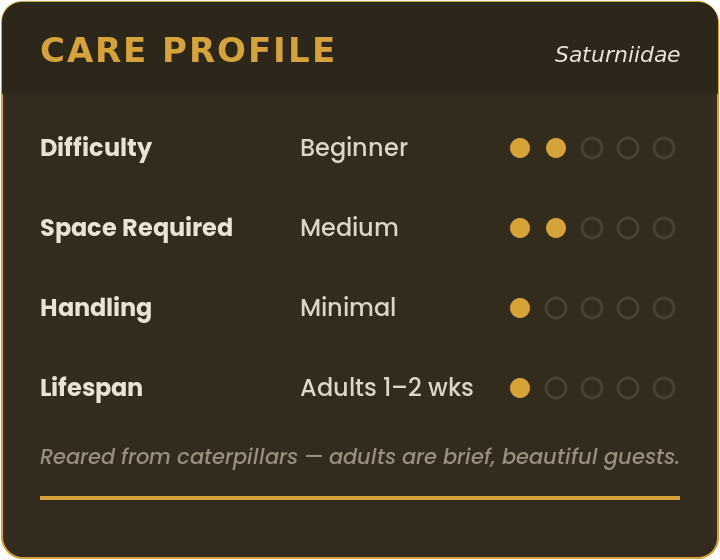
A quick truth up front: You don’t really keep an adult moth as a pet. Many of the most spectacular species — lunas, cecropias, polyphemus — have no working mouthparts and never eat. They live only a week or two as adults, just long enough to mate and lay eggs. The hobby is rearing: raising the caterpillars through to adulthood, then releasing or breeding them. That’s where all the joy lives.
What Are Moths — and What Does “Keeping” Them Really Mean?
Moths are invertebrates in the order Lepidoptera — the same group as butterflies, but vastly larger, with over 160,000 known species compared to roughly 18,000 butterflies. For the keeper, they fall into two broad camps:
- Giant silk moths (family Saturniidae) — the showstoppers. Luna, cecropia, polyphemus, promethea. Huge, dramatic, short-lived as adults, and the backbone of the rearing hobby.
- Sphinx / hawk moths (family Sphingidae) — fast, heavy-bodied fliers, often with hidden pink or red hindwings they flash to startle predators. The Big Poplar Sphinx is one of these.
When people say they “keep moths,” they almost always mean they collect eggs or caterpillars, raise them through their molts, watch them cocoon, and witness the emergence — one of the genuinely jaw-dropping events in the pet-keeping world.
New to inverts entirely? Start with our Invertebrates care guide.
Best Moths for Beginners
If you want a high success rate your first time, start here. All three are widely available, hardy, and forgiving:
- Polyphemus moth (Antheraea polyphemus) — often called the easiest giant silk moth to rear. Eats oak, maple, birch, willow and more, so host plants are easy to find.
- Luna moth (Actias luna) — the icon. That pale-green, long-tailed adult is the reason most people get into the hobby. Caterpillars take walnut, hickory, sweetgum, birch and persimmon.
- Cecropia moth (Hyalophora cecropia) — North America’s largest native moth, with a wingspan up to six inches. Caterpillars are generalists: maple, cherry, apple, willow, lilac and birch.
All three emerge in late spring to early summer, mate within a day or two, and the caterpillars hatch about a week later — a tidy, watchable cycle.
The Rearing Setup
You don’t need much, and that’s part of the appeal. The essentials:
Some links below are affiliate links — if you buy through them, we may earn a small commission at no extra cost to you. See our affiliate disclosure.
- A rearing cage or mesh enclosure — pop-up mesh butterfly cages are inexpensive and ideal; they breathe well and prevent mold.
- Floral water tubes, a floral foam block, or a jar of water — to keep cut host-plant branches fresh for feeding.
- Paper towel or kraft liner — for easy frass (caterpillar droppings) cleanup.
- A spray bottle — light misting maintains humidity, especially for eggs and freshly hatched larvae.
- Branches or a substrate corner — cocoon-spinners need somewhere to anchor; ground-pupating species need leaf litter or soil.
- A regional moth field guide — invaluable for identifying adult moths, caterpillars, and the host trees they feed on (this one covers the Northeast and Upper Midwest).
Keep the cage out of direct sun, away from pesticides, and at normal room temperature. That’s genuinely most of it.
Building something more permanent? Read our Bioactive Terrarium Isopods setup guide.
Feeding Your Caterpillars
This is the one thing that matters most: caterpillars eat host-plant leaves, and most species are picky about which. Match the plant to the species before you bring eggs home.
- Offer fresh leaves daily and remove wilted ones.
- Keep cut branches in water (sealed so caterpillars can’t drown).
- Never use leaves from trees that may have been sprayed with pesticide — this is the number-one killer of captive caterpillars.
- As they grow, they eat astonishing amounts. Plan your host-plant supply before the eggs hatch.
Remember: the adults of most silk moths don’t eat at all, so once they emerge your feeding job is done.
Cocoons, Molting & Emergence
Caterpillars molt four to five times, getting dramatically bigger (and often more colorful) with each stage, called an instar. When fully grown, they spin a silk cocoon or burrow to pupate.
- Overwintering: many species spend winter as a cocoon or pupa. Store cocoons somewhere cool, with light humidity, and don’t let them dry out completely.
- Emergence: when the adult ecloses, it needs a vertical surface (cage mesh, a stick) to climb and hang from while it expands its wings. Without that, the wings deform permanently.
- Be patient and hands-off. Resist handling fresh adults until their wings have fully hardened.
Sustainable & Ethical Rearing
Doing this responsibly is non-negotiable, and it’s easy:
- Source eggs and cocoons from reputable breeders, not by stripping wild populations.
- Release only local species, only where they’re native. Never release non-native moths into the wild.
- Check local regulations — some species and states have rules about collection and release.
- Don’t light-trap to exhaustion. If you collect a wild female for eggs, release her afterward.
Related Guides
- Invertebrates: The Ultimate Care Guide
- Bioactive Terrarium Isopods: The Ultimate Setup Guide
- Best Terrarium Plants for Bioactive Setups
Be good. Do the research. Love your weirdo.