
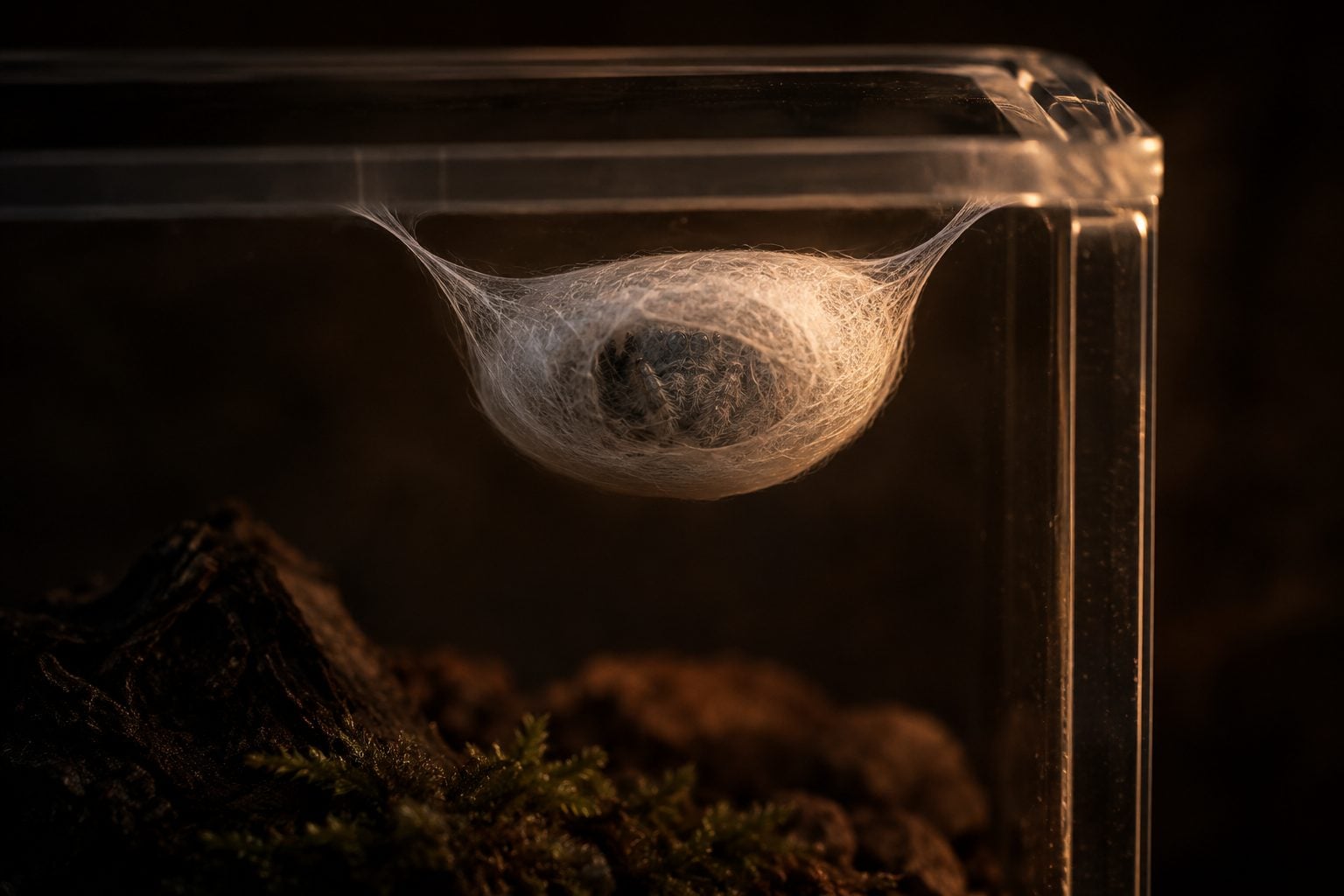
| Quick Answer What happens when a jumping spider molts? Molting (ecdysis) is the process by which a jumping spider sheds its old exoskeleton to grow. The spider seals itself in a silk cell, flips onto its back or side, splits its old exoskeleton open, and slowly extracts itself over 15 to 45 minutes. The new exoskeleton is soft and vulnerable for 5 to 7 days afterward. Keepers should never disturb a molting spider, remove all prey from the enclosure before molting, and wait at least 7 to 10 days after a molt before feeding again. |
Molting is one of the most miraculous things you’ll witness as a jumping spider keeper — and one of the most dangerous periods for your spider if you’re not prepared. In the 30 to 60 minutes of the molt itself, a jumping spider goes from hard-shelled and invulnerable to soft-bodied and completely defenseless. What you do (and don’t do) before, during, and after the molt directly determines whether your spider emerges safely.
This guide walks you through the complete molt cycle: the signs that tell you a molt is approaching, exactly what happens during ecdysis, the post-molt recovery window, and the specific actions that prevent the failed molts that cause so many preventable captive deaths.
What Is Molting and Why Do Jumping Spiders Do It?
The Habitat & Humidity Kit
The stuff that actually keeps a spider comfortable between molts — cover to hide in, and a way to know what the air is doing.
- Magnetic temp & humidity monitor — made for jumping spider enclosures, sticks on and stays put
- Cork bark pieces (15-pack) — climbing structure and anchor points for a hammock web
- Jumping spider hide — a spider with somewhere to retreat is a spider you’ll actually see
- Coconut fiber substrate (2-pack) — holds humidity without going mouldy on you
Unlike vertebrates, which have internal skeletons that grow continuously, arachnids have external skeletons (exoskeletons) made of chitin that cannot expand. To grow, a jumping spider must shed its entire exoskeleton — every external surface including the chelicerae (fangs), the eye area, the legs, and the abdomen — and replace it with a new, larger one.
This process is called ecdysis (from the Greek ekdyein, “to shed”). Every growth increment in a jumping spider’s life is achieved through a molt. The stages between molts are called instars: most pet jumping spider species go through 8 to 12 instars from egg to adult.
Molting frequency decreases with age. A spiderling in its first months may molt every 3 to 4 weeks. A mature adult may molt once or twice per year, or not at all after reaching final adult form. Each molt represents a significant physiological event — the spider’s body has been preparing for weeks, and the energy expenditure of the molt itself is substantial.
Pre-Molt Signs: How to Know It’s Coming
Recognizing pre-molt is critical because your response in this phase — or lack of interference — determines molt success. Here are the reliable indicators:
Behavioral Changes
Stopped eating: a spider approaching molt will refuse food, sometimes for 1 to 4 weeks beforehand. This is the most reliable early indicator.
Reduced activity: pre-molt spiders spend increasingly long periods still, resting, and retreating from their normal viewing spots
Increased time in the silk cell: most jumping spiders build and regularly use a silk sleeping sac. A pre-molt spider will spend more time in this sac and begin to seal the entrance more thoroughly
Restless burrowing or wall-climbing: some spiders pace restlessly in the enclosure for a period before settling into pre-molt stillness
Physical Changes
Duller coloring: the iridescent metallic scales on a Phidippus regius will look dimmer; the spider may appear muted or grayish
Abdomen changes: may appear slightly smaller (the spider has fasted) and darker
Thickening appearance: the body overall may look heavier or more compact as the new exoskeleton develops inside
The Sealed Silk Cell
The most definitive pre-molt indicator: the spider has sealed itself completely inside its silk sleeping sac and the entrance is fully closed. At this point, the molt is imminent — from 24 hours to several days away. This is your cue to stop all interference.
The Molt Process: What Actually Happens
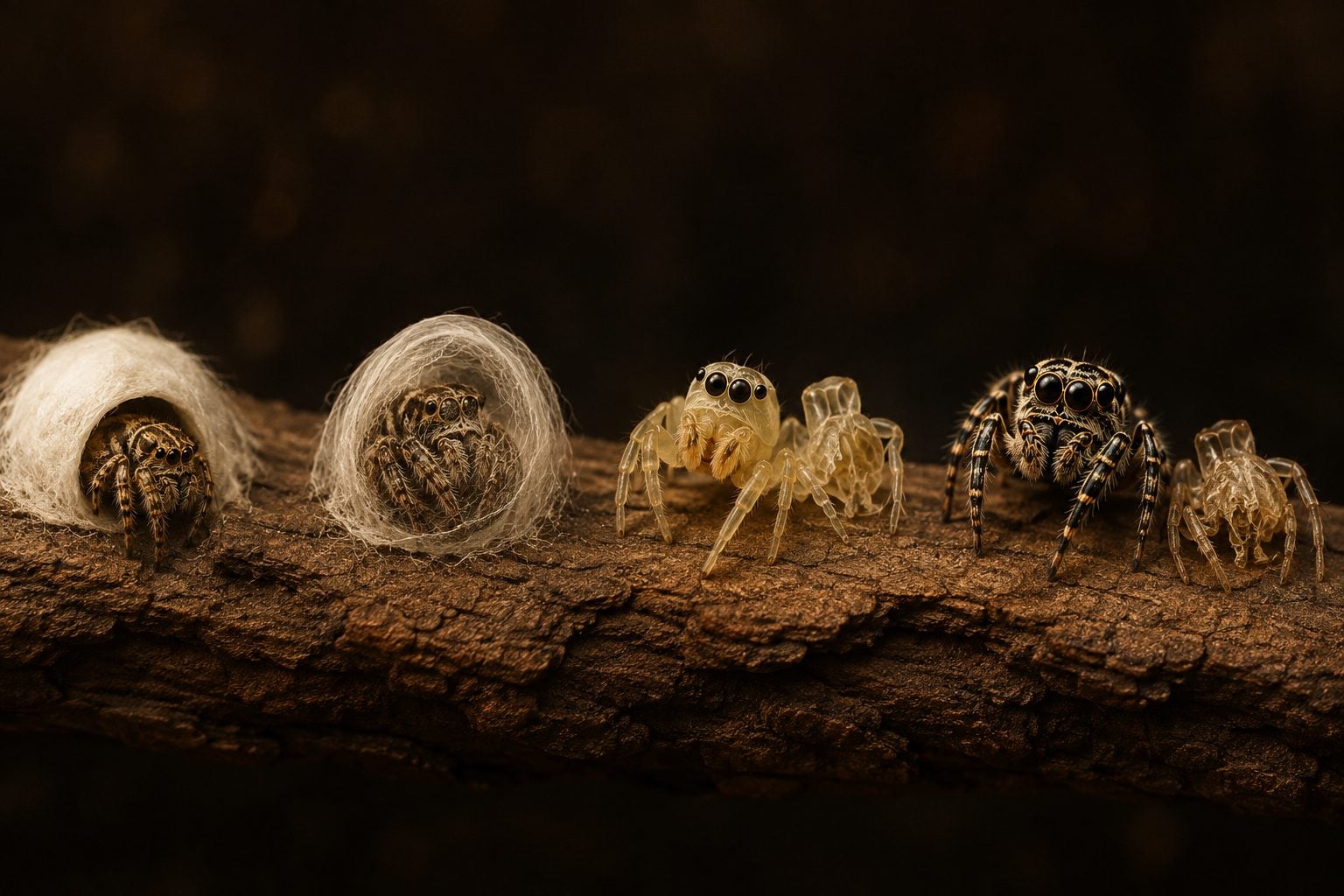
Once the spider has sealed itself in, the molt can take anywhere from a few hours to several days to begin (spiders spend time preparing internally before the external shed begins). When ecdysis starts:
Stage 1: Exuviation Begins (0–5 minutes)
The spider rolls onto its back or side inside its silk cell. The old exoskeleton splits along a seam at the junction between the carapace (top of the cephalothorax) and the abdomen. This split is the molt beginning.
Stage 2: Extraction (5–30 minutes)
The spider slowly works itself out of the old exoskeleton through a combination of muscular contractions and fluid pressure. Each leg must be extracted individually — the new leg pulling cleanly out of the old leg casing like removing a glove. This is the most vulnerable moment. Any disturbance, drop in humidity, or interference at this stage can cause limbs to be trapped in the old exoskeleton.
Stage 3: Emergence (30–60 minutes total)
The spider fully separates from the old exoskeleton (now called the exuviae). It is now completely soft-bodied, pale in color, and unable to defend itself. The new exoskeleton will begin hardening over the next several hours but remains soft for 5 to 7 days. The spider remains in or near the silk cell during this recovery period.
Post-Molt Care: The 7-Day Rule
After your spider emerges from the molt, the most important rule is: do nothing for 7 days. Specifically:
Day 1–3: Spider is maximally soft and vulnerable. No feeding, no handling, no disturbance of any kind.
Our pick
coconut fiber substrate — humidity is the single biggest factor in a clean molt
Day 3–5: Spider begins to regain normal color and firmness. Still no feeding. Normal misting schedule can resume.
Day 5–7: Spider is approaching full exoskeleton hardness. Can observe normally from outside enclosure.
Day 7–10: Offer a small, soft prey item (fruit fly or waxworm). If the spider hunts it successfully with coordinated movement, post-molt recovery is complete and normal feeding schedule can resume.
Why wait 7 days? The new exoskeleton — though the spider may look normal from outside by day 3 or 4 — is still hardening internally. A spider that eats too soon risks damaging soft mouthparts on prey. A spider that is handled too soon risks dropped limbs or injury from even gentle pressure.
Recommended: Daerky Jumping Spider Water Dispenser — fresh water on tap during the fragile post-molt week — no flooding, no disturbing your recovering spider.
Failed Molts: Causes, Signs, and Emergency Response
The Habitat & Humidity Kit
The stuff that actually keeps a spider comfortable between molts — cover to hide in, and a way to know what the air is doing.
- Magnetic temp & humidity monitor — made for jumping spider enclosures, sticks on and stays put
- Cork bark pieces (15-pack) — climbing structure and anchor points for a hammock web
- Jumping spider hide — a spider with somewhere to retreat is a spider you’ll actually see
- Coconut fiber substrate (2-pack) — holds humidity without going mouldy on you
A failed molt (dysecdysis) is when the spider cannot successfully shed its old exoskeleton. It is one of the most preventable causes of captive jumping spider death, and almost always traces to one of three causes:
Cause 1: Low Humidity
The most common cause. Low humidity means the old exoskeleton dries out and becomes brittle instead of pliable, making it impossible for the spider to extract cleanly. Limbs get stuck. Prevention: ensure humidity is within species-correct range throughout the pre-molt period.
Recommended: Exo Terra Mini Mister Spray Bottle — a fine, gentle mist raises humidity ahead of a molt without drenching the enclosure or disturbing the silk cell.
Recommended: Coconut Fiber Substrate (2-Pack) — coco fiber holds moisture far better than paper or bare floors, keeping ambient humidity stable through the molt window.
Cause 2: Prey Left in the Enclosure
Our pick
a humidity monitor — so you know it’s right instead of hoping it is
A cricket, roach, or other prey item that encounters a molting or freshly-molted spider will attack it. Even a single cricket can cause fatal injury during the molt. Prevention: remove all prey as soon as you notice pre-molt signs.
Cause 3: Disturbance During the Molt
Opening the enclosure, accidentally knocking it, or handling the spider during ecdysis can cause the spider to interrupt the extraction sequence, trapping a limb or the entire body. Prevention: treat the enclosure as completely off-limits from the time the spider seals its cell until 7 days after emergence.
Emergency Response for a Stuck Molt
If you observe that your spider has partially emerged but is stuck — a limb caught in the old exoskeleton, for example — you have a difficult decision. In most cases, the best choice is still to wait and allow the spider to work itself free. Intervention is rarely successful for non-specialists and often causes additional harm.
If the spider has been stuck in the same position for more than 4 hours with no progress and appears to be losing strength, some experienced keepers attempt gentle assistance: using soft forceps to carefully peel back the stuck exoskeleton near the trapped limb while the spider is kept in high humidity (90%+). This is a last resort and not recommended for beginners. The realistic outcome in severe stuck molts is often loss of the affected limb (autotomy) or death despite intervention.
Prevention through correct humidity management is worth ten interventions.
Autotomy: When Spiders Lose Legs
Jumping spiders, like most arachnids, can voluntarily drop a leg (autotomy) as a last-resort escape response — or they may lose limbs during a difficult molt. A jumping spider that loses one or even two legs can survive and function normally. Lost legs are typically replaced (partially) at subsequent molts — they regrow smaller than the original but functional.
A spider that has lost a leg should be given a few extra days of post-molt recovery time and monitored for signs of infection (darkening at the leg stub, unusual lethargy, failure to eat after 14 days).
Molt Frequency by Life Stage
Spiderlings (instar 1–3): molt every 3–5 weeks; growth is rapid
Juveniles (instar 4–6): molt every 4–8 weeks; feeding before molts is critical
Sub-adults (instar 7–8): molt every 2–4 months; pre-molt periods extend
Adults: molt 0–2 times per year; some adult males do not molt after sexual maturity
Note: these frequencies are guidelines. Individual variation is significant. Ambient temperature, feeding quality, and genetics all influence molt timing.
Recommended: TempPro Digital Hygrometer with Probe — Monitoring humidity during molt is critical. This probe hygrometer sits outside the enclosure while reading conditions inside.
Recommended: VCEPJH Natural Cork Bark — Cork bark gives your spider a rough surface to grip while pulling free of the old exoskeleton — a key molt aid.
Building a molt-safe setup? The full jumping spider supplies guide covers everything from substrate to misting gear.
Frequently Asked Questions
How long does a jumping spider molt take?
The active molt process (from exoskeleton split to full emergence) takes 15 to 45 minutes for most pet jumping spider species. Preparation inside the sealed silk cell may begin hours or even a day before the visible molt starts. Post-molt recovery in the cell continues for several hours before the spider becomes mobile.
Should I remove the old exoskeleton after a molt?
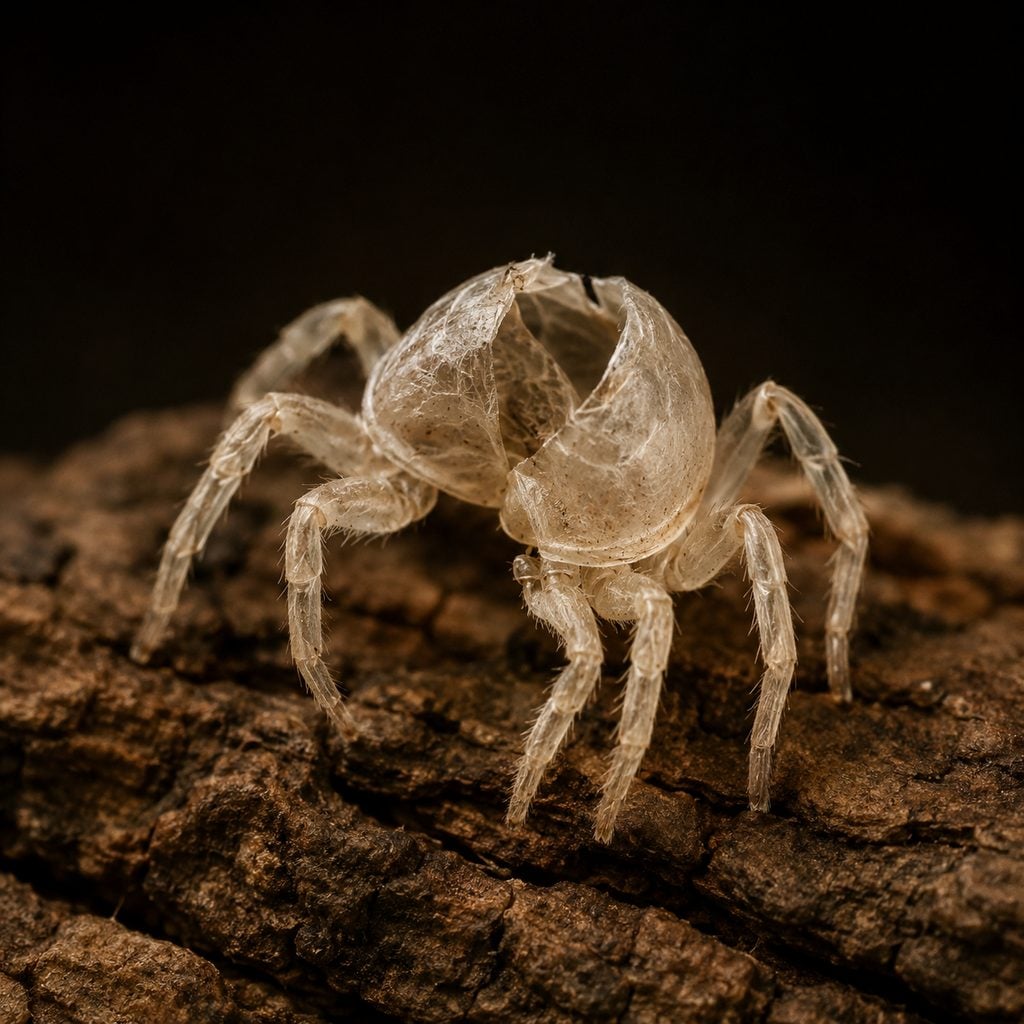
Wait at least 24 hours before removing the exuviae (shed exoskeleton). Some spiders will consume part of the old exoskeleton to recover minerals. After 24 to 48 hours, the exuviae can be removed. It is a fascinating souvenir — the shed skin is nearly translucent and shows every detail of the spider including the corneal lenses of the eyes.
My spider has been in its silk cell for 3 weeks. Should I check on it?
Do not open the enclosure or disturb the cell. A jumping spider can safely spend 3 to 6 weeks in pre-molt seclusion without any intervention needed. As long as no prey has been left in the enclosure and humidity is correct, patience is the right response. If you have not opened the cell but genuinely cannot see any movement after 6 weeks, very gently (without touching) look for the spider’s silhouette through the cell wall.
The Habitat & Humidity Kit
The stuff that actually keeps a spider comfortable between molts — cover to hide in, and a way to know what the air is doing.
- Magnetic temp & humidity monitor — made for jumping spider enclosures, sticks on and stays put
- Cork bark pieces (15-pack) — climbing structure and anchor points for a hammock web
- Jumping spider hide — a spider with somewhere to retreat is a spider you’ll actually see
- Coconut fiber substrate (2-pack) — holds humidity without going mouldy on you
Can I handle my jumping spider right after a molt?
No. Wait a minimum of 7 to 10 days post-molt before any handling. The exoskeleton appears normal from outside before it is fully hardened internally. Handling too soon can cause leg joints to flex incorrectly, limb loss, or injury from even gentle pressure. When in doubt, wait longer.
My jumping spider came out of a molt with a missing or bent leg — is this normal?
Bent legs that don’t fully extend are a common result of a slightly difficult molt. They typically straighten at the next molt. Missing legs from autotomy (voluntary leg dropping) during a stuck molt are survivable and partially regenerate over subsequent molts. Monitor for infection but otherwise continue normal care.
| About the Author Itsy Bitsy Pets Editorial Team The ItsyBitsyPets.com team combines hands-on keeping experience with peer-reviewed arachnology research to produce accurate, practical care guides. We update our content when new scientific evidence or community findings warrant revision. Site: itsybitsypets.com | Twitter: @ibp2025 |
| Join 7,000+ Micro-Pet Lovers Get The Micro-Pet Minute — free weekly care tips, species spotlights, and product picks. Subscribe at itsybitsypets.com |