
This post contains affiliate links. If you purchase through our links, we may earn a small commission at no extra cost to you. See our Affiliate Disclosure for details.
Jumping spider care is surprisingly straightforward once you understand the basics, which is part of what makes these charismatic arachnids the fastest-growing segment of the pet spider hobby. Unlike tarantulas or other exotic spiders that demand specialized setups and cautious handling, jumping spiders are small, docile, and genuinely seem to enjoy interacting with their owners. Their large, expressive eyes and curious personalities make them feel more like tiny pets than typical arachnids.
This comprehensive jumping spider care guide covers everything from housing and temperature to feeding, hydration, molting, and handling. Whether you just brought home your first jumping spider or you are researching before you buy, this guide will help you provide the best possible life for your eight-legged companion.
Jumping Spider Care: Housing and Enclosure Setup
The most important aspect of jumping spider care is providing a proper enclosure. Jumping spiders are arboreal arachnids that naturally live on vertical surfaces like tree bark, walls, and fences. Their enclosure should be taller than it is wide to accommodate their climbing instincts.
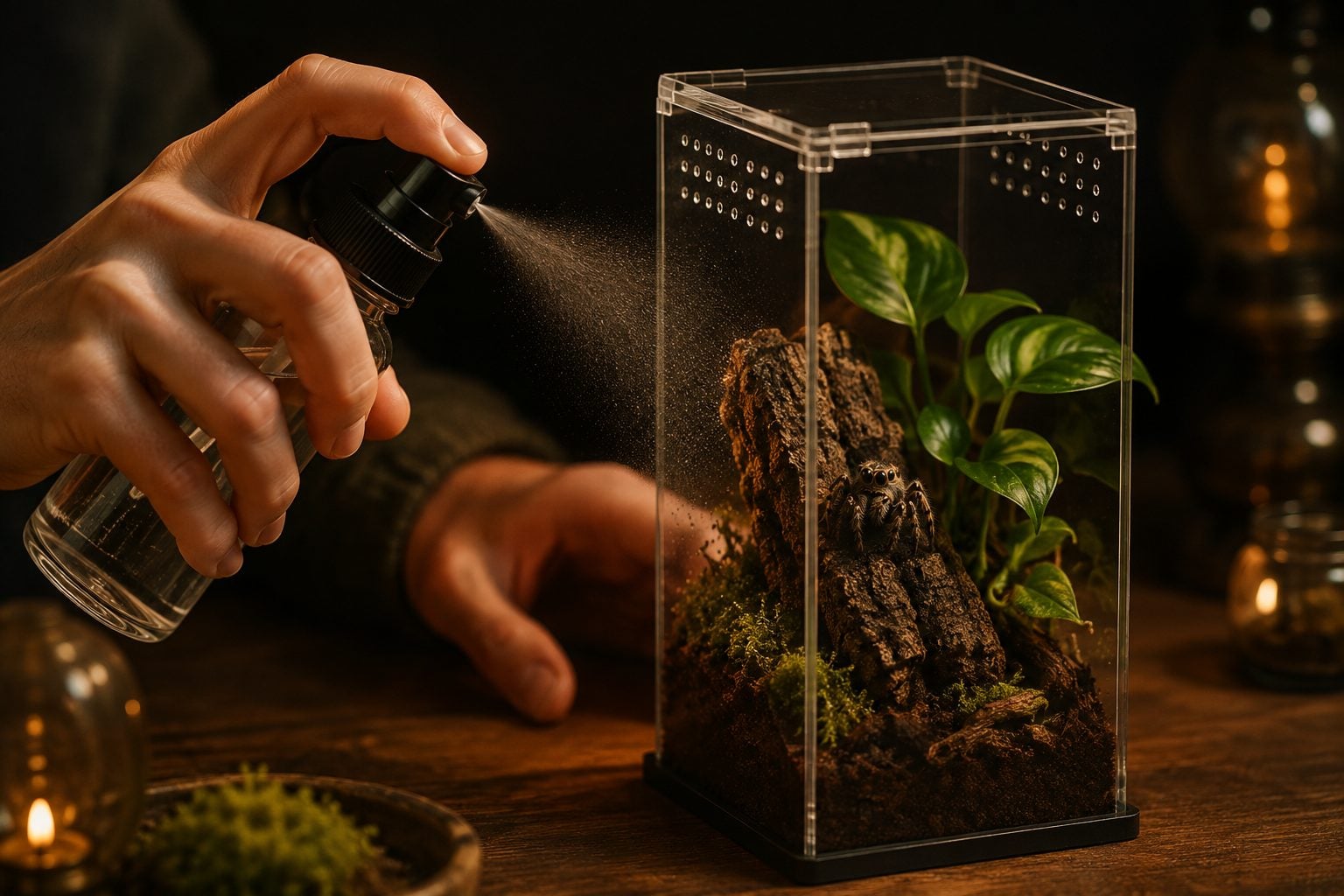
For adult Phidippus regius or Phidippus audax (the two most popular pet species), an enclosure measuring roughly 4 x 4 x 6 inches is ideal. Modified deli cups, acrylic terrariums, and purpose-built jumping spider enclosures all work well. The critical feature is cross-ventilation — jumping spiders need airflow to prevent stagnant, humid conditions that promote mold and mite infestations. Enclosures should have ventilation holes on at least two opposite sides.
Add a few pieces of artificial or dried foliage for web anchor points. Jumping spiders build small silk hammocks called sacs or retreats where they sleep, molt, and hide. They need a few attachment points near the top of the enclosure for this purpose. A small piece of cork bark or a fake leaf positioned vertically works perfectly. Avoid overcrowding the enclosure with decorations, as jumping spiders prefer open sightlines for hunting.
Temperature and Humidity Requirements
Jumping spider care is forgiving when it comes to temperature. Most pet species thrive at normal room temperature between 70-80°F (21-27°C). They tolerate temperatures as low as 65°F and as high as 85°F without problems, but avoid placing enclosures in direct sunlight, near heating vents, or in drafty areas where temperatures fluctuate rapidly.
Humidity should be kept moderate, around 50-60% for most Phidippus species. The easiest way to maintain proper humidity is to lightly mist one side of the enclosure with a fine mist spray bottle every 2-3 days. Do not soak the enclosure or create standing water. Jumping spiders drink from water droplets on the enclosure walls, so misting also serves as their primary water source. Over-misting is one of the most common jumping spider care mistakes and can lead to fatal mold growth or bacterial infections.
Feeding Your Jumping Spider
Jumping spiders are active visual hunters that pursue and pounce on live prey. They will not eat dead or pre-killed insects. Understanding what jumping spiders eat is essential for proper care.
The staple diet for most pet jumping spiders consists of flightless fruit flies (Drosophila hydei for adults, Drosophila melanogaster for spiderlings), small crickets, and blue bottle or green bottle fly spikes (larvae that you allow to hatch into flies). Feed adult jumping spiders 2-3 appropriately sized prey items every 3-4 days. Spiderlings should be fed more frequently, roughly every 1-2 days.
The prey item should be no larger than the spider’s abdomen. Oversized prey can injure or stress your spider. If your jumping spider’s abdomen appears very round and plump, skip a feeding or two. If it appears shriveled or flat, increase feeding frequency. A healthy jumping spider has a slightly rounded abdomen that is neither bloated nor concave.
Remove uneaten prey within 24 hours to prevent stress and keep the enclosure clean. Crickets left overnight can actually bite and injure a molting spider, which can be fatal.
Hydration and Water
Jumping spiders do not drink from water dishes. They obtain moisture from their prey and by drinking water droplets from enclosure surfaces. Light misting every 2-3 days provides both humidity and drinking water. You will often observe your spider approaching fresh water droplets and drinking from them directly, which is one of the more endearing behaviors to watch.
Use dechlorinated or spring water for misting. If you notice your spider looking lethargic or its abdomen appears unusually shrunken, dehydration may be the cause. Offer a few drops of water on a flat surface inside the enclosure and increase your misting schedule.
Understanding the Molting Process
Molting is a critical and vulnerable period in any jumping spider’s life. As arachnids, jumping spiders must shed their exoskeleton to grow. Spiderlings molt frequently (every 2-3 weeks), while adults molt less often (every 1-3 months or longer). Female jumping spiders go through roughly 7-9 molts before reaching maturity, while males typically go through 6-8.
Signs that your spider is about to molt include refusing food for several days to over a week, becoming less active, spending extended time inside their web sac, and developing a darker or duller appearance as the new exoskeleton forms beneath the old one. During this pre-molt period, do not attempt to feed your spider. Remove any live feeder insects from the enclosure, as crickets and flies can injure a molting spider.
The actual molt usually takes a few hours and typically happens inside the spider’s web sac. Your spider will emerge slightly larger and often with brighter coloring. After molting, the spider’s new exoskeleton is soft and vulnerable. Do not handle or feed your spider for at least 48-72 hours after a molt to allow the exoskeleton to fully harden. A failed molt (called a “bad molt”) is one of the most common causes of death in captive jumping spiders and is often caused by insufficient humidity during the molting process.
Handling Your Jumping Spider
One of the greatest joys of jumping spider care is that these spiders genuinely tolerate and even seem to enjoy being handled. Unlike most spider species, jumping spiders will willingly walk onto your hand, explore your fingers, and make eye contact with you. Their excellent vision means they recognize movement and may track your face or follow your finger.
To handle your spider, slowly offer your flat, open hand near the spider and allow it to walk on voluntarily. Never grab, pinch, or scoop a jumping spider. If the spider retreats or seems stressed (rapid jerky movements, attempting to flee), respect its space and try again later. Most jumping spiders become comfortable with handling after a few gentle sessions.
Always handle your spider over a soft surface or close to the ground. Despite their name, jumping spiders can be injured or killed by falls from significant heights. Their silk dragline provides some protection, but it is not reliable at great heights. Concerned about safety? Read our guide on whether jumping spiders bite — spoiler: they very rarely do, and when they do, it is less painful than a mosquito bite.
Jumping Spider Lifespan and Aging
Understanding how long jumping spiders live helps you set realistic expectations. Most pet jumping spider species live 1-3 years total, with females generally living longer than males. Phidippus regius females can live up to 2-3 years with excellent care, while males typically live 1-1.5 years.
As jumping spiders age, you will notice reduced activity, less frequent feeding, and less interest in hunting. Elderly spiders may spend most of their time in their web sac and struggle with prey capture. This is a natural part of the aging process. Continue offering food regularly, but do not be alarmed if an aging spider eats less frequently.
Common Jumping Spider Care Mistakes
Even experienced keepers make mistakes. The most common jumping spider care errors include over-misting the enclosure (leading to mold, mites, and bacterial infections), feeding prey that is too large (risk of injury), insufficient ventilation (stagnant air promotes disease), handling during pre-molt or post-molt periods (risk of injury to soft exoskeleton), and keeping the enclosure in direct sunlight (overheating).
Another frequent mistake is keeping multiple jumping spiders together. Jumping spiders are solitary predators and will cannibalize each other if housed in the same enclosure. Always keep one spider per enclosure, with the only exception being brief, supervised mating introductions for breeding purposes.
Breeding Jumping Spiders
Breeding jumping spiders is an advanced aspect of jumping spider care that requires careful planning. Males perform elaborate courtship dances involving leg waving, body vibrations, and visual displays of their colorful markings. Introduce the male into the female’s enclosure only when the female is well-fed and appears receptive. Always supervise mating encounters, as females may attack and eat males before, during, or after mating.
After successful mating, females will construct an egg sac inside their web retreat. A single egg sac can contain 50-200 eggs depending on the species and the female’s size and condition. Spiderlings emerge after approximately 2-4 weeks and should be separated into individual containers within a few days of emerging to prevent cannibalism.
Essential Jumping Spider Care Supply List
To get started with jumping spider care, you will need a proper enclosure with cross-ventilation, a small spray bottle for misting, a reliable source of feeder insects (fruit fly cultures are the easiest for beginners), long tweezers or feeding tongs for prey placement and waste removal, a few pieces of artificial foliage or cork bark for web anchors, and optionally a small digital thermometer-hygrometer to monitor conditions inside the enclosure.
The total startup cost for jumping spider care is remarkably low compared to other exotic pets. A complete setup including the spider itself is generally affordable, and ongoing monthly costs for feeder insects are minimal. This accessibility is one of the many reasons jumping spiders have become such popular pets.
Jumping spider care rewards patience, gentle handling, and consistent routines. These remarkable little arachnids pack enormous personality into their tiny frames, and with proper care, they will thrive and bring you daily entertainment as you watch them hunt, explore, and interact with their world. For more on finding your perfect spider, browse our guide on jumping spiders for sale.